Sign up for the daily CJR newsletter.
In late April, journalists arrived at the Casa Rosada (“Pink House”), the official seat of the Argentine government, on the Plaza de Mayo in Buenos Aires. They were not allowed to enter. Later, a government official said that their press accreditation was not being revoked permanently, but that everyone’s credentials were suspended as part of a preventive measure “in response to a complaint filed by the Casa Militar,” a government body that oversees the security of the president and the logistics of running the presidential palace, “regarding illegal espionage.” According to the official, two journalists—Luciana Geuna and Ignacio Salerno of the TV channel Todo Noticias (TN)—were being accused of secretly filming inside the Casa Rosada.
In fact, Geuna and Salerno had been reporting; Salerno had recorded some public corridors of the building using smart glasses. While the criminal complaint has now been dismissed, and the government has restored TN’s access to the presidential palace, the administration of Javier Milei, the Argentine president, is still refusing to let Salerno back in. The press office inside the palace, meanwhile, is “operating under extremely restrictive movement rules with no clear justification,” according to Geuna. “Most journalists have stopped going because there’s basically no point in working there anymore,” she told CJR. Variations of this situation are playing out across the world, in federal and local government buildings, at sports arenas and Hollywood junkets. “Whereas at one time people needed the media to sell their various projects in entertainment,” said Matthew Belloni—a former editor of the Hollywood Reporter, and the author of Puck’s flagship What I’m Hearing newsletter—“now, with a few exceptions, they can go direct to their consumers via their own channels.” They can also decide not to communicate with the public at all.
The stakes vary, as do the experiences of journalists and of the news influencers increasingly appearing to take their spot on publicity contact sheets. “It feels like the lines have really been blurred,” Jazmine Hughes, a contributing writer at New York magazine, observed. Chris Whipple—who wrote a blockbuster story for Vanity Fair about Susie Wiles, the White House chief of staff, and other members of the Trump administration—views access as a measure of fairness. “My access has never been better,” he said. He also argued that access is “the most important thing for journalists.” As Michael Wolff—who writes a Substack called HOWL, and before that covered Donald Trump, Jeffrey Epstein, and others—put it, “I don’t think that there is such a thing as too close.”
Not everyone feels the same way. After six years covering Michigan State football and basketball for the Detroit Free Press, Jemele Hill felt it was time to change beats. “I was concerned that I was getting too chummy with the people I was covering because it’s just by nature of proximity,” she said. “After a while, you start to feel the familiarity of complacency.” To understand how access has evolved, we spoke with a range of people who have managed to secure it. Their responses have been edited for length and clarity.
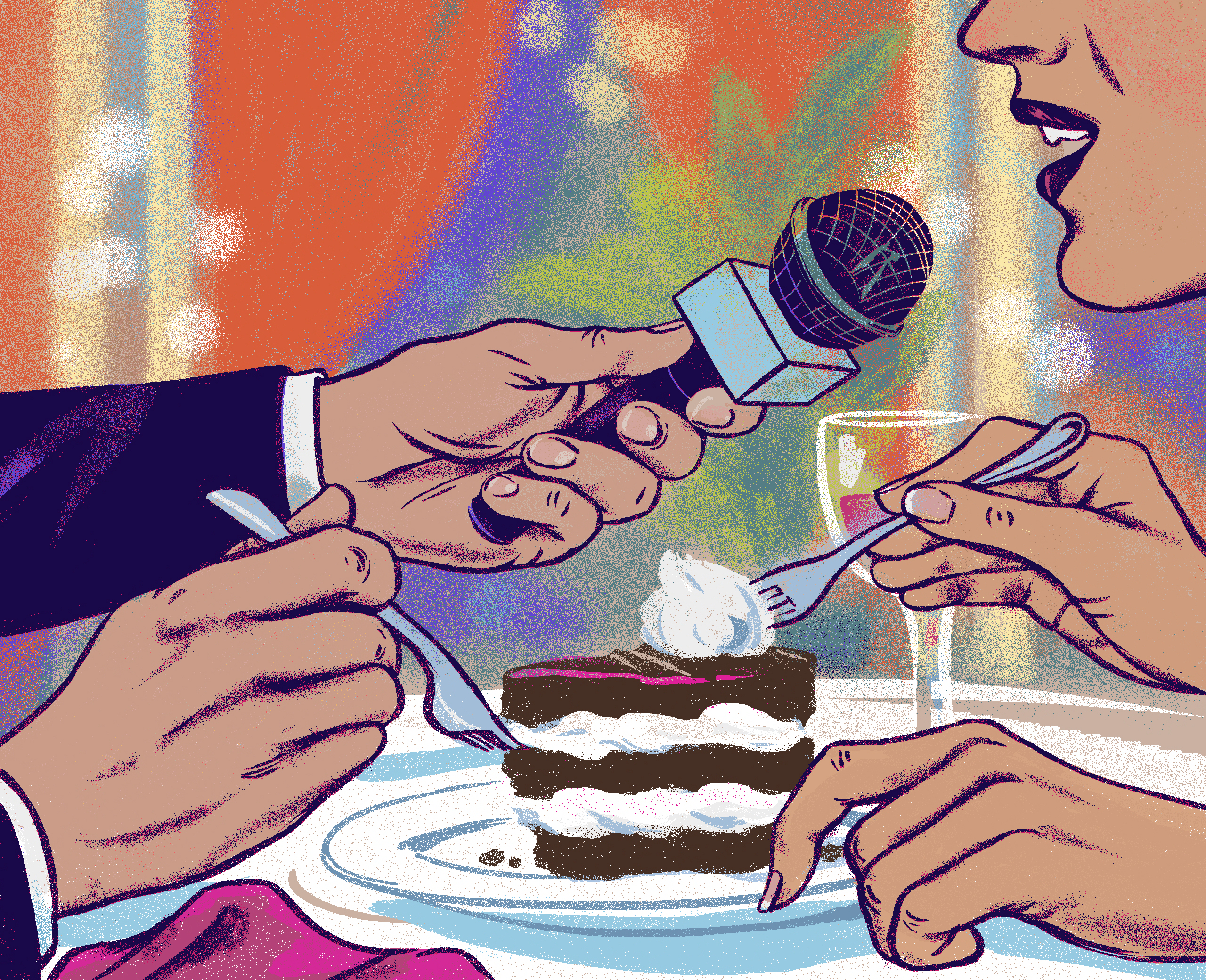
 Illustration by Agata Nowicka
Luciana Geuna
Host of ¿Y Mañana Qué?, Todo Noticias, ArgentinaJavier Milei, like Trump, wants what he wants when he wants it. He’s not even going to the specific media groups now; he’s going against specific journalists. They have an army of people on social media who reproduce everything they want to—all the aggressive speech against journalists that has been happening throughout his tenure. At this point, he’s starting to cross the line with these lawsuits.
On April 26 I made a statement on my TV show explaining what was going on, and the administration used AI to make it look like I was doing the statement wearing an orange suit inside a jail. I’ve been doing this half my life; recently, I had three or four days that I myself personally couldn’t speak to anyone because I was in bad spirits. I write a weekly politics column that later appears on the TN website, so I started reaching out to sources again, and everyone answered the phone. Inside the government there is a lot of fear about how Milei will react if he finds out that they are talking to me. But everyone is talking to me anyway.
Matthew Belloni
Author of Puck’s What I’m Hearing newsletterWhereas at one time people needed the media to sell their various projects in entertainment, now, with a few exceptions, they can go direct to their consumers via their own channels. That has basically eliminated what I would call legitimate access journalism.
The various outlets that could offer the cover of a magazine had leverage. They could spend a week with you. They could come to your home. They could meet your family. They could get to know you. You had to take a risk by allowing the journalists into your life if you wanted to be on the cover of the magazine. Flash forward to today—you don’t even have to be interviewed by a real journalist anymore. If you want to be on the cover of Vogue, chances are, if you’re a big enough star, they’ll let a friend interview you or they’ll let you write an essay yourself. They will do whatever it is you ask of them.
For most people, when they are promoting a project in entertainment, they now have a buffet of podcasts and video shows that they can do that reach the audience they want to consume their product. They are not going to ask you anything uncomfortable. And if anything comes up, you can probably get them to take it out of the show. If you talked to celebrity publicists who had a major star in an upcoming movie, and you asked them whether it was more important to be on the cover of Vanity Fair or to book, let’s say, Joe Rogan, Smartless, or Call Her Daddy, I’m betting that the A-list podcast booking would be the most important.
The value of access journalism to the consumer has decreased significantly in the twenty years that I have been a journalist in entertainment. It’s usually an error on the part of the subject or their representatives when they inadvertently give you some kind of insight into their life. The goal is to conduct a press tour without providing any actual access to the lives of the subject. And you can do that now in a way that was not possible even ten, fifteen years ago.
Taffy Brodesser-Akner
Features writer on general assignment, the New York Times magazineEvery generation, someone like me who has done a lot of profiles announces the death of the profile, and it’s never true. I was so offended when my heroes were saying that when I was just getting started. What’s actually true is that the profile changes and it becomes a little unrecognizable.
I ask for a lot of time up front. And then I ask for more. I was on Billy Bob Thornton’s tour bus for three days through Alabama—like, he got no break from me—and that profile is one of my favorite things I’ve ever written. But everything else, I was given two hours, which is always ninety minutes. And it was up to me to compel them to see me again. You do that by being a normal person. People front-load their interviews with the hard questions because they’re worried that the interview will end. That scares interviewees away because that’s not how normal conversation goes. If you can have the confidence to let them tell their version of a story, you can later say, “I need a little more time.”
Podcasts are just trying to make sure they have the biggest name possible, and to do that, they have to be friendly. I am not even saying that’s bad. Hearing a celebrity’s story on their own terms is interesting. But I do think we’re missing something when someone who is willing to push back on someone’s version of events or ask them hard questions isn’t there.
 Illustration by Agata Nowicka
Michael Wolff
Author of All or Nothing: How Trump Recaptured America and HOWL, a SubstackThere are different types of access. There’s getting people on the phone and getting a quote from them. There’s bookers, getting people to go on television shows or podcasts. And then there’s another kind of access, which consists of trying to build a relationship with people, whom you’re trying to know beyond their position as a public person.
I’m looking to have as up close a view of the people I’m writing about as I can possibly get. When I managed to go into the White House during the first Trump administration, that was the product, among other things, of knowing Trump, or crossing paths with Trump, and being acquainted with Trump, for nearly twenty years. It’s like bankers who speak of being “in the deal flow.” It doesn’t happen overnight.
As you become more well known for doing this, it’s a funny thing because people think they can beat the house, or they’re flattered that you’re interested in them. Some people say no. But I would say, more often than not, they are agreeable to talk.
I don’t think that there is such a thing as too close. That’s a bullshit straw man that’s erected by people who have never been close. I literally can’t imagine what is too close. But those political commentators with a transparent bias are not particularly practicing journalism. You’re kind of more a politician than you are a reporter about politics; more a tech professional than you are a reporter about technology.
Kimberly Adams
Host, Marketplace Morning ReportIt used to be that if you could get into the right rooms in DC and smoke cigars with the right people, drink with the right people, get invited to the right parties, that gave you the kind of access that you needed. I’ve talked to plenty of women journalists in this town who, simply because they were women and so many of the leading public officials were men, felt like they couldn’t get the same kind of access and scoops as their other peers in the Washington press corps. There’s still people who get scoops that way, but all of those people know exactly who they’re giving those scoops to and why.
I love the fact that TikTokers and podcasters and people from a broad variety of backgrounds can now ask questions of public figures. Having a broader range of people get access to these spaces can be good, but there is finite time. There is finite space. As a news consumer, I want the people in those rooms to have a standard of practice that involves a fact-checking process, that involves a corrections process if they get something wrong, that involves a disclosure process if they are being paid or influenced by an outside source. And so at some point there does have to be a limit. I would hope that those limits are not Who is the friendliest questioner? but, rather, Who is the person who can best serve the public interest?
 Illustration by Agata Nowicka
Jemele Hill
Sports journalist, contributing writer for The AtlanticIf you’ve been covering something for a long time, naturally things are going to look different. When I was covering Michigan State football and basketball for the Detroit Free Press, after my sixth year on the beat, I asked to be taken off the beat. I was concerned that I was getting too chummy with the people I was covering because it’s just by nature of proximity. You’re with these teams more than you’re with your own family. I knew all the administrative assistants, and was being invited to folks’ houses for dinner. And, especially if you’re in a college town, it’s kind of small. So you’re seeing each other at the same places. It’s just natural that a rapport develops. And even knowing some of the players’ parents, and them asking me to hang out—it’s just like, wow. You definitely try to make them aware: we have a good relationship, but I’m a reporter. But after a while, you start to feel the familiarity of complacency. So after six years, I went to my bosses, and I asked for another beat.
For any insider, it’s a really tough business to navigate, because your job is to get the information. And to some degree, a lot of the well-known insiders have become celebrities themselves, and when they’re in that realm of celebrity insider, it makes their job that much more complicated—but, also, that much more vulnerable to these kinds of conflicts of interest.
There used to be a general standard that everybody sort of followed. But in an age where branding and popularity, in many ways, have eclipsed the actual job, the basic journalistic standards are now—I don’t want to say nonexistent—but it looks like the abacus in the land of computers.
Margaret Brennan
Moderator, Face the Nation, and chief foreign affairs correspondent, CBSI sometimes kind of laugh when people ask, well, why didn’t you have so and so on for an interview? Just because they don’t appear doesn’t mean we didn’t ask them. We both have to agree that we’re going to have an informed conversation, and that it’s worth your time and the public’s time. It’s a different audience than on social media, where the incoming content is decided by an algorithm. So it’s likely feeding them more of the same: maybe affirming, not informing.
Chris Whipple
Writer, filmmaker, authorAccess is oxygen. It’s the most important thing for journalists. I’m in a slightly different category from somebody who does the daily beat, but I would say that, for me, my access has never been better.
I don’t mean to minimize the extent to which the media in general has become really partisan and polarized and in some cases even vicious. It’s certainly true that like-minded sources are speaking to like-minded journalists, sometimes to the exclusion of everyone else. God knows that’s true of Fox, and it’s true of other platforms as well.
I’ve been fortunate in my career. When I wrote a book about White House chiefs of staff called The Gatekeepers, I was able to speak to every living White House chief at the time. For my book on the CIA directors, The Spymasters, I was able to speak to every then-living CIA director as well. And the coin of the realm is fairness and nonpartisanship.
There’s a reason why Susie Wiles, Trump’s chief of staff, spoke to me even though some people told her not to. It was because she knew my previous work, and she’d read The Gatekeepers. She knew White House chiefs of staff who had been interviewed by me in the past, and she was, as she told me, hell-bent on trying to get a fair shake. She thought she would get it from me. So access, in my experience, has been the result of a track record of fairness. And for me, that hasn’t changed.
 Illustration by Agata Nowicka
V Spehar
Under the Desk NewsI don’t think there’s been any change from the structure of the biggest, most exclusive things still going to legacy media outlets, despite their complaints that influencers or creators are taking their access. Just because I got to moderate one stop of Kamala Harris’s forty-eight-stop book tour doesn’t mean I took it from trad media.
I want to have somebody come on and explain a bill that they just posted, or have them explain what they’re doing with the Epstein files—it’s a little bit more pedestrian, casual.
I did a set of videos with Kathy Hochul recently. My purpose in meeting with her at her high school was to talk about universal childcare and to talk about protecting trans kids and trans kids’ families in the New York public school system. We had tough conversations about that. Then at the end, I was like, “What is your lipstick color? Because every time I see you, when I see that purple lipstick, I’m like, ‘This bitch is gonna lay it down.’” My audience is 70 percent female, millennial and Gen X, and they will ask me, “Hey, did you get her lipstick color? Hey, where did you get that top?”
I doubt Lesley Stahl is going to ask about her lipstick color, but I bet everybody watching her on 60 Minutes is going to wonder, just like they all wondered after Monica Lewinsky’s 2020 interview—the number one search was “What lipstick color was she wearing?” Glaze by Club Monaco.
Jazmine Hughes
Contributing writer, New YorkIf I were president, journalism would be treated as a trade, not as an art. The difference between an influencer and a journalist is research. It’s a system in which things are checked and arbitrated by external parties—it’s not a perfect system, but there are also points of strength.
Nobody really knows what journalism means, and thus you’ll get a celebrity—or even, my God, a politician—who also doesn’t fundamentally understand what the deal is. We’re supposed to be holding people to account. We are not an extension of a PR team. We are not an extension of stans, and we’re not an extension of trolls. It feels like the lines have really been blurred.
For a journalist to do their job well and present their best effort at an accurate representation of who their subject is, they need time. We can’t really do that in two hours or, God forbid, forty-five minutes over Zoom. What I’d like to see is PR teams and artists or subjects giving us a day or two. Like, I don’t have to talk to the subject the entire time—I’d rather not, actually. But I’m so happy to trail them around, be a part of their posse. I always tell my students that when you’re writing a profile, your story is the closest that the reader is going to get to experiencing this person.
Dan Diamond
White House reporter, Washington PostThe White House has created the new-media seat. That person sometimes is a traditional reporter, but often it is an influencer who might have a big audience online. That person can get the first question at a White House press briefing, which can set the tone. Sometimes those folks get interviews and scoops that we find out about only later.
I came to journalism as a nontraditional person myself. There can be a risk of boxing out people just because they didn’t follow a traditional path. But I think the challenge is sometimes that these untraditional voices are tapped because the White House knows—the Biden White House knew, the Trump White House knows now—that they’re not going to be as critical. You get good raw information, where the president might make an announcement or be really revealing. But you don’t get the necessary follow-up questions.
Chris Black
Cohost, How Long GonePublicists and guests are learning that the things that they say and do on podcasts can have an almost bigger effect than interviews they give to the New York Times or the Wall Street Journal, because if they say something salacious, it gets clipped and millions of people see it almost instantly. The atmosphere is more relaxed and allows people to open up, which is great for the medium.
My cohost Jason Stewart and I have always come at it from a perspective of: “We’re trying to have a fun, entertaining conversation where you hopefully learn something about someone that you haven’t learned elsewhere.” There’s no “gotcha!” We’re not trying to ask hard-hitting questions. But we’ve never let anybody hear an episode before it goes up. We don’t get questions approved. We don’t do any of that shit. If that’s the game you want to play, you can go somewhere else.
The blowback to podcasts is coming because people are conflating journalism and entertainment. If you think Jake Shane, the influencer and comedian, is a journalist, or you think that in the history of time there’s ever been interesting questions or conversations happening on a red carpet or at an awards show, you’re sadly mistaken.
Check out all of the pieces from our special edition, The Access Issue, about restrictions, trade-offs, and who gets in where.
Has America ever needed a media defender more than now? Help us by joining CJR today.