Sign up for the daily CJR newsletter.
The first time Estefany Rodríguez saw Alejandro Medina III, who would be her husband, it was through a screen. It was 2024; she was living in Houston but reporting for a Spanish-language site called Nashville Noticias, and often covered the city’s Hispanic community remotely. While editing a video feature about Medina, an artist who combines regional Mexican music with American country, something piqued her interest. “I thought to myself, ‘That one is going to be mine,’” she told me.
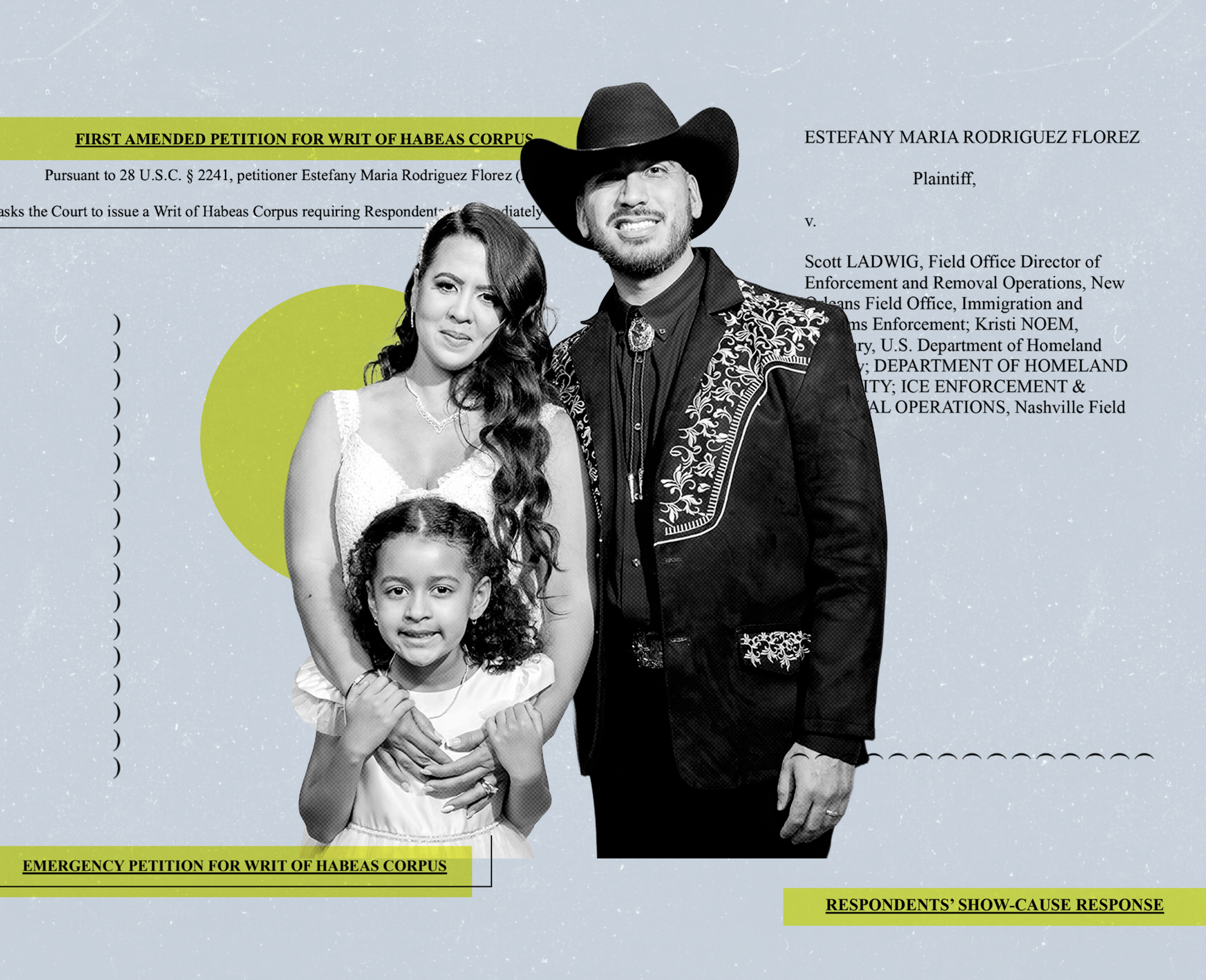
Later, they met in person, at the annual Nashville Noticias Christmas Day parade and toy giveaway. They stayed in touch. Journalism has given her a lot, she said, over a video call from her cream-colored couch. Rodríguez, who is thirty-five, wore a gray-and-white checkered shirt, her hair parted to one side. Beside her sat Medina, who smiled sheepishly as he listened to her tell their love story. They looked happy. Light poured into the room. To their right, a houseplant sprouted from a pot. He recalled how, back then, they would talk on the phone for hours, “about life, where she comes from, where I come from, our goals, our ambitions, what we want to leave behind.” It wasn’t long before Rodríguez moved to Nashville with her daughter Mariangel, who is now nine. On January 21, Rodríguez and Medina got married.
Then, on March 4, the couple was pulling into the parking lot of a Crunch Fitness in a Honda marked with the Nashville Noticias logo when they found themselves surrounded by Immigration and Customs Enforcement agents. Rodríguez, who is from Colombia, was arrested, then taken to a county jail in Alabama; later, she was transferred to a detention center in Louisiana, where she remained until she was granted bond and released, on March 19. “You’re the reporter from Nashville,” an ICE agent told her on the bus ride to Alabama, she said in a recent court filing. “You’re good at your job.” When she was transferred to the Louisiana facility, a group of fellow detainees recognized her, too. They had followed her work in Tennessee and couldn’t figure out how she had ended up with them. “Estefany,” she recalled a woman saying to her. “What happened?
Rodríguez still doesn’t fully know. And though she is now home, her circumstances—and the First Amendment questions embedded therein—remain uncertain. The day before federal agents booked Rodríguez, she had been out reporting on ICE activity in the suburbs southeast of Nashville. ICE had just arrested three people, including a man of Venezuelan origin. She was filming a video for Nashville Noticias in the parking lot of his apartment building. “His car is here, behind me,” she said in her story, pointing in the direction of a dark-gray sedan. “We have an exclusive video of the operation.”
Immigration wasn’t always her focus. When Rodríguez started at Nashville Noticias, she typically covered culture stories about the city’s Hispanic community: concerts, musicians, local businesses. But after Donald Trump took office for the second time, in January of 2025, and ICE’s presence in the state increased, Rodríguez’s attention shifted. She continued to cover general local news—recently, she reported on how volunteers at an elementary school, including a few mothers in Nashville’s Hispanic community, turned a classroom into a kitchen to help those affected by a winter storm—but her work became focused on raids and arrests.
Rodríguez’s reporting came to provide a reliable record of how ICE’s aggressive sweeps have affected immigrants and those close to them: often, she speaks to the families of those in detention and asks how the experience has upended their lives. She has also interviewed people inside ICE facilities. In late February, she spoke by phone with Dennis Ribera, a thirty-five-year-old from Honduras who was detained, as she sat beside his wife in the couple’s home. “How has this been for you?” she asks him in footage from the interview posted on Nashville Noticias’ social media. “I know you’re worried about your family.” Veronica Salcedo, the director of Nashville Noticias, told me that, over the years, Rodríguez “has carved out a special place for herself not just at the publication, but in the community.”
When Rodríguez was taken into custody, she had a valid work permit, an active asylum case—she said that she received threats for her reporting in Colombia—and a pending green card application through Medina, who is a United States citizen. Rodríguez, Medina, and her immigration lawyer, Joel Coxander, had repeatedly engaged with the ICE field office in Nashville prior to her arrest—a prolonged bureaucratic ordeal that involved delays caused by an ice storm and an agent who could not find her in the computer system. ICE took her into custody well before the date she had been scheduled for an appointment at the office.
Rodríguez’s friends, colleagues, and family have struggled to make sense of it all. “She’s not a criminal,” Salcedo told me. “She’s not a flight risk.” In a habeas petition, Rodríguez’s lawyers questioned the constitutional basis of her detention, arguing that she was likely booked as retaliation for her work as a journalist. And notably, according to Michael Holley, one of her attorneys, she was “not served with a warrant” at the time—a violation of her Fourth Amendment rights. (To cover the mounting legal costs—as well as her bond and gaps in her income from missed work while she was in detention—Medina started fundraising on GoFundMe.)
The Department of Homeland Security, which oversees ICE, maintains that Rodríguez overstayed a tourist visa she used to enter the country in 2021 and that she has no lawful immigration status. In court filings, DHS denied the claim that Rodríguez was not shown a warrant and argued that First Amendment rights “may not even be applicable to an illegal alien.” Her lawyers’ argument, per DHS, is “nothing more than a challenge to a discretionary decision to commence removal proceedings.” DHS did not respond to a request for comment. Rodríguez’s habeas case is ongoing in federal court.
Press-freedom and other advocacy organizations have sided with Rodríguez, whose case follows a series of journalist arrests, including that of Mario Guevara—who is originally from El Salvador and also reported on immigration, and who was deported last year after spending more than a hundred days in ICE custody. “Rodríguez’s detention is part of a broader erosion of democratic norms and human rights in the United States in which immigration authorities are increasingly being used to chill free expression and First Amendment rights,” a coalition of forty-six civil-society and press-freedom organizations, which included the Society of Professional Journalists, the National Press Club, and PEN America, said in a statement published in March. “This practice must stop.” When Rodríguez was arrested, Katherine Jacobsen, a program coordinator for the Committee to Protect Journalists, told me that she “couldn’t help but think of Guevara.”
In detention, over the course of sixteen days, Rodríguez thought of him, too. They knew each other; he lived not far away, in the Atlanta metro area. Sometimes they would talk shop. “When everything happened to Mario, it worried us immensely,” she told me. Immigration reporting by immigrants and for immigrants—the kind that she and Guevara have practiced—is essential, she said, because it’s the only way you can reach the many people who either don’t feel comfortable with the English language or who don’t speak it at all.
Back in Colombia, Rodríguez worked as a correspondent at RCN Televisión, one of the country’s major channels, covering Barranquilla and the Caribbean, and later at an RCN radio station. Her father, Juan, a cameraman who has since retired, worked for the same channel. When Rodríguez was growing up, and her mother, María Eugenia, a schoolteacher, who has since passed away, suggested that she should become a lawyer, he always disagreed: “Better journalism,” Rodríguez recalled him saying.
He recommended her for a job at RCN when she was in her early twenties, when she received a degree in journalism from the Universidad Autónoma del Caribe. Despite the family tie, she felt she had to prove herself. “You might be Juan’s daughter, but if this doesn’t work, it doesn’t work,” she recalled a supervisor telling her. Over the years, she reported on police, politics, sometimes culture. She interviewed Daddy Yankee, the reggaeton star, as well as the Mexican band Maná, among other prominent artists. Every February, Barranquilla hosts what organizers say is the second biggest carnival in the world; each year, it becomes more “colorful” and more “beautiful,” Rodríguez said. But the city has a dark side, too: she described reporting from a crime scene where a mother had killed her three children, and said that what she saw there still haunts her. Barranquilla, Rodríguez told me, is home to both extreme joy and extreme violence. Threats were always part of the job. In 2019, while covering a series of protests in response to economic reforms introduced by Iván Duque, who was then the president, her cameraman was attacked.
In 2020, she moved to Valledupar, the capital of Cesar Department—one of the thirty-two administrative districts in the country—to be closer to Mariangel’s father, and started reporting for the local RCN radio station. The threats got worse, as the news she covered was often guerrilla-related: dissident groups associated with the National Liberation Army (ELN), a Marxist-Leninist organization, still operated in the area. Rodríguez worked on a story about ELN’s attack on a police station and reported on the group’s suspected involvement in the kidnapping of the father-in-law of the head of Cesar Department’s Victims Unit. “Why is this important?” she told me. “Because they are the ones that denounced guerrilla-related violence” in the region. One day, she received a call from a person who said they were going to bomb RCN’s studio. Rodríguez told her boss and higher-ups at RCN. “I was very scared,” she recalled. She also reported the threat to authorities. But the response process was slow. Because of the pandemic, communication had to take place online. By the time a security detail started “making the rounds” outside her house to protect her, she was already in the US, where she filed for asylum.
Shortly after getting her work permit, Rodríguez started working for Nashville Noticias. She never thought she had anything to worry about. “I came from Colombia because of a security problem, but I felt safe here,” she said. The Constitution, she knew, protects freedom of speech, and this is “supposedly a democratic country.” Besides, she told me, hearing both sides of any story was important to her. “Let’s say a man had been detained. I would go and ask the authorities, ‘Why?’ And they would tell me, ‘Because of this or that reason, he has a deportation order.’” As she put it, “I never covered anything in a biased way.”
Rodríguez is now back to work—last week, she covered the impact of rising gas prices on Tennesseans and a suspected murder in Antioch, in downtown Nashville—but she hasn’t been reporting on ICE activity. “To be honest,” she told me, “at this very moment I don’t feel I’m able to go out and do what I was doing before, because I’m scared.” Lately, she has made a habit of going up to the window to check if a car is outside. She worries about her front door—whether she closed it properly, whether it’s locked—and wonders if there’s a chance someone could get in. Certain noises startle her. In the early hours of the morning, when she’s lying in bed, Rodríguez often finds herself turning to her husband and asking, “Did you hear that, too?”
The days she spent in ICE custody are something of a blur. In Alabama, her hair was combed through in a lice inspection and, even though nothing was found, she was put in solitary confinement. In Louisiana, the lights were always on, and the air-conditioning was always blowing cold air everywhere. It was hard to know how long she had been held there. To pass the time, she read a Colleen Hoover book loaned to her by another detainee. Back in Nashville, Medina worried about her. “The only thing that I cared about, that I thought about, that I worked on, that I spent my time on, was How do I get my wife out of here faster?” he told me.
Though Rodríguez is no longer in detention, she’s still in limbo: the government is arguing that the habeas case is now moot because she is no longer in ICE custody. Holley maintains that it’s still relevant, as there remain “serious restrictions on her liberty that don’t apply to the ordinary public.” He is asking Judge Eli Richardson, who is overseeing the case, to remove all aspects of the detention that linger: she would get her bond money back; she would have no obligation of check-ins; ICE would no longer have the ability to redetain her at any point; her passport, which has been seized, would be returned to her. “We also want to order protection from retaliation in the future,” he said. The crucial next step, assuming the judge rules that the case is not moot, is to get discovery underway and, ultimately, have a hearing to “determine why they did these things to her” in the first place. Holley did not challenge removal proceedings against her, and she would still have to go to immigration court someday, but she has paths to remain in the country. Rodríguez’s asylum petition has not yet been addressed, and Coxander, her immigration lawyer, is still working on adjusting her immigration status through marriage, which can “go forward separately while she’s in removal proceedings,” Holley told me.
She is not the only one facing an uncertain fate. At home, Rodríguez thinks often about the women she met at the detention center: the Guatemalan ladies making bracelets out of plastic bags speaking in a dialect she couldn’t identify, the girl who painted the underside of her bunk bed using toothpaste and a makeshift brush. “I’m not saying I was doing interviews in there, but people vented by telling their stories,” she said. “Imagine seventy or so women in a room in Louisiana, each talking about how they got there.”
Rodríguez has kept in touch with some of the people she met. The day before she and I spoke, a pregnant woman from Peru she met in Louisiana, who had been in detention for five months, called her: “I’m in New York, and I’m okay,” she told her. Rodríguez was happy to hear the news. Not knowing what will happen in her own case, she is putting her faith “in God and the law,” she said. She finds herself praying, above all, for certainty. “The most complicated thing,” Rodríguez told me, “is that I don’t know when this is going to end.”
Has America ever needed a media defender more than now? Help us by joining CJR today.