Sign up for the daily CJR newsletter.
In December 2023, Mehdi Hasan, the British American journalist, posted on X that his weekly MSNBC program, The Mehdi Hasan Show, had been canceled. The final episode would air in a few weeks’ time. Fans were shocked. For many on the left, Hasan’s show represented something rare on cable television: his interviews were hard-hitting, his coverage thorough and unapologetic. Speculation swirled that Hasan had been too outspoken about Israel’s bombardment of Gaza, then in its early weeks, for MSNBC’s comfort—and that of its advertisers and executives.
In the aftermath of the announcement, it appeared Hasan would stay on at MSNBC as a fill-in host and guest analyst. But he was never really comfortable with the idea, he told me. “Being on the bench—that wasn’t really an option for me,” Hasan said. “It was kind of a no-brainer that I was going to leave MSNBC and make sure I had my voice.” It was an election year. Gaza was being obliterated by American-supplied bombs. Hasan had things to say.
When the last episode of his show aired, in early January of 2024, Hasan announced only that he would be leaving the network. But an idea had begun to percolate. A few weeks earlier, he had been approached by a group of fans after a comedy show. “They said, ‘We will follow you wherever you go,’” Hasan told me. He was flattered. Then he thought: “Actually, that’s the basis of a business plan: an audience who say they will follow me.’” After all, Hasan reasoned, right-wing and right-leaning journalists and commentators like Bari Weiss, Ben Shapiro, and Tucker Carlson had built audiences without the backing of a newsroom. “Why are people on the progressive side not doing it?” Hasan wondered.
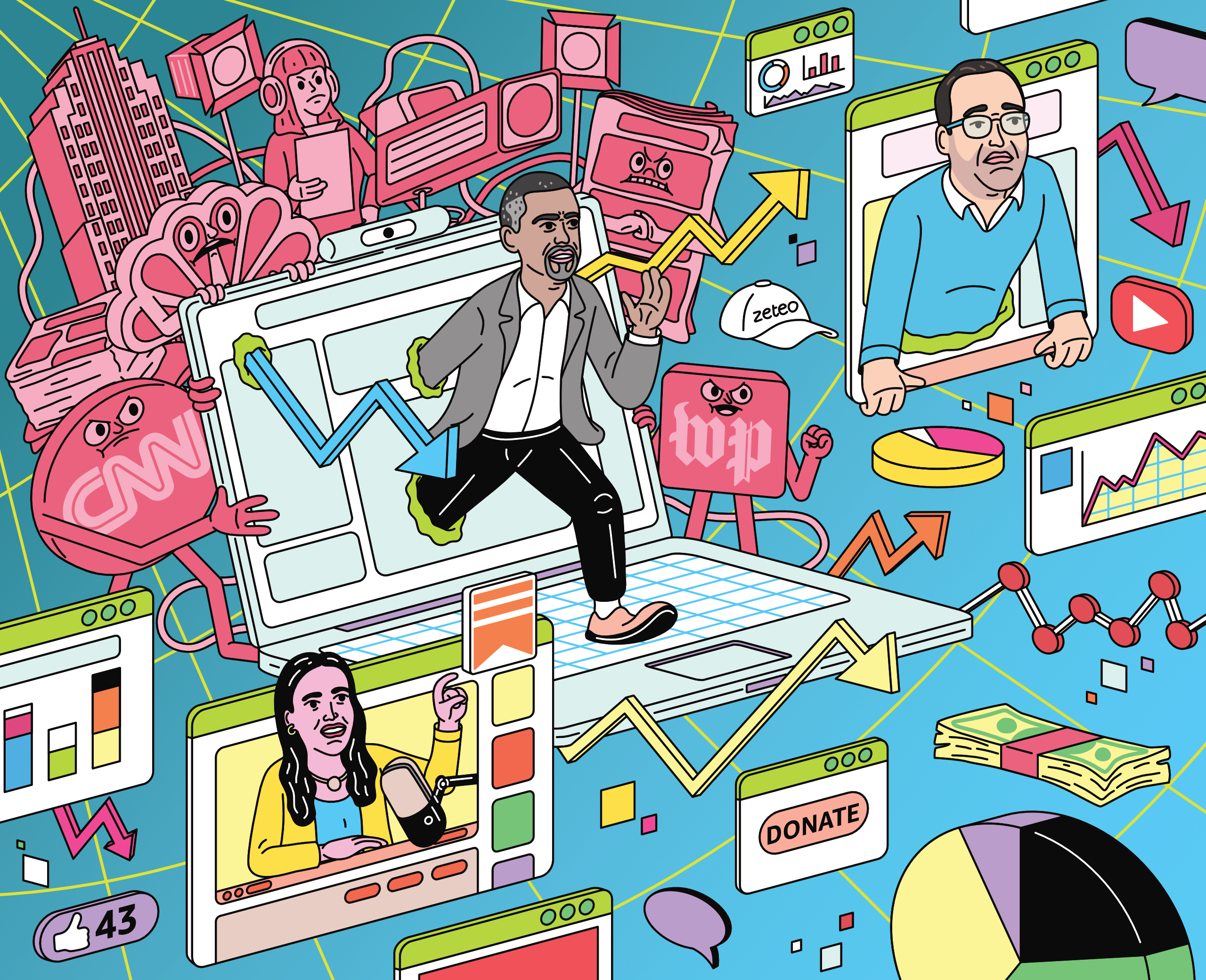
In late February of 2024, Hasan launched an independent media company, Zeteo, published through Substack. He was one of a slew of established journalists to strike out on their own after leaving stable positions at legacy media outlets, either by choice or following one of the many rounds of layoffs that have cut outlet after outlet to the bone. A few of these reporters have built out their own small newsrooms, as Hasan did, including Weiss (the Free Press), Jonah Goldberg and Steve Hayes (The Dispatch), and Richard Rushfield (The Ankler, now Ankler Media). Even more have chosen to forge a path as solo acts on social media, Substack, and other, similar newsletter platforms, including Andrew Sullivan (the Weekly Dish), Matthew Yglesias (Slow Boring), Casey Newton (Platformer), and Derek Thompson (Derek Thompson). All of these journalists are enabled by an unprecedented ability to bypass traditional distribution channels and to speak directly to followers through the internet. They are also spurred on by a growing distrust of mainstream news outlets and join an increasing number of content creators on social media who peddle information about politics and current events with wildly varying degrees of deference to journalistic norms.
But even for those schooled within traditional news media, there is something to the notion that sidestepping corporate bureaucracy and answering only to an audience of followers can be a good thing for journalism. For Hasan, this model has provided an opportunity to produce reporting that had not been possible before: rawer, more personal, and, most importantly of all, more honest. “There’s no C suite, there’s nobody looking over our shoulders, no worrying about sponsors or advertisers,” Hasan told me. “I don’t have to worry about being bullied by lobby groups. And unfortunately, mainstream media organizations do.”
Taylor Lorenz, a tech reporter, put it even more bluntly. “If you challenge systems of power, you’re never going to have a place in traditional media,” she told me. Lorenz said that the ability to speak freely online, both in her reporting and when posting on social media, is a major advantage of working independently. Though she has written for a series of high-profile outlets, including stints as a reporter for the New York Times and a columnist at the Washington Post, she has always blurred the lines between journalist and internet personality; she posts prodigiously on social media, often engaging directly with her detractors, of whom there are many. It’s something of a mixed-media approach to journalism that has become more common with the rise of the news influencer.
While on staff at the Times, Lorenz was uncomfortable with policies that set limits on what she was allowed to post online, rules that are on the books at many media outlets to prevent the appearance of bias. At the Post she managed to kick up controversy anyway, after calling Joe Biden a war criminal in a private Instagram Story. The problem, Lorenz said, is that there isn’t really room in mainstream newsrooms for the critiques she is inclined to level.
In October of 2024, Lorenz left the Post and debuted her newsletter, User Mag, and podcast, Power User. Since then, she said, she has been able to express her thoughts freely in a way that would have put her on thin ice if she held a staff position. When Luigi Mangione shot Brian Thompson, the CEO of UnitedHealthcare, for example, Lorenz wrote a piece in her newsletter called “Why ‘we’ want insurance executives dead,” explaining why she believed so many Americans, many of whom have long suffered from the for-profit whims of health insurance companies, celebrated the murder. (In our interview, she was quick to qualify that she does not believe people should shoot other people dead in the street—“obviously, obviously, obviously.”) After posting it, Lorenz said, she heard from many fellow journalists at mainstream outlets. “They were like, ‘I completely agree, but I can’t say any of that online,’” she told me. “I was able to talk about it in a way that I would have never been able to if I was in the mainstream media—or I might have been able to, but I probably would have gotten shit from my bosses.” Her Substack audience, meanwhile, is hungry for this type of analysis; in an interview on CNN, Lorenz told Donie O’Sullivan that the biggest bump she had seen in newsletter subscriptions until that point came thanks to her piece about Mangione: “People were like, ‘Oh, somebody, some journalist, is actually speaking to the anger that we feel,’” she said.
But there are also ways that this new model—one in which journalists are responsible not only for reporting but also for fostering a committed fan base and capitalizing on it—can disincentivize quality journalism. “Independent journalists are not being fully honest when they say, ‘We don’t have to worry about anything. We’re fully independent,’” Hasan told me. “Actually, you’re dependent: you have to worry about your audience.” As a result, he explained, audience capture—the phenomenon whereby content creators are motivated to tailor content to their subscribers’ tastes—can start to infringe upon independence. This is because building a following requires “having a human relationship” with fans, Hasan said. Many newsletter writers “don’t want to piss those people off by speaking truth, by saying something that their subscribers might not like.”
According to Chris Cillizza, the political analyst, post-specific performance analytics—which enable him to calculate precisely what the numbers mean for his bottom line—add a layer of complication to his independence. In 2023, after being laid off from his job as an analyst and writer at CNN, Cillizza started his own Substack and YouTube channel, So What. He said he knows, for example, that one of his top-performing pieces is an article he wrote called “Does Donald Trump Smell?” riffing on comments made by Adam Kinzinger, a former Republican congressman. This is not, Cillizza said, because “Does Donald Trump Smell?” was an example of his most astute analysis or incisive reporting. It’s because the market rewards extreme takes. “If you are writing about politics today, the smartest business thing you can do is be as extreme anti-Trump or as extreme pro-Trump as possible all the time,” he said. “The truth is that the editorial incentive and the business incentive don’t always match up.”
In the influencer economy, receiving payment or gifts in exchange for posts is frequent practice, and those relationships are not always clearly disclosed. Influencers who present themselves as journalists are not necessarily an exception. Lorenz recently published a piece in Wired about a scheme by a liberal dark-money fund to pay political influencers, including, possibly, Aaron Parnas, who runs a popular TikTok news account and Substack’s top-ranked news newsletter. “A lot of really unethical practices are completely normalized in the influencer industry, and I think that that’s really bad for our media climate,” Lorenz said.
Despite her antipathy toward the power dynamics at play in mainstream media, Lorenz said she owes much of her understanding about ethics in journalism—things like the necessity of disclosure—to her experience in professional newsrooms. “I do very much credit my time in the mainstream media with helping me understand what sort of things are okay to do and what sort of things not okay to do,” she said.
The piece in Wired angered some of Lorenz’s followers; because her reporting is often antagonistic to the right, she said, many readers were surprised and uncomfortable when she reported so critically about the left. She lost a number of subscribers as a result. This, she said, speaks to the challenge of maintaining journalistic rigor while relying on a fan base for financial support. “It’s team sports,” she said. “Any criticism of the people that they like is not tolerated.”
Lorenz told me that she is currently making more than she made as a full-time staff member at a mainstream outlet but that one significant challenge of reporting independently is the lack of stability. She has been offered a small number of brand deals that don’t create a conflict of interest in her reporting, she said, including from DeleteMe, a service that removes personal information from data-broker databases, which Lorenz did a campaign with this year. She is determined not to be swayed in her reporting by a media environment that encourages pandering. “I just want to show that it’s possible to make a living ethically,” she said. “I think it sets a good example for younger journalists.”
One way Cillizza keeps himself from being too reliant on his own subscriber base is by diversifying his income stream. In addition to the money he makes from subscription fees, he does paid speaking engagements and is currently a political contributor to NewsNation, the cable network—things he was contractually barred from doing while on staff in a newsroom. As a creator, “I’m the hub,” he said. “And I need to build as many monetizable spokes off that hub as possible.”
But in a broader sense, Cillizza said, the survival of independent journalism may depend on the ability of principled, balanced journalists to convince readers that it’s worthwhile to pay for the service they provide society. “I think we have to get people to understand that you must invest in the things that you think are valuable,” he said. “Content isn’t free. It can’t be if you want to continue to have quality news.”
Part of the work of being an independent journalist, it seems, is reminding subscribers of this constantly. Cillizza takes a moment in nearly all of his videos to explain to viewers why they should subscribe to and support his channel. “I’m independent from big corporate media. I’m independent from the two political parties,” he said in a recent appeal. “I’m never going to do fan service. I’m never going to tell you something because I know you’re going to like it.” Lorenz begins every email that goes out to her unpaid subscriber base with a three-paragraph solicitation: “User Mag was founded on the belief that journalists should not have to work under the thumb of reactionary billionaires who decide what stories get told.” On its about page, Hasan’s Zeteo asks readers, “How many times have you complained about the ‘mainstream media’? About corporate control or censorship? About softball interview questions or lazy ‘both sides’ coverage?” It ends with this call to action: “Let’s change the news together. Because it’s time for a media organization…that isn’t afraid.”
This is the value proposition of independent journalism: that it can offer reporting that traditional newsrooms cannot or will not. It brands itself as the antidote in an ailing media ecosystem dominated by ethically compromised companies that are too partisan, too risk-averse, too willing to cater to the interests of the rich and powerful. It’s a message that resonates with an increasingly large share of the American public; according to an October Gallup poll, just 28 percent of Americans have a “great” or “fair” amount of trust in the news delivered by television, newspapers, and radio. (That number was at 40 percent just five years ago.) Seventy percent of the country has either “not very much” confidence, or “none at all.”
This is why some independent journalists, such as Lorenz, think most traditional outlets are not long for this world. Others, like Hasan, believe large media companies with the capital to maintain foreign bureaus still have a place—especially, he said, given that a large number of influencers who present themselves as independent journalists do no original reporting of their own. While touting the intellectual and political freedom of the independent model, these influencers might regurgitate information gleaned from the mainstream outlets they purport to subvert, often with an added layer of casual commentary that is affirming of the worldviews of their audience, which demands to be served. In a sense, they have traded one overlord for another.
This is the media climate in which an increasing number of establishment voices are setting out to make their mark, independent of the newsrooms that elevated them to fame. Some of the most successful of them—the Bari Weisses of the world—have styled themselves outcasts while doing little to challenge power in a meaningful way. Weiss left her post as an opinion editor at the New York Times in 2020 and started the Free Press the following year, branding it as a beacon of independence and free speech within a news ecosystem beset by woke censorship. She leveraged discontent over the mainstream media to amass a following of over a hundred thousand paid subscribers, then, earlier this year, sold the whole operation to Paramount Skydance and took a new role as editor in chief of CBS News. Other independent journalists are perhaps more honest about the recalibration of ethics necessary to make it in this new world, embracing a personality-forward, point-of-view journalism model that rejects classic notions of objectivity without discarding a principled commitment to honest reporting.
This piece is part of Journalism 2050, a project from the Columbia Journalism Review and the Tow Center for Digital Journalism, with support from the Patrick J. McGovern Foundation.
Has America ever needed a media defender more than now? Help us by joining CJR today.