Sign up for the daily CJR newsletter.
The United States is at war. But the Pentagon has forced journalists out of the building, making it harder than ever for the press to report on what’s happening. Press conferences are rare. Pete Hegseth, the so-called secretary of war, takes questions only from friendly outlets. No mainstream news organizations have reporters embedded with US military units in the Middle East. Pentagon sources are increasingly reluctant to talk to journalists for fear of retaliation from the administration. In a recent speech, Hegseth compared reporters to “Pharisees,” who in the Bible call Jesus’ teachings into question. Hegseth’s secretaries, for their part, hurl insults and threats at the press.
None of this happened overnight. Hegseth assumed office in January of 2025 with an antagonistic view of the press and, in his nearly five hundred days in office, stripped away the protections necessary for reporters working to keep the military in check. Yet journalism has prevailed. Reporters continue to deliver news and maintain the trust they’ve built with service members. And now, thanks to a lawsuit filed by the New York Times, the Pentagon’s attempts to skirt the First and Fifth Amendments face a serious challenge.
The Department of War
Hegseth sworn in
January 25, 2025
Former Fox News anchor Pete Hegseth is sworn in as secretary of defense.

Press corps, remixed
January 31, 2025
Hegseth pushes the New York Times, NBC News, NPR, Politico, and other outlets from their long-held desks in the Pentagon, where they are soon replaced by One America News Network, the New York Post, Breitbart, and HuffPost.
Operation Rough Rider
March–May, 2025
President Trump launches the first large-scale Middle East operation of his second term: a military campaign against Yemen’s Houthi rebels.
Signalgate
March 11–24, 2025
Mike Waltz, who was then Trump’s national security adviser, accidentally adds Jeffrey Goldberg, the editor in chief of The Atlantic, to a Signal group chat where senior administration officials discuss the Yemen operation. Goldberg then publishes a redacted account of the chat, followed by a transcript of the entire conversation.
Jeffrey Goldberg (in The Atlantic, March 9, 2026)
“The ad hominem campaign by Waltz, Hegseth, [then–Director of National Intelligence Tulsi] Gabbard, the CIA, and White House Press Secretary Karoline Leavitt, combined with the assertion that no classified information had been included in the chat, presented me with a dilemma. I knew, of course, that the information I’d seen on my phone would ordinarily be judged top secret by the military, and I knew that the White House lies were meant to undercut the credibility of this magazine. I simply could not understand why the administration was goading me into releasing the full message chain, which would show that I was correct in stating that the information was highly secret.”
Chaos Reigns
March–April, 2025
In the wake of Signalgate, a team of Wall Street Journal reporters reveals that Hegseth brought his wife to sensitive meetings involving foreign military officials and fired officials suspected of leaking plans of a classified briefing for Elon Musk on China.
Movement restricted
May 23, 2025
An order citing national security concerns bars the free movement of reporters throughout most of the Pentagon.
Operation Midnight Hammer
June 22, 2025
The US attacks three nuclear facilities in Iran as part of Israel’s Twelve-Day War.
Operation Southern Spear
September, 2025–ongoing
US forces strike alleged drug-smuggling boats in the Caribbean and Eastern Pacific. The operation has been responsible for more than 190 casualties.
Tightening Up
“Approved for public release”
September 18, 2025
The Pentagon issues a seventeen-page memo instructing journalists to report only on material “approved for public release by an appropriate authorizing official, even if it is unclassified.” Failure to comply is said to result in the forfeiture of reporting badges.
Polygraphs, NDAs
October 2, 2025
The Washington Post learns of Defense Department plans to tighten scrutiny over leaks, including random polygraph tests.
Tara Copp, Washington Post
“They even created a new category called CUI: Controlled Unclassified Information. It is literally unclassified information that they’re saying they can’t release. And that ultimately inhibits watchdogs, inhibits lawmakers, inhibits anyone who wants to show where the taxpayer dollars are going or how soldiers were injured or killed. This level of secrecy isn’t normal.”
Doubling Down
October 6, 2025
Following negotiations with the Pentagon Press Association, the DOD’s “revised” reporting policy still prevents journalists from doing their jobs by banning the “solicitation” of unreleased information.
Konstantin Toropin, the Associated Press
“The Pentagon’s efforts don’t just physically keep us out of the building. There is a growing culture of fear among the service members we talk to, who may see something that concerns them and think that the public would deserve to know. It has a chilling effect.”
Exodus
October 15, 2025
Most of the Pentagon press corps, including MAGA-aligned outlets like Fox News and Newsmax, leave the DOD in an organized protest.
Copp, Washington Post
“Access is critical. The only reason I’ve been able to hang in there and continue to do this type of reporting is because I had that access in the past. A new reporter coming in right now who does not have these relationships, who has not met these people face-to-face, who hasn’t built up that trust, would have a very difficult time.”
Boat strike survivors
October 17, 2025
Reuters reports that the US military has detained two survivors of boat strikes in the Caribbean—the first time news about boat strike survivors emerges. Later, the New York Times reveals how the Pentagon tried to keep the survivors away from American courts in an effort to avoid shedding light on the military action.
Donald Trump on Truth Social, October 18, 2025
“It was my great honor to destroy a very large DRUG-CARRYING SUBMARINE that was navigating towards the United States on a well known narcotrafficking transit route. U.S. Intelligence confirmed this vessel was loaded up with mostly Fentanyl, and other illegal narcotics. There were four known narcoterrorists on board the vessel. Two of the terrorists were killed.”
Trans Troops
October 31, 2025
The AP finds that following Trump’s executive order to ban trans people from the military, a Pentagon policy gave commanders the power to override separation board decisions that would have allowed trans officers to serve.
Toropin, AP
“My reporting relied on a deep relationship with this community of service members who I got to know over the multiple stories I’ve written about them and who saw me as somebody who would take them seriously. The elements of this story were flagged to me by the folks on the ground, and by advocates and attorneys who were working with them.”
Mixed Messages
“Kill all” order revealed
November 28, 2025
An investigation by the Post finds that Hegseth ordered a “double tap” strike on a Venezuelan boat, killing all survivors after the initial hit. Hegseth calls the story fake news and denies ordering a second strike, despite previously boasting about the attack.
Boot camp
December 1–3, 2025
The Pentagon organizes a three-day event welcoming newly accredited media organizations, including MAGA-aligned podcasters and news influencers.
Filing Suit
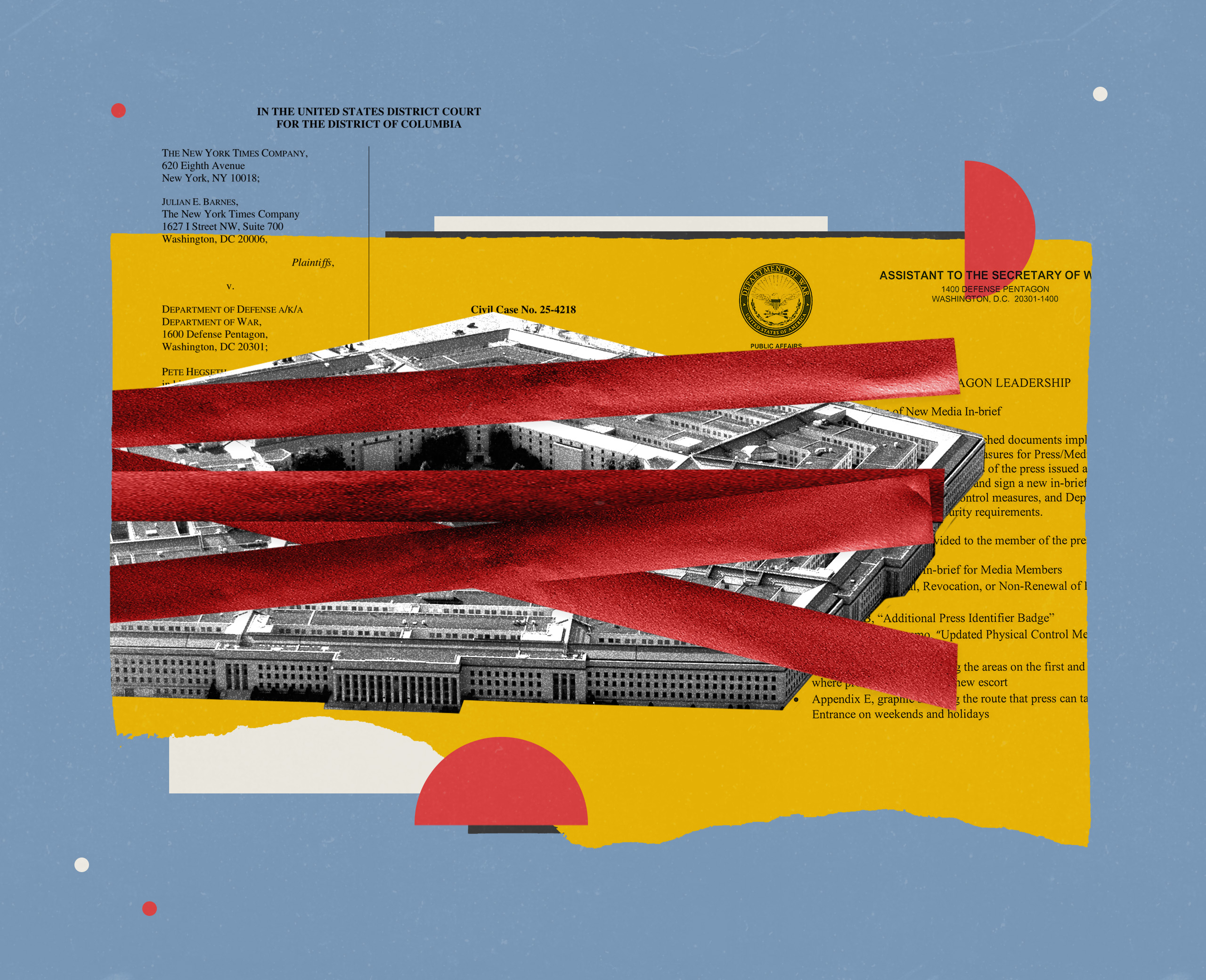
The New York Times sues the Pentagon
December 4, 2025
Citing the First and Fifth Amendments, the Times takes the Pentagon press policy to court.
A.G. Sulzberger, the chairman of the New York Times Company (in the New York Times, January 24, 2026)
“Unchallenged, this move would set a bad precedent that could be embraced by other parts of the government. Even more than that, it is a disservice to the American people, who have no interest in having government propaganda replace independent journalism.”
On the Offensive
Operation Hawkeye Strike
December 19, 2025
Following an ambush that killed two US soldiers in Syria, the US launches a military attack against the Islamic State.
Operation Absolute Resolve
January 3, 2026
The US invades Venezuela and captures President Nicolás Maduro and his wife.
Claude in Venezuela
February 13, 2026
Axios reports that Claude, Anthropic’s AI agent, was used in the operation, via the Pentagon’s cooperation with Palantir, to capture Maduro. Anthropic previously opposed the use of its products for surveillance and attack drones. Following the Venezuela story, the Pentagon severs ties with the company, Trump bans federal agencies from using its products, and the DOD designates it a “supply chain risk,” which Anthropic goes on to challenge, successfully, in court.
Maria Curi, Axios
“When these types of moments happen, it’s much harder to parachute in and get people to talk to you. But if you have already been laying down groundwork with no immediate story in mind, just trying to get to know the people in and around these agencies and institutions in DC, then all of a sudden when news breaks, you’re getting a tip, and you know who to call next.”
Operation Epic Fury
February 28, 2026–ongoing
The US and Israel launch air strikes on Iran, despite lacking a clear casus belli. The attacks kill Ali Khamenei, the supreme leader.
“Micro-scoops”
February 28, 2026–ongoing
In the first forty-eight hours of the war, at least a dozen outlets publish news based on “exclusive” phone interviews with Trump.
Curi, Axios
“I actually have found that folks like to talk. President Trump famously picks up calls from like eighty different reporters in DC. Accessibility is not always what’s most difficult, but parsing through everything and making sure that you’re not so caught up in what is being said that you miss what the big picture is.”
Civilian targets
March 5, 2026
A visual investigation by the Times shows that US air strikes hit an elementary school in southern Iran, killing more than a hundred children. Reuters reports that a US investigation also points to American culpability.
Face Off
Legal battle
March 6, 2026
After forgoing the discovery phase, the Times and the Pentagon meet in the US District Court for the District of Columbia.
Pentagon bars photographers
March 11, 2026
Following the publication of “unflattering” images of Hegseth from Iran war press briefings, the DOD bans photojournalists.
Central Command
Iran school was on target list
March 11, 2026
The Washington Post finds out that the elementary school that the US struck in southern Iran was on the US military target list, mistaken for a military site.
Copp, Washington Post
“That story was a beast to get out the door. We relied not only on US but also on Israeli officials. It took a very wide spread thinking about who we knew. Because we know the administration wouldn’t say anything. We know the Navy is not officially responding, that Central Command is not officially responding. So who in the second and third order do we know that can help us get to this? It takes that level of thinking and then talking to those people and asking who they know and if they might be willing to put in a good word for us. It takes time. It takes a lot of patience. It takes weekends and nights, and working very odd hours because your night is their morning and vice versa. And then it takes many levels of review. This administration is looking for anything to use against us—as the Washington Post or journalists in general. We’ve seen threats for the Espionage Act. We’ve seen law enforcement go to reporters’ doors.”
Pentagon clamps down on Stars and Stripes
March 14, 2026
The DOD expands oversight over the publication—which receives Defense Department funding but has long operated independently—criticizing its focus on “woke distractions.”
$200 billion
March 18, 2026
The Post reveals the DOD’s estimated price tag to continue the war in Iran. The Pentagon later claims that the costs are closer to $25 billion.
On and Off Court
NYT victorious
March 20, 2026
Judge Paul Friedman orders reporters back into the Pentagon, ruling that the credentialing policy violated the First and Fifth Amendments.
To the Annex
March 23, 2026
The DOD finds a work-around: ditching its contested policy but moving the press area to a remote building.
Back in court
March 30, 2026
The Times brings the DOD back to court, challenging the Pentagon’s work-around.
Times motion to compel compliance
“The intent is obvious: The Interim Policy is an attempted end-run around this Court’s ruling.”
Reinstatement
April 9, 2026
Judge Friedman reinforces his previous ruling, again ordering the reinstatement of journalists into the Pentagon.
The Pentagon appeals
April 10, 2026
The DOD appeals the court rulings that deemed the credentialing policy unconstitutional.
Stars and Stripes Drama
Stars and Stripes ombudsman fired
April 23, 2026
The Pentagon fires Jacqueline Smith, the paper’s ombudsman for editorial independence. The firing comes after Smith criticizes the Pentagon’s overhaul of the publication.
Jacqueline Smith (in Stars and Stripes, April 23, 2026)
“A recent opinion column I wrote as the Stars and Stripes ombudsman began with this: ‘Pete Hegseth doesn’t want you to see cartoons in this newspaper anymore.’ Apparently the Pentagon also doesn’t want you to hear from me anymore about threats to the editorial independence of Stars and Stripes. They fired me.”
Escort Service
Access, with escorts
April 27, 2026
While the Court of Appeals for the DC Circuit considers the Pentagon’s appeal in the Times lawsuit, it approves the DOD’s request for an administrative stay: journalists cannot roam the halls unaccompanied.
NYT sues the Pentagon, again
May 18, 2026
While the initial lawsuit sits at the appeals court, the Times alleges that the DOD’s requiring escorts to accompany journalists in the Pentagon at all times violates the First Amendment.
Times lawsuit challenging the escort requirement
“This is the second time Plaintiffs have been forced to file suit in this District to challenge Defendants’ unlawful efforts to restrict Plaintiffs’ constitutionally protected newsgathering and reporting, and to punish Plaintiffs for exercising their First Amendment rights. Defendants adopted the Interim Policy one business day after—and in direct response to—a court order that vacated and enjoined provisions of a prior Pentagon press credentialing policy as unconstitutional.… Like its predecessor, the Department’s Interim Policy is patently unconstitutional.”
Has America ever needed a media defender more than now? Help us by joining CJR today.