Sign up for the daily CJR newsletter.
Welcome back to Ask Anika, a column for addressing questions about the ethics, legal considerations, and best practices of adopting new technologies in journalism. Send me your questions at askanika@cjr.org.
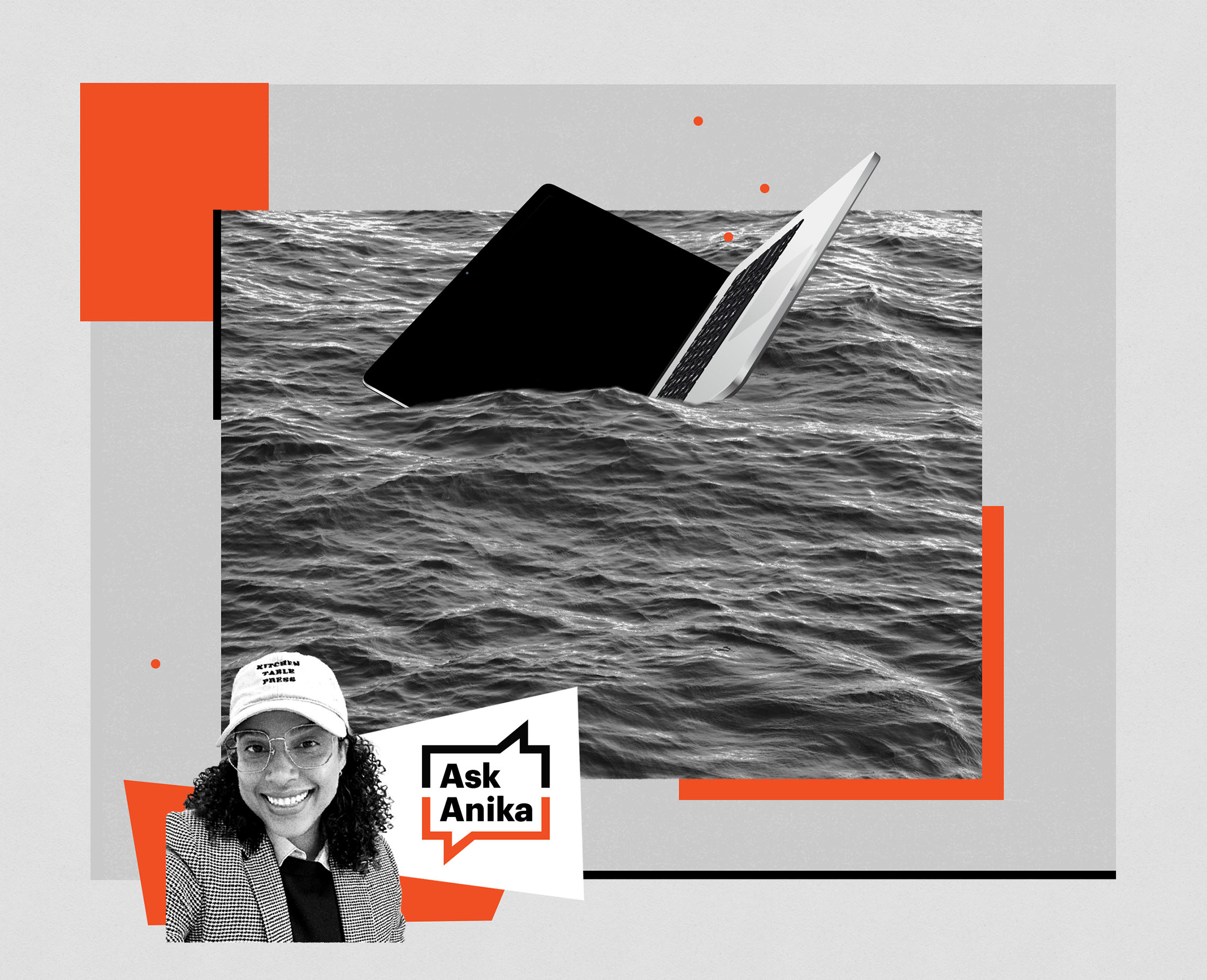
Q: Should I throw my laptop into the sea? Or, to put it another way: What sort of relationship should I have with AI, as a journalist?
A: Do I think you should yeet your computer into the ocean—or, as I mentioned in my last column, abstain from using artificial intelligence altogether as a way to mitigate the ethical complications? Sure, if you want to. Do what feels right. But I don’t mean that in a “good vibes only” neon-sign-in-a-weed-smoke-hazed-room kind of way. What I mean is: You can decide what kind of relationship you want to have with technology. We still have choices, even when it feels like we are at the mercy of the whims of Big Tech oligarchs.
Last year, while hosting a podcast, Through to Thriving, I spoke with Dr. Timnit Gebru, a computer scientist and the founder of the Distributed AI Research Institute, about her forthcoming book, Deep Unlearning, and whether AI is the next inescapable evolution. She said that we are often taught that there were “horses and then steam engines and then cars, and then self-driving cars and then flying cars. This is the natural progression of things.” But in reality, “there is no natural progression of things. All of it is about who is getting the resources to execute on what imagination.”
Gebru’s position challenges the prevailing notion that AI’s rise is predestined. “If we say, ‘AI is bad, I don’t want to use it,’ it will happen to us,” Tom Rosenstiel, the author of The Next Journalism: How the Press Must Change to Serve Democracy, recently told CJR. But AI’s inevitability is being resisted in some places. Communities are fighting against data centers—so vigorously that it’s shaking up midterm elections. From Georgia to Virginia and up to New York, people are destroying Flock surveillance cameras, which hook into an AI-powered network, in their neighborhoods. “It’s easier to deface a camera than it would be to smash Claude or ChatGPT,” Chris Gilliard, the author of the forthcoming book Luxury Surveillance, said in a recent Verge article about the phenomenon. In newsrooms, employees mandated to use AI have started organizing—and in some cases have forced executives to roll policies back.
But if you do want to use AI in an informed way—and transparently (at the time of publication, not shamelessly disclosing AI use after you’ve been called out)—you’re not necessarily adrift. Technology will evolve, but journalism’s work remains the same. (Last month, the Society of Professional Journalists released a draft of its updated code of ethics, in part to meet the moment with AI. The core principles of the code have been left unchanged.)
Journalism’s basic values remain important because the reality is no one—not journalism experts nor sardonic advice columnists—actually knows what the future is or where the next emerging technologies like AI will take us. And even when our tech overlords are given seemingly endless resources to make their dreams into the rest of the world’s reality—with help from their friends in high office, who argue, for instance, that there is both a “strong and sovereign interest” in LLMs being able to train on journalists’ copyrighted material—it sometimes doesn’t work out like they planned. I’m old enough to remember when glassholes thought their goggles were glorious (RIP Google Glass), when NFTs were allegedly going to transform the creative arts, when Web3 was poised to replace the internet. And I’ll never forget cackling in mid-pandemic hysteria when Mark Zuckerberg told us that the legless Metaverse was our preordained future.
I’ve also been around long enough to find out that life is complex. Not every person learns, thinks, or writes the same way. I know some professors who are having crashouts about their students’ obvious AI use, though that has not yet been my experience (knock on wood). Rather, I’ve learned that there are people who do not use AI for a variety of reasons, political and technical. I was in my first year of law school way before language models were large, and I was often the sole student writing notes and exams by hand. For me, the connection between listening, thinking, and handwriting has always been essential to my learning process. But that’s a personal decision, not a mandate.
So do I think you should yeet your computer into the ocean?
Sure. If you want to.
AI disclosure: I consulted Google Search’s AI Overview in the drafting process but used none of the results in the final version of this story, thanks to cuts made by my human editors.
This piece was produced with support from the Craig Newmark Center for Journalism Ethics and Security.
Has America ever needed a media defender more than now? Help us by joining CJR today.