Sign up for the daily CJR newsletter.
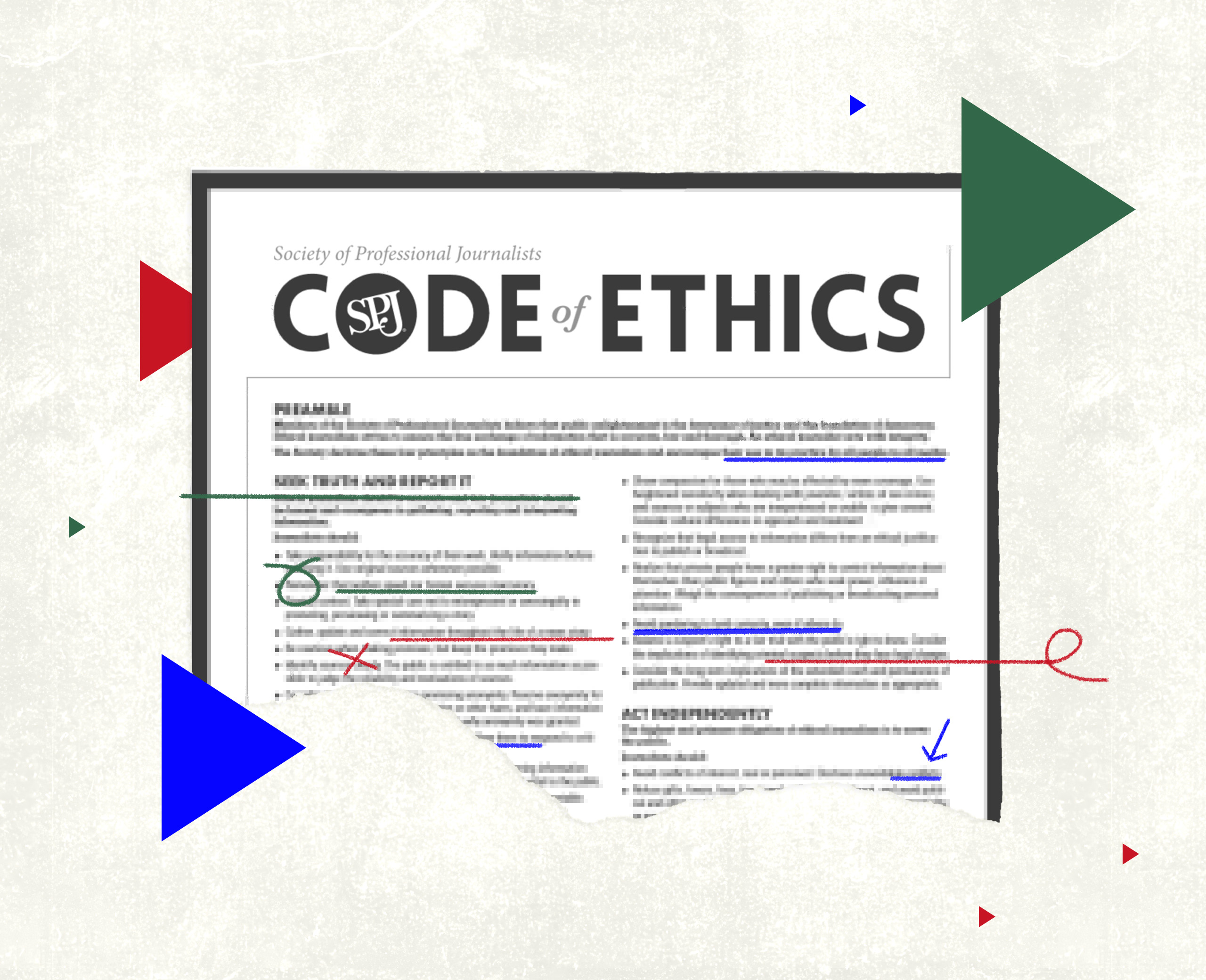
The Society of Professional Journalists (SPJ), a more than century-old industry organization with nearly five thousand members across two hundred and fifty chapters in the United States, might be best known for its code of ethics, a set of bullet-pointed precepts that can fit on a poster designed to hang in journalism classrooms and newsrooms: “Seek Truth and Report It”; “Minimize Harm”; “Act Independently”; “Be Accountable and Transparent.” Each is described in succinct sentences. Now, with AI, creator journalists, and other industry changes in mind, SPJ is revising that code for the first time in more than a decade.
The first draft of this update, created by committee, is being made public today for consideration by SPJ’s full membership. To produce even a draft revision has taken close to a year, encompassing surveys of journalists and the general public, two panel discussions, a half dozen Zoom meetings, and a marathon in-person drafting session. “The debate was really on the language and what needed to be tweaked,” said Patrick Lee Plaisance, a Penn State media ethics professor and the author of Virtue in Media: The Moral Psychology of Excellence in News and Public Relations. The in-person meeting was “exhausting,” Plaisance said. “It was not a very pretty process, but I think it was respectful. The process and the product, I think, turned out better than expected.”
The committee included sixteen writers, editors, academics, and members of other industry organizations, including Investigative Reporters and Editors and the National Association of Black Journalists. All of SPJ’s members can now prepare to weigh in at their upcoming October convention—though they’re not guaranteed to give the guidelines a rubber stamp.
The draft code does not name-check any AI tools or ban the use of AI in researching, outlining, or writing articles, even as journalist unions and newsrooms push for guardrails along these lines. The code’s drafters insist they’re being mindful that some journalists are required to use the technology or are open to experimentation. “If someone wants to write an article based on source material that they gathered through interviews or document research, that is a choice that I think some journalists might be okay with. But the deeper issue is you have to be responsible for that,” said Nicholas Diakopoulos, the director of Northwestern University’s Computational Journalism Lab and an outside adviser to the SPJ committee on AI matters.
Diakopoulos was in favor of the committee’s decision to forgo naming any generative AI platform in the draft. The committee even opted against using the term “AI” to avoid prematurely dating the new code (much as the previous version avoided mentioning social media or the word “link”). Instead, it emphasizes that journalists are responsible for verifying their work, regardless of the technology used in its production. The draft code tells journalists to “remember that speed, technology or medium do not excuse inaccuracy or unfairness. Journalists are ethically responsible for their work, regardless of the tools and technology used.” Chris Roberts, a cochair of the latest revision and the director of the Office of Research in Media Integrity at the University of Alabama, told me, “We’re trying to be platform-agnostic, yet still say the things that we feel we need to say.”
The most noteworthy change to the code’s existing language may be striking a line that journalism should “give voice to the voiceless,” which had been added during a 1996 revision. It’s not up to the committee or SPJ to decide who’s voiceless, said Jackie Padilla, the digital director for Nashville’s NewsChannel 5 and an executive-board member of the National Association of Hispanic Journalists. “We all have a voice, and I would argue that for decades people have been speaking or shouting or protesting” while being ignored, said Padilla, who pushed for the change. “The code of ethics is not meant to be a pamphlet with all these emotionally charged phrases. It should get straight to the point and not make assumptions or insinuate anything.” The line was replaced with: “Be vigilant and courageous about holding those with power accountable. Counter the unfair marginalization of those with less power.”
The discussion of whether anyone is truly “voiceless” gets at a fundamental question for SPJ’s ethics code and whom it’s designed to serve. The ethics committee has cited the steep decline in media trust as a reason for revamping the document. At the same time, legacy newsrooms—whose employees are generally overrepresented in the membership of industry organizations such as SPJ—make up a shrinking share of newsroom hiring and the industry overall. SPJ is now targeting its updated code at a broader audience. Chris Vaccaro, SPJ’s president and an assistant adjunct professor of journalism at Hofstra University, told me: “I think the code of ethics could apply to everybody creating content. It doesn’t just have to be a traditional journalist—it can be somebody who is creating content for a larger audience, and hoping they’re doing it with truth and fact and sourcing and all the tenets of the code that have existed for a hundred years.”
But the troubled dynamics of legacy media helped create an opening for independent journalists to become the new trusted sources—so why should they have to follow the old guard’s rules? “I grew up with codes of ethics that were based largely on SPJ,” said Liz Kelly Nelson, the founder of Project C, an organization supporting independent creator journalists. “I’m not sure how relevant it is anymore. It’s an important thing for SPJ to be doing and thinking about how to capture and build trustworthy content for audiences in 2026. But those audiences have turned away from institutional media in droves because of a lack of trust.”
Tom Rosenstiel—the author of The Elements of Journalism, a seminal text in journalism classes, and an outside adviser to the SPJ’s revision committee—agreed that it was time to reevaluate. “The press used to imagine itself as a gatekeeper over what people know,” he told me. “Today, the press is less of a gatekeeper and more of an annotator over what people have heard elsewhere.”
Despite these challenges, SPJ is pressing ahead. “We cannot continue to surrender ethical standards in this profession simply because people aren’t interested in them,” Kevin Smith, the executive director of the Kiplinger Program in Public Affairs at Ohio University, said. Smith oversaw two earlier code revamps and is now participating in a third. “What we’ve done is we’ve allowed our standards to slip over time,” he said. “I think sometimes it feels like an exercise in futility—and trust me, since 1995 or 1994 it has, at times, felt like spitting into the ocean. But I can’t imagine if we don’t stick to our principles.”
The code has never attempted to define who gets to be called a journalist. But the draft text—which begins each precept with “ethical journalism should”—seems to suggest that not everyone who identifies as a journalist will act ethically. “There’s an explosion of people who are using the title of journalist, and doing it without any real desire to know what our ethics are,” Smith said.
The concept of an ethical code for journalism arose during the Progressive Era, when the industry was evolving from so-called yellow journalism into a more serious profession. In 1909, ten students who were passionate about “upholding high standards in the profession” founded the Sigma Delta Chi Society at DePauw University, a liberal arts college in Greencastle, Indiana. After borrowing an ethics code from the American Society of Newspaper Editors in 1926, they produced their own in the seventies and, by 1988, had renamed their group the Society of Professional Journalists, offering awards and scholarships while expanding to other campuses and continuing to revise the code periodically. Each revision has reflected its time. For the 2014 revision, as the job market declined, SPJ struck the rule that journalists should avoid secondary employment.
The current draft was shaped mostly at a coworking space in Indianapolis over Father’s Day weekend in mid-June. A dozen committee members, SPJ executive leaders, and staffers flew in. “We spent thirteen and a half hours over two days debating every punctuation mark, every article, every clause,” said Dan Axelrod, a communications instructor and media consultant who is the chairman of SPJ’s ethics committee and cochair of the revision process. Roberts, Axelrod’s counterpart steering the code revision, described it as a “geek-fest.”
Between now and late September—when SPJ’s national board is expected to vote on advancing the code to its annual convention, in October—SPJ is soliciting feedback on what the committee has produced. Axelrod stressed that the code will be subject to some degree of change prior to the convention. In the meantime, SPJ will publicize the draft code on its website and social media and share it directly with some journalist creators.
“There are people who want to see the code evolve, and I think there are loyalists and traditionalists who don’t like to see anything change. Everybody has to be meeting in the middle,” Vaccaro said. “I do expect there to be lively discussion and potential debate; that’s what this is all about. Everyone in our membership group and our board has a voice, and we’ll see how it all pans out.”
This piece was produced with support from the Craig Newmark Center for Journalism Ethics and Security.
Editor’s Note: This piece has been updated to identify the source of the final quotation.
Has America ever needed a media defender more than now? Help us by joining CJR today.