

Sign up for the daily CJR newsletter.
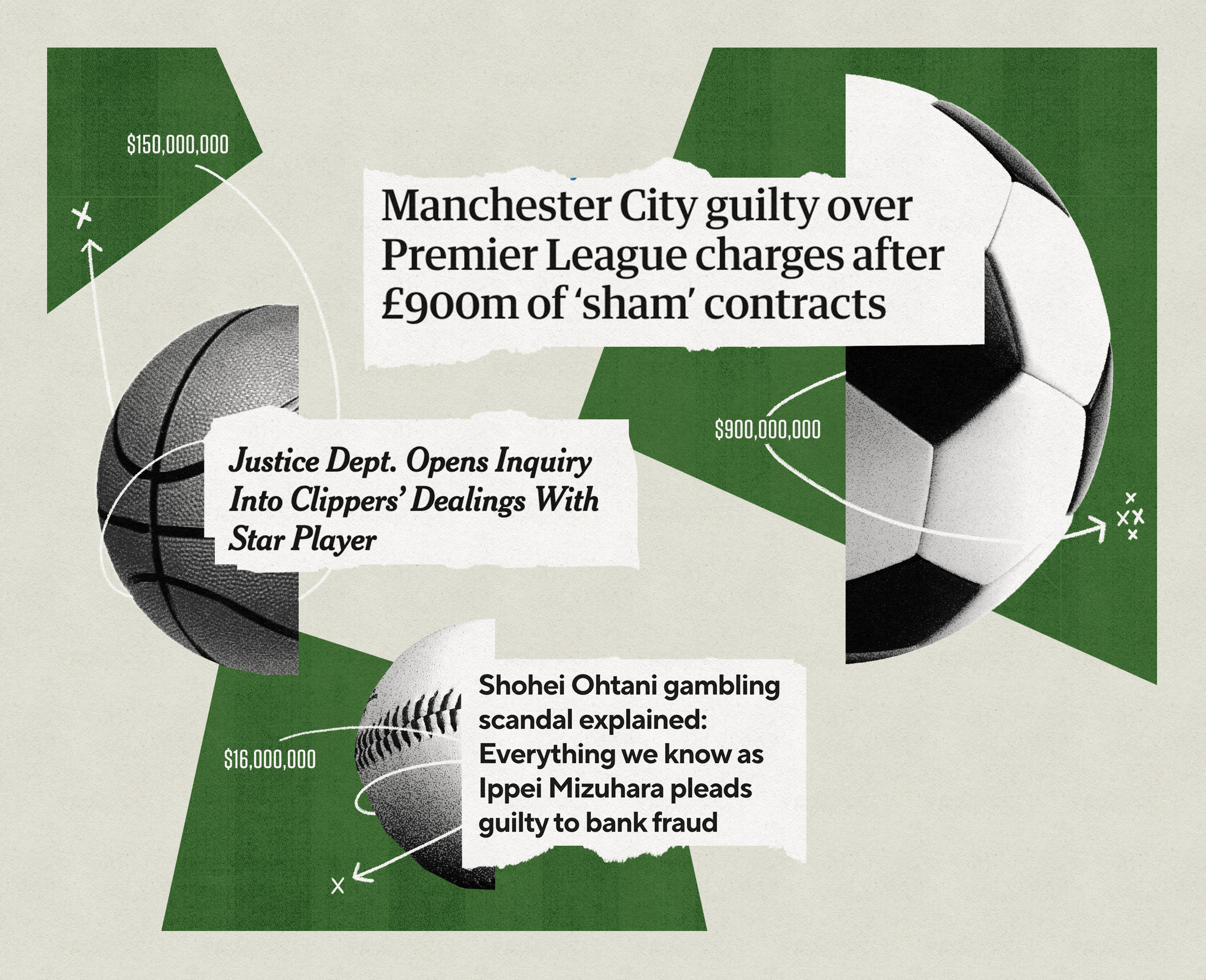
For fifteen years now, Nick Harris, a British sportswriter, has been covering allegations that Manchester City—a perennial winner of the English Premier League, the richest soccer league in the world—was, as he puts it, “cooking the books.” The story, in brief, went like this: from 2009 to 2018, City allegedly engaged in widespread cheating by deceiving the Premier League with more than a billion dollars in sham contracts, which allowed it to spend beyond its limits to acquire some of the best players in the world. Eight years ago, the Premier League officially began investigating the allegations. Two years ago, an independent commission empowered by the league held an official hearing. City—whose majority owner is Sheik Mansour, a multibillionaire Abu Dhabi royal—has waged an expensive, extended fight against the league’s charges. Harris had started to believe that the investigation would continue “for years without us knowing the verdict.”
On September 29, the commission dropped its ruling: City was guilty of “extremely serious, significant, sustained and intentional or reckless breaches.” Harris was flabbergasted. “It was so utterly damning that it came as a shock,” he said. “It was properly oh my goodness.” City is now appealing, but if the verdict holds, “it’s not hyperbole to say this is the biggest scandal in the history of British sport.” The drama has blown up beyond soccer, as Andy Burnham, the prime minister of the United Kingdom and a steadfast supporter of Abu Dhabi’s investments, is now attempting to salvage his country’s relationship with the wealthy Gulf state.
Harris, formerly of the Mail on Sunday and now on Substack at Sporting Intelligence, has been chasing this story alongside peers including Rafael Buschmann, Christoph Winterbach, and Nicola Naber of Der Spiegel, Matt Slater of The Athletic, and Rob Harris of Sky Sports. Der Spiegel collaborated with more than a dozen media companies and nearly eighty journalists in a consortium called European Investigative Collaborations, sifting through more than seventy million documents known as Football Leaks. The coverage has collectively faced extreme pushback from fans, which meant the court decision represented not just vindication for reporters but a “relief that something is still happening,” as Winterbach told me. “It’s been such a long time since we started publishing these articles.”
The City story is also part of a wave of investigative sports reporting that has been growing despite the diminution of daily and local sports journalism. Over the past few decades, almost 40 percent of local papers in the United States have shut down, according to Northwestern’s Local News Initiative. Over the past three years, the Los Angeles Times, the Washington Post, and the New York Times have all curtailed or altogether closed their sports sections. But ProPublica, the investigative powerhouse, last year hired Gus Garcia-Roberts, a Washington Post veteran, to be its first reporter explicitly focused on sports. This year, Pablo Torre Finds Out, the upstart video podcast, won a Pulitzer Prize for its investigation into the Los Angeles Clippers and their blatant evasions of the NBA’s spending rules. Reporters at ESPN and The Athletic (which is owned by the Times) have been similarly afforded time and space to do investigative work. “Sports is about everything,” Tracy Weber, ProPublica’s managing editor, told me. “It’s massive money. It deserves accountability reporting.”
Reporters chasing sprawling scandals like the Manchester City story—“long-running conspiracies of silence,” as Slater calls them—often wind up facing the wrath of rabid sports fans. In 2020, someone published Nick Harris’s home address on a City fan forum and encouraged fellow fans to attack him in retaliation for his reporting. Harris’s wife passed away that year; he has since received a steady stream of messages “along the lines of ‘you deserve her death,’” he told me. “It’s not enjoyable. But neither has it dissuaded me from following the story.” Winterbach said he has received death threats for his sports reporting over the years but has “never taken them seriously.”
In the City case, the team’s own media relations team has helped fuel the anti-journalism fervor. In 2023, Harris reached out to City for a comment on a story he was reporting for the Mail on Sunday. The team’s lawyer responded with a threatening letter to the newspaper, accusing Harris of harboring a “very strong negative emotional response” to the team.
After the City verdict came down, a video clip from 2019 started making the rounds: it was from a press conference in which Rob Harris, of Sky Sports, asked Pep Guardiola, City’s beloved, brilliant manager, if he was being paid off the books. (Evidence suggested a previous City manager had had millions secretly routed to him through an Abu Dhabi soccer club.) City had just won the FA Cup, one of English soccer’s major tournaments, and Guardiola was aghast: “Do you think I deserve this?” He also never explicitly answered “no” to Harris’s question.
Harris, nicknamed “Trouble” by his colleagues for his pugnacious approach, takes no pleasure in angering City’s fans by asking their heroes hard questions. He sympathizes. “This is not like reporting on a chain of grocery stores being under investigation,” he told me. “There’s an emotional attachment. They carry the fandom through the generations. It’s the rhythm of their years.”
When it comes to being sports freaks, Americans, of course, are no slouches. Over the course of his Clippers investigation, Torre was often assured by NBA diehards that he was wasting his time. “You’re out on a limb and it’s creaking and people are telling you it’s about to fucking fall,” he told me. “You imagine you’re gonna go to your grave feeling insane: ‘I will be the guy on a street corner yelling about sports financial crimes, and no one is gonna care.’”
In August, ESPN, where Torre worked for over twelve years, reported that the NBA had found “no evidence” that the Clippers were guilty of the most serious allegations. On social media, people sent Torre messages calling him things like a “clout chasing podcaster fraud.” Suddenly he could see the whole picture: “The dam was released. I got a sense for how many people were rooting against me.” Then, in early September, the NBA finally released its ruling: in fact, the Clippers were guilty of “significant rules violations”—Torre had it right.
This time, online, he felt a wave of support. “People were waiting for the NBA to confirm journalism, which is a fraught dynamic,” he said. He also realized that “there is nothing, unfortunately, that can substitute for an official sporting institution raising their hand and saying ‘We believe the journalists.’”
The set for Torre’s show is awash in neon. He always tries to kick episodes off with a bit that will get a laugh “before we get into the serious big-J journalism,” he said. “I want people to know that there’s going to be a lot of documents and numbers, but it’s going to be fun.” Torre said the goal is not to “hide medicine in peanut butter,” as you would with your dog, but, rather, about “leaning into the human stupidity” that is all over sprawling scandals like those of the Clippers and Manchester City. For fans who feel cheated, that also offers a kind of “revenge,” Torre said: “You can laugh at people who act like they are impervious to shame.”
Torre’s formula has been a smashing success: a recent episode, “We Investigated the Christian ‘Scam’ Fronted by Tim Tebow,” has 1.4 million views on YouTube. (It was a collaboration with Mother Jones, one of many outlets Torre has worked with since starting the show; in 2023, my reporting for The Lever was featured on an episode. He produces the series independently but has a licensing deal with the New York Times’ Athletic network.) “I’m shocked by the metrics,” Torre said. “I continuously am like, ‘Oh shit. This can be popular.’”
ProPublica, too, is having luck with unconventional tactics. For a recent exposé on DraftKings, the sports gambling company, Jake Pearson, a ProPublica reporter, posed as a problem gambler, armed with twenty-two thousand dollars of company cash, and watched as DraftKings did all it could to incentivize him to lose more. “We had to front money for his gambling,” Weber told me. “That was unusual!” (Reporting took an unexpected turn when one of Pearson’s purposely bad bets—that the Knicks would win it all this past season—actually hit.)
ProPublica then produced a twenty-seven-minute documentary that netted over five million views on YouTube, Weber said. A third of those viewers watched the whole thing. “We’re pulling all the levers,” she said, “and it’s bringing a whole new audience of people who didn’t know what ProPublica was.”
Last year, Torre ended his show’s relationship with DraftKings. (“We’re doing stuff that’s nothing like what our licensing partner might reputationally indicate,” he explained at the time.) At ESPN, still the biggest name in sports media despite a long-term decline in subscribers, DraftKings’ advertising is omnipresent: viewers are incentivized to gamble not just by ads but by the network’s hosts themselves. That dynamic raises an unavoidable question: Can a media organization properly investigate sports gambling’s harms while taking the industry’s money? (For CJR, Danny Funt recently interviewed Nicole Noren, an ESPN producer who quit her job in protest of the network’s promotion of gambling. “I’m not going to have blood on my hands,” Noren told Funt.) I reached Tisha Thompson, an investigative reporter for ESPN, who in 2024 uncovered a riveting scandal surrounding Shohei Ohtani, the Los Angeles Dodgers superstar, and Ippei Mizuhara, his interpreter: Mizuhara stole nearly seventeen million dollars from Ohtani to cover gambling debts; he’s now in Allenwood Low, a federal prison in Pennsylvania.
Thompson told me she viewed her Ohtani investigation in part as “the story of the devastating consequences of sports betting addiction” brought to a mass audience because it was “told through the lens of the most famous baseball player in the world.” A goal of hers, she said, is to make “the fans, the readers, the viewers a little bit smarter, a little bit safer, a little bit healthier.” She added that in her ten years at ESPN, “no one has ever asked me to water down or not pursue a story because of the company’s business relationships.” (An ESPN spokesperson told CJR, “Our editorial decisions are guided by news judgment and journalistic integrity, and we demonstrate this every day.”)
Der Spiegel’s Naber told me that, for millions throughout Europe and the UK, soccer fandom has replaced the role once held by churchgoing; these teams, these people, are sacrosanct. But Naber pushed back on the idea of devotional fandom as corrosive, and pointed me to the street protests that emerged throughout the UK and Europe in 2021 against the Super League, a breakaway institution that would have been open solely to the biggest soccer teams in the world. (Der Spiegel first reported the secret plans for the Super League in 2018.) The response from fans was so intense that within seventy-two hours, the plans collapsed. “Football can be tribalism,” Naber said, “but it can also be a unifying thing. ‘We want it to be a fair sport. We want it to be good.’”
Referencing the Super League protests, Torre said he hopes his reporting instills a radical ethos in American sports fans. “Sports is the most important thing in American culture,” he said. “We love it so much we allow ourselves to be abused. And this sounds borderline rom-com—but loving sports means that you have to stand up for the reason you fell in love in the first place. My hope is that people realize you do not need to be permissive about stuff that feels scammy or autocratic or insanely unfair.”
As for the City verdict, coming as it did after so many years of intense international reporting, Nick Harris told me, “I would just hope that readers have a little bit more faith in investigative journalism. Some people are trying to get it right.”
Has America ever needed a media defender more than now? Help us by joining CJR today.