At some points in time, people engaged in the profession of journalism tend to learn to acquire the negatively associative behavior of bringing into use multiples of individual kinds of expressive compositional terms in the execution of their quotidian duties.
In other words, sometimes journalists are wordy.
Using too many words may be justifiable when journalists are paid by the word. It’s understandable that someone paid a nickel a word would write “the house, which was located at 315 Oak St.” and get forty-five cents instead of writing “the house, at 315 Oak St.,” for a mere thirty cents.
But readers have precious little time these days, and sometimes precious little attention. Even if you’re paid by the word, you’re better off using shorter and more concise writing, allowing you to pack more information and less repetition into your articles. Sometimes, of course, you want to use more words, for effect or to set a tone. But most of the time, it’s just a bad habit.
So here’s a primer on saving a few words, or making a few words clearer. Pay yourself the nickel for every word you save, and buy yourself something nice.
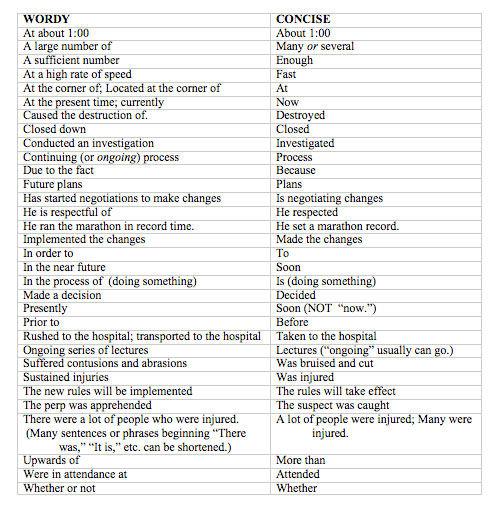

Nice and handy list, one that should make one the master of Twitter! Brevity is a welcome feature. Some phrasings, however, are a matter of degree rather than of the event per se. For example, "Taken to the hospital" certainly lacks the force and sense of exigency of "Rushed to the hospital".
#1 Posted by Kausik Datta, CJR on Wed 19 Jan 2011 at 06:51 PM
Editing one's own work can help eliminate unwanted repetition and needless words. I've been in the practice of doing this for a few years now. I write, then proofread, musings, emails, blog comments, etc. Doing this can help one catch overused phrases and extra words that actually create confusion. In short, paring down creates clarity.
#2 Posted by Bill Walker, CJR on Thu 20 Jan 2011 at 11:13 AM
Duh! A lot of the 'shorter' expressions suggested have the exact same number of words as the 'longer' expressions. 'Made the changes' doesn't contain fewer words than 'implemented the changes' . In fact, one could make an argument for the use of a wider vocabulary...
#3 Posted by Lia, CJR on Sat 12 Feb 2011 at 08:31 AM
Want to shorten about a million sentences a day on TV, in print, and on the Internet? Teach people that "exact" and "same" don't need to go together: they have the same (the exact same) meaning.
One of the commenters wrote:
Duh! A lot of the 'shorter' expressions suggested have the exact same number of words as the 'longer' expressions.
Duh!
#4 Posted by Eddie, CJR on Thu 17 Feb 2011 at 03:06 PM
you can do without "different" in phrases like "five different times."
#5 Posted by sandyb, CJR on Wed 23 Feb 2011 at 11:07 AM