Sign up for the daily CJR newsletter.
Journalism is at a uniquely vulnerable point in its history. To name just a few of the concerns on the horizon, media workers are staring down corporate consolidation, Donald Trump is waging direct attacks on press freedom, content creators on TikTok and YouTube are cluttering the information ecosystem, and, of course, there’s the specter of artificial intelligence—which threatens to topple the business model, if not render news publishing obsolete. Change can be scary, but it can also bring new opportunities for journalists—and every outlet is now trying to adapt.
But how? The common sentiment seems to be that what the media industry looks like by 2050 may well be unrecognizable to the people working in the field today. This fall, CJR asked newsroom leaders, independent journalists, and international reporters how they see the media changing in the next twenty-five years. Their answers describe upheavals to come in both the business and practice of journalism.
The journalists we spoke to are not soothsayers; their eyes are trained to see the world as it is now. But clarity of vision in the present can tell us much about what’s to come. Some refrains came up again and again: the dominance of a few outlets and the demise of the rest; the need for journalists to mix seamlessly into online content; the risks and rewards of AI. Emma Tucker, the editor in chief of the Wall Street Journal, predicts that “big brands” such as the Journal and the New York Times will still be around in 2050. Not so much for CNN, ABC, CBS, and other news networks, says Ben Smith, the editor in chief of Semafor. According to David Remnick, the editor of The New Yorker, “X will be gone.” And Taylor Lorenz, the founder of User Mag, wonders whether journalism as we know it now will survive at all. (She hopes so.)
Some of the journalists we spoke to think the integration of AI into journalism is inevitable, or beneficial; Dave Jorgenson, a cofounder of a startup called Local News International, thinks that AI might make a smaller splash, more akin to the arrival of email. Everyone agrees that if it is to survive, journalism will need a human touch. In any case, Kara Swisher, the New York magazine contributor and podcaster, says, one thing’s for sure: by 2050, we’ll be blasted with information all the time from the multitude of screens floating in front of our faces. Which, actually, is not too far off from the present. These responses have been edited for length and clarity. —Camille Bromley
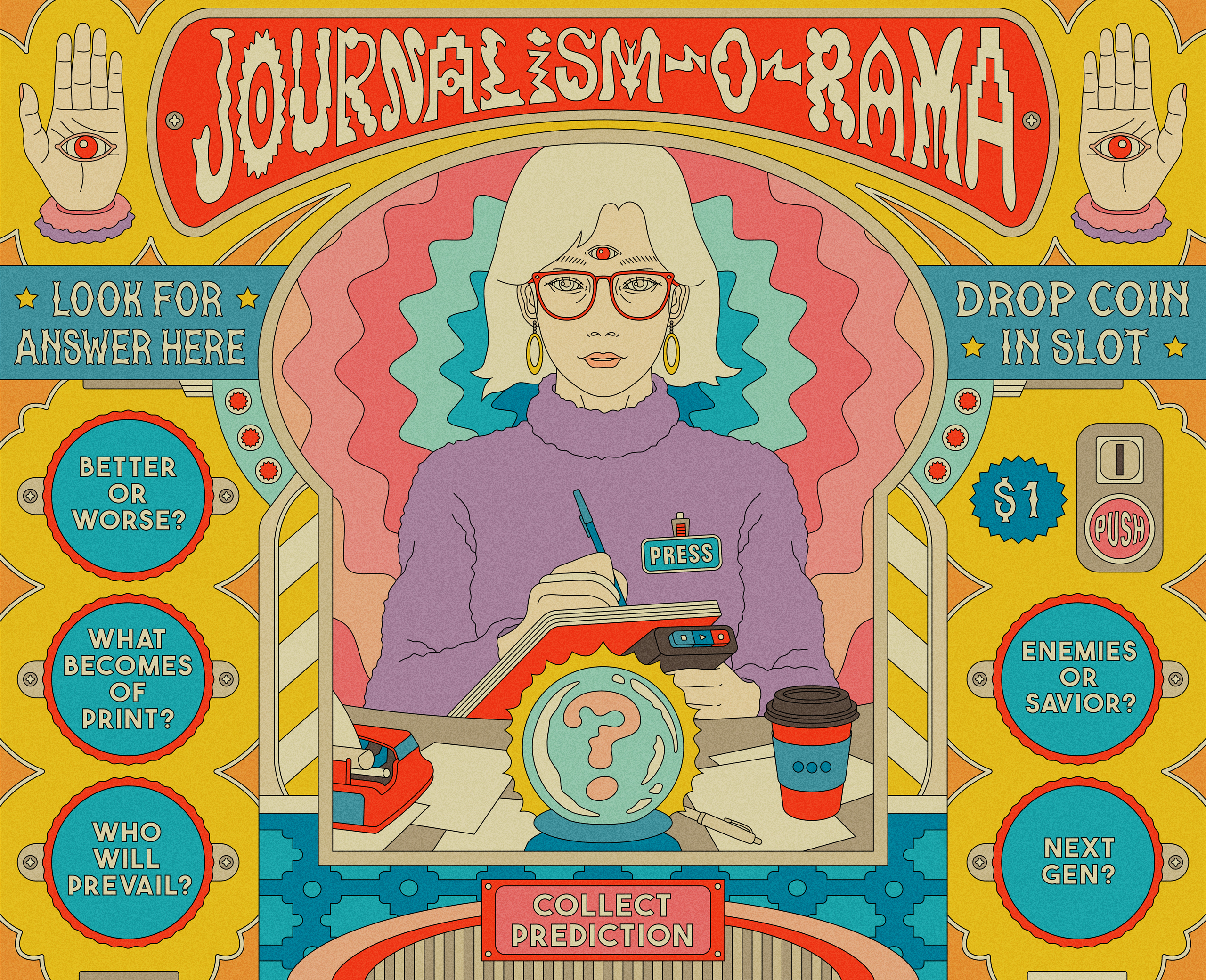
 Illustration by Kendra Ahimsa
Esther Wang
Cofounder, Hell GateI’m assuming we’ll all get news via the chip implanted in our brains. But the question of who will be providing that news is a good one. I would like to think that, twenty-five years from now, our state and local governments will have realized the value of all the small local outlets that exist in towns across our country that provide a really important service to local communities. My hope is that we’ll be funding local news robustly and there will be public funding.
We’ve seen local outlets shutter, and the winnowing down of local news by private equity. To me that is the biggest crisis in news. Not to mention AI and the ways corporate executives want journalists to be using that these days, in some cases to replace real people and real reporting. So we’ll need robust efforts to combat this. I’m hoping that will be in place by 2050 and we’ll have a vibrant ecosystem of not just worker-owned outlets, but also nonprofits and locally owned ones. As for the worst-case scenario, I think we’re already kind of living in it.
Ben Smith
Editor in Chief, SemaforMost of the big names will be around. The New York Times will still be around. The Wall Street Journal will still be around. The Washington Post will still be around. Some of these brands have actually proven more enduring than anybody expected—like, Newsweek is somehow still around, in this slightly zombified form. One of the things we’ve realized through the digital transition is that brands that reach a certain altitude are pretty hard to kill.
I’m not sure that’s true of television brands. It’s pretty existential for television news networks. In a video space that’s a total free-for-all, and is totally dominated by personalities, it’s not totally clear to me what the point is of a three-letter network brand. I think ABC, CNN, CBS all are really going to have to figure out why they exist.
There’s an old line about media that there are only two things that happen: bundling and unbundling. In twenty-five years, there’s enough time for three more swings of the pendulum. Right now, we are past the peak of fragmentation and headed back into kind of a roll-up cycle where everybody’s buying podcasts and Substacks and things are rebundling. There are too many streaming services, and they’re rebundling, and Substack’s going to start offering you a bundled price. Everybody’s trying to figure out what they’re going to be: a bundler or bundlee. But twenty-five years gives you enough time to fragment, rebundle, fragment, and rebundle again. So I assume in 2050 somebody’s gonna be bundling holograms or something.
Emma Tucker
Editor in Chief, Wall Street JournalI think the big brands that are well known today will still be around in 2050, and each territory will have one or two names that remain. So, in the US, it’ll be the New York Times and the Wall Street Journal and probably a big network that will have reinvented themselves. In the United Kingdom, the BBC and one other big brand, possibly The Times. It’ll be a kind of winner-takes-all scenario. Alongside that, however, you’ll have a much more diversified news ecosystem comprising the sorts of things we’re beginning to see now: individual newsletters, hyper-specialized publications. And we’ll still have local media, but it won’t be the general local newspaper bundles of yesteryear.
The big brands that succeed will be the ones that really understand their audiences. They will also have a really solid business plan and will need to know how to monetize content—because if you haven’t got that, it’s hard creating a news product people are willing to pay for. It’s not the same as entertainment, for example. And the third thing is never, ever ceding on trust.
One thing that we’re likely to see is a much more direct relationship between journalists and their audiences. News was pretty generic, even until quite recently. You could google a story, and you wouldn’t even look to see who was doing it. But, in the future, it’ll matter much more to people where that news comes from. Audiences will continue to demand more from journalists. It won’t be enough to just report something. You’ll have to be an expert in your field, and also build connections with audiences. The relationship will be much more conversational.
Katie Drummond
Global Editorial Director, WiredI believe fundamentally that what will still be around in twenty-five years is human-generated journalism, whether it’s text or audio or video. Journalism generated by people, created by people for people, will still be around, and it will be around in a much more robust way than it is even today, as audiences get really tired of all of the AI-generated content that is flooding the internet already and that will, I think, continue to proliferate in the next few years.
I actually think that we will see a rebound of human-led journalism and human-led writing and work. Maybe that’s optimistic and utopian of me. Publications now that really lean into human-led work will be around and will be thriving. Publications that are leaning into AI as a solution for their journalism will not. Whether it’s AI-generated podcasts or AI-generated articles, I do not think that there is an appetite among audiences for that kind of work, and neither is there a sustainable business model.
 Illustration by Kendra Ahimsa
Don Lemon
Former CNN anchor, now host of The Don Lemon Show on YouTubeI am of the belief that legacy media aren’t as sober as they should be about the decline of legacy media. It’s going to hang on, but it’s only hanging on because of the corporate involvement. These companies have so much money that they can pour into it, but they will tire of doing that, and so they’ll jettison and then sell the journalistic parts.
I see it coming to people like me. And to people like even some influencers. I’m in a weird position, because I’m in the streaming space, not quite a podcast or not quite an influencer, but still a journalist, but independent.
Part of the problem now is that we don’t have a shared sense of reality and of what a fact is. I don’t know if we should be expanding the definition of what a journalist is, but I do think that the tent is big enough for many people to have influence, whether you want to call that an influencer or not. But someone has to do the investigative reporting. Someone has to do the shoe-leather reporting. Someone has to be a local beat reporter.
David Remnick
Editor, The New YorkerThere are all kinds of reasons to think that a lot will be lost or wiped out in a tsunami that started some time ago. But I’m an optimist in the sense that I think that things of great value that have an audience, particularly an audience willing to pay for them, will find ways to survive. And I include in those The New Yorker. I have a hard time believing that the New York Times or the Wall Street Journal, or even the now troubled Washington Post, will somehow vanish into thin air.
I look at my own personal experience. I’ve been the editor of The New Yorker for a while, and when I began, we were a weekly magazine in print that published a dozen things and some gag cartoons and a cover, and that’s what The New Yorker did. Now we are that—and a website and social media and video and any number of podcasts and a daily report online, and there’s no end to the possibilities. The critical thing is to maintain your values and sense of mission and sense of purpose, and not let it be overwhelmed by every last permutation of technology that comes down the pike. And so I don’t know where we’ll be in 2050, but what I want, and what I would insist on, is that our values of fairness and accuracy and depth and delight and much more are at the center of what we do.
I think X will be gone. I don’t think its trajectory is promising. But it’s owned by the richest man in the globe, who can prop it up as long as he wants, I suppose. It is really fascinating to see the complicated and negative direction it’s taken. There was a period when, if you wanted to see what the “conversation” was at a given moment, you would tune in to Twitter, right? And it was not all good, to say the least, but it was a damn sight different than what it is now.
 Illustration by Kendra Ahimsa
Kara Swisher
Contributing editor at New York and host of the podcast On with Kara SwisherI’ll probably be dead, or retired at the very least. But there will be fewer corporate news organizations and many more independent ones. Probably, you’ll be consuming news through some sort of visual device—glasses or something in front of your face—and the news will be specifically tailored to you and your concerns. It might have a humanlike interface, talking to you about things as you ask about them. The broadcast networks will be gone, and people will get news on demand in a much more significant way.
You probably won’t have physical newspapers. There will be some sort of flexible device that you’ll get your news on. That’s been thought about for years, but it’s a great idea, sort of like what they have in Harry Potter. It’ll change as the news changes. I suspect screens will be everything, and everywhere. And there will be screens that aren’t actually screens, too. They’ll just appear in the air, but won’t be attached to anything.
 Illustration by Kendra Ahimsa
Patricia Campos Mello
Reporter-at-Large, Folha de São PauloMy sense is that investigative journalism will survive. What we’re seeing now is that everywhere in newsrooms, repetitive tasks are being replaced with AI, which is not a bad thing. I use AI for several things: translation, summarizing, transcribing. There isn’t much of a point in resisting that. But I think it’s interesting when people say that journalism is going to be replaced with AI, because where is it going to get accurate information to train these models?
A few months ago, a journalist at The Verge asked Google what she should do to keep cheese from falling off a slice of pizza, and the AI overview told her to use nontoxic glue. Google was just scraping information from Reddit because it was free and open, and that’s the perfect example of this: if you have low-quality information, you’re going to be eating pizza with glue. So when you’re thinking about the future of journalism, there’s still a basic need to have quality information, accurate information—and there’s a need to have the journalistic process to get to this information.
Taylor Lorenz
Founder of User MagA lot of traditional media will be gone. Most legacy organizations that we know today will have long gone out of business. The New York Times will be around. I don’t think the others are relevant brands. The businesses are not set up to survive—they’re just going to be these dinosaur companies that don’t exist.
We’ll be getting most of our information from personally tailored AI systems. We’ll probably be receiving information in lots of different new ways and formats. I’ve been around long enough and reported on tech long enough to know the dominant platforms of today are almost never the dominant platforms of ten years from now.
I hope journalism will still be around, but I’m not sure. Certainly the concept of journalism we have today probably won’t be around, in the sense that a lot of the old-school legacy mindsets about journalism will have been totally obliterated. People will still want information, and there will be a great desire for news. I don’t think that the concept of people investigating wrongdoing will go away completely. But the forms that it might take are not the same as what we see now.
 Illustration by Kendra Ahimsa
Dave Jorgenson
Cofounder, Local News International, and former face of the Washington Post’s TikTok and YouTube accountsRight now there’s almost a panic or confusion around how much legacy media is going to exist. And we’re already seeing that there are places like the New York Times that are doing a really good job of diversifying what they have to offer. So I think we’re going to see a lot more of that, and there’s going to be far more legacy media around than you might expect. Everyone at this point seems to realize they need to adapt. But are they able to do it?
My former employer, the Washington Post, and other places are correctly going, “Okay, let’s bring in a creator hub. Let’s try to meet people where they are.” But that’s the first step. The second step is actually making stuff that aligns both with the organization and the audiences that are watching it.
Everyone is bought into AI, and that’s okay, but how much is it helping? I wonder how much of it will be a tool versus the tool. When email came around, it was like, “Wow, this is a big thing, and we’re all going to use it.” And that’s true; we all use email every day. But it hasn’t totally consumed everything else. It’s just helpful to have around.
Alissa Quart
Executive Director, Economic Hardship Reporting ProjectWhen we look at what’s happening to CBS and the Washington Post, and with Bari Weiss and let’s just say veering away from traditionalistic norms, it becomes more obvious that we need reliable media. One of the things I keep thinking is that hopefully disinformation will burn itself out and readers and viewers will eventually learn they’re eating empty calories, sort of like discovering smoking was bad for you, or driving without a seat belt. And AI creations will start to have health warnings on them.
My fear is AI will concentrate ownership power and largely destroy the middle class outside of certain medical tasks. But we should look to the Writers Guild of America bargaining agreement, and some of the other non-journalistic guardrails we’ve seen, which stipulate that AI is not a writer, that studios cannot use AI-generated material to pay writers a lower fee. This is what you get when you have a strong union. And I’m not just talking about unions but also labor consortiums and other forms of collective action of the media—which, to me, isn’t really happening right now. It’s hard, partially because we’re so depleted by our own economic situation and technology, but also by AI itself and basically from being thieved all these years. We’re used to competing. That’s kind of the journalistic ethos.
Moussa Ngom
Coordinator of the independent, publicly funded investigative media network La Maison des ReportersI think that what will remain in 2050 is a journalist’s personal touch: their ability to communicate emotions, prioritize one news story over another, and identify the most appropriate angle for the subject. What will no longer exist are the manual tasks of data aggregation and analysis. Also: straightforward reporting on events, and journalists who refuse to incorporate AI in a reasonable way into their work. Radio programs and television broadcasts will give way to content on demand. Traditional journalism school programs that separate media into categories like text, video, and audio will disappear, and in their place Web journalism programs that are versatile by necessity will emerge.
This piece is part of Journalism 2050, a project from the Columbia Journalism Review and the Tow Center for Digital Journalism, with support from the Patrick J. McGovern Foundation.
Has America ever needed a media defender more than now? Help us by joining CJR today.