Sign up for the daily CJR newsletter.
Uninhibited, Robust, and Wide-Open: A Free Press for a New Century | By Lee C. Bollinger | Oxford University Press, 224 pages, $22.95
It is a good day when a leading university president takes the time to write a book lauding the First Amendment. It’s an even better day when that president is Columbia’s Lee Bollinger, and the driving thesis of the book is that the First Amendment will play a key role in the future exchange of global information.
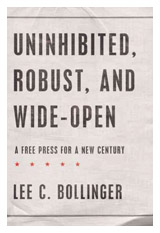 In Uninhibited, Robust, and Wide-Open, Bollinger reminds us that even though press freedoms are threatened by both political and economic forces, there is still a world of possibility created by technological advances. We are interconnected like never before. For information, at least, geographic borders are irrelevant. That means that free-press values—not to mention global protections for all journalists—can and should travel freely.
The first half of the book makes a case for why First Amendment values are worthy of being exported. In that sense, it is an admirable primer on the development of First Amendment law in this country over the last century. Bollinger begins with America’s longstanding aversion to government censorship, which has traditionally made our system the envy of journalists around the world. He outlines the laws that gave the press the right to invade private subjects, as long as the information disclosed was for the public good, or contained in public documents. The book surveys such related topics as the right of all citizens to attend trials, and the ability to hold the government accountable through our freedom of information laws. Bollinger also takes us through the regulatory schemes that control radio and television, rightly questioning the differing standards applied to these media.
It is, however, our libel and state secret laws that most interest the author in terms of his larger thesis.
For Bollinger, New York Times Co. v. Sullivan is perhaps the most important Supreme Court decision of the modern era. This libel case, he suggests, “articulated the central rationale for–and the spirit of–the First Amendment.” It came before the Supreme Court in 1964, at the height of racial tensions in the South. Four years prior, the Times had published an advertisement that sought to raise funds for the legal defense of Martin Luther King, Jr. In describing the brutal behavior of police officers during student protests in Montgomery, Ala., the ad included several errors. The city’s police commissioner asked the paper to retract the ad—and when this request was not met, he filed suit and was awarded $500,000 in damages by an Alabama court.
When the case reached the Supreme Court, it was Justice William J. Brennan Jr., the single most important voice on First Amendment issues in the second half of the century, who wrote the opinion. Any errors by the press, he held, had to be considered against the backdrop of a national commitment to First Amendment values. Only in this way could we ensure that debate on public issues, especially those involving the government, would remain “uninhibited, robust and wide-open.” Tracing the history of American free speech back to 1801, Brennan raised the standard for actionable libel and erected a new bulwark of constitutional protections for the press.
As Bollinger sees it, Brennan’s reasoning in Sullivan led directly to the court’s decision in the Pentagon Papers case. In this 1971 case (which also involved The New York Times), the court concluded that there could be no stopping a news organization from publishing government secrets, even in wartime. Open debate was critical, unless the government could show actual harm to U.S. troops.
Many scholars have plumbed these landmark cases. What makes Bollinger inspiring is his effort to apply our national experience with the First Amendment to the international arena. Should we consider government funding as a way to sustain quality international newsgathering? Anticipating objections, the author is quick to remind readers that the BBC is funded to the tune of $4 billion annually, through a tax imposed on the sale of each television set in Great Britain. Few would argue that public funding has made the BBC anything but a first-class organization—indeed, one of the leading news institutions in the world.
Imagine if the U.S. had an equivalent institution. Such an enterprise would have enormous scope, and could embody the best of our First Amendment principles. Bollinger urges us not to be discouraged by our poor history of government-supported journalism (which has often been nothing but outright propaganda). A bad track record need not be a blueprint for the future, he insists, nor a deterrent to using our public funds to expand such initiatives as National Public Radio overseas.
If there is a weakness in this book, it is how the theoretical can be linked to the practical. The concept of press freedom is hard to separate from the means of production and distribution. And as we know, the business model at most American media companies has been moving away from national or international reporting, and toward a local or even hyper-local approach. The wisdom of this model remains to be seen—but it is less than hospitable toward the ideas of an internationalist like Bollinger. He does, of course, acknowledge the severity of the economic freefall. Yet he does not explore fully the way in which the crisis stymies the advancement of press freedoms in the U.S., let alone the rest of the world.
Meanwhile, few leaders in the U.S. newspaper or broadcast industries today are focused on press rights. Even The New York Times, a key player in both of the landmark cases discussed by Bollinger, is not leading the charge for the First Amendment. Instead, the paper is fighting simply to survive.
In fact, the retreat of First Amendment values in this country over the last decade is undermining the very institution that Bollinger has pegged for a global platform. The press is under siege. For example, in what has become known as the BALCO case, two Hearst reporters from the San Francisco Chronicle wrote 425 articles chronicling the prevalence of steroids and other performance-enhancing drugs in professional baseball. When they refused to reveal the identities of several dozen confidential sources to federal prosecutors, they were each sentenced to eighteen months in prison. Ultimately our legal team at Hearst won the case and kept the reporters out of jail. Still, such incidents make it harder to sell the U.S. as a role model abroad.
Bollinger, meanwhile, is confident that the principles of free speech enshrined in the First Amendment have the inherent ability to influence the course of global events. Indeed, several countries are showing a willingness to reflect free speech principles after years of shunning them. In Canada, for example, the Supreme Court recently held in two libel cases that journalists are not liable if their stories, whether true or false, are in the public interest. This ruling changed decades of Canadian law that protected government officials and powerful public figures from criticism. And last month, the European Court upheld the right of British journalists to protect their confidential sources when reporting on matters of public concern. The same court is scheduled to consider a similar request regarding Dutch journalists next month.
Notwithstanding the complexities on the world stage and the shrinkage of First Amendment protections in the U.S., Bollinger’s concept of universal press freedoms is worth considering. Perhaps there should be a First Amendment ombudsman at the White House or the Department of Justice.
In addition, law schools and journalism schools should join forces to provide actual representation overseas to journalists in distress. Local attorneys will always be the first line of defense for embattled journalists, but an international cadre of press lawyers could assist in making the broader, principled arguments that Bollinger suggests. Such interventions have the potential to make a real difference. In 1995, I represented a Khmer journalist in Phnom Penh who was charged with seditious libel. My physical presence, as well as an articulation of First Amendment principles, helped win the day in a Cambodian court during a time of political turmoil.
Bollinger urges the U.S. to apply pressure on behalf of free speech in every possible venue. We should use the Universal Declaration of Human Rights and other such treaties that have free speech requirements and are customary international law. We should use world courts. We should also, the author suggests, require free speech values to be part of our international trade discussions. How can we change things internationally if we cannot assure the survival of our own journalistic culture, or rely on our own courts to protect the values we cherish? The answer is that we must. Bollinger is right.
Click here for a complete Page Views archive.
Has America ever needed a media defender more than now? Help us by joining CJR today.