Sign up for the daily CJR newsletter.
Ever since Donald Trump thudded onto the national political stage, the press has had a difficult time handling the frequency, magnitude, and outlandishness of his lies. Trump lies to bolster his ego, to protect his business interests, to tear down his adversaries, and to burnish his political record (“Two years ago, our country was dead. Now we are the hottest country anywhere in the world”). Sometimes he seems to lie just for the hell of it, like when he claimed last year that the White House must mandate the return of plastic straws because paper straws sometimes “explode.” Too often, especially during Trump’s first term, the press let itself be hijacked as a megaphone for his bogus narratives and false information.
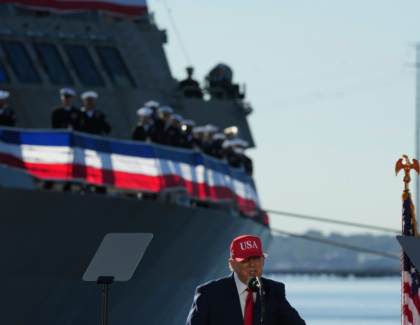
Over the past decade, though, many news organizations have learned to avoid uncritically giving statements—from Trump and other media manipulators—the “oxygen of amplification,” to use a term deployed by internet researchers. That lesson was in evidence on July 16, when the White House formally asked broadcast networks to air a prime-time speech by the president. That evening, Trump walked up to a podium in the East Room of the White House—his tone grave as he read from a teleprompter to the senior administration officials seated before him—and tried to sow doubt, with false and exaggerated claims, in the integrity of US elections ahead of this year’s midterms.
Earlier that day, network executives had been “locked in hours-long meetings about how to handle the address,” CNN’s Brian Stelter reported. To their credit, NBC, ABC, and CNN did not air the full speech live. (Trump lashed out at the media for being “part of a plot,” name-checking NBC and ABC, and threatened to revoke broadcast licenses. Private Eye, the British magazine, wrote that, “if they are, it is a plot to shield innocent Americans from meandering drivel.”) Most news websites and broadcasters critically analyzed Trump’s weak allegations that US elections have been “left vulnerable to being rigged and stolen.” On the New York Times site, a few hours later, the speech was relegated to the fifth-highest story—an analysis with the headline “A Trump Obsession That Carries a Cost for Democracy”—in which Peter Baker wrote that the address was “an astonishing spectacle featuring a president intent on persuading the country that its elections cannot be trusted, at least not the ones where he or his allies fall short.” The Wall Street Journal and Washington Post, similarly, framed Trump’s speech as an “effort to sow doubt” and as having stopped “short of offering evidence” of vote tampering, respectively. Other newsrooms followed suit. Some, such as CBS News, went with fact-checking; CNN published annotated transcripts of the speech, while The Guardian used the address as a peg to report on how Trump could undermine American elections—and challenge results he disfavors.
One thing that did disappoint me about that coverage was an article from the BBC, which Trump is personally suing for its editing of a speech he gave on January 6, 2021. “Trump alleges ‘shocking vulnerabilities’ in US election security ahead of midterms,” a BBC News headline went, seeming to take Trump’s spurious claims at face value. (The headline appears to have since been changed online, to “Trump alleges China meddled in 2020 election and questions voting security ahead of midterms,” which has the same problem.) Overall, though, I was glad that most outlets—outside the MAGA sphere, at least—stopped Trump’s counterfeit claims from spreading unchallenged. Even Fox News, which rarely questions his version of events, raised an eyebrow. “Fox News has not seen that documentation yet and is not in a position to assess the accuracy of the president’s statements tonight,” Bret Baier, its chief political anchor, told viewers.
The thoughtfulness with which the press handled the July 16 speech was worlds apart from the farcical spectacle of the White House Correspondents’ Association (WHCA) dinner. A lot of ink has already been spilled about the dinner, the first iteration of which, in April, was interrupted by gun violence. It is a Beltway fixture that, in normal times, gives many people in the media a sickening feeling; the New Republic has described it as “rotten to the core,” and Times journalists have not attended as guests since 2007 because of its odor of chumminess. In our current moment, the dinner feels especially incoherent and misguided—seven hundred journalists, dressed in their finest clothes, agreeing to break bread and drink wine with administration figures who are aggressively and systematically cracking down on journalism and free speech. (For a full look at the WHCA, check out Liz Skalka’s profile of the organization for CJR’s Access Issue.) This month, CJR’s Susie Banikarim wrote that the organization’s role is “not to preserve access to the administration at all costs,” and concluded that the decision to forge ahead with a dinner—meant to celebrate the First Amendment—in the wake of this month’s alarming retaliatory subpoenas of multiple Times journalists “seems particularly egregious.”
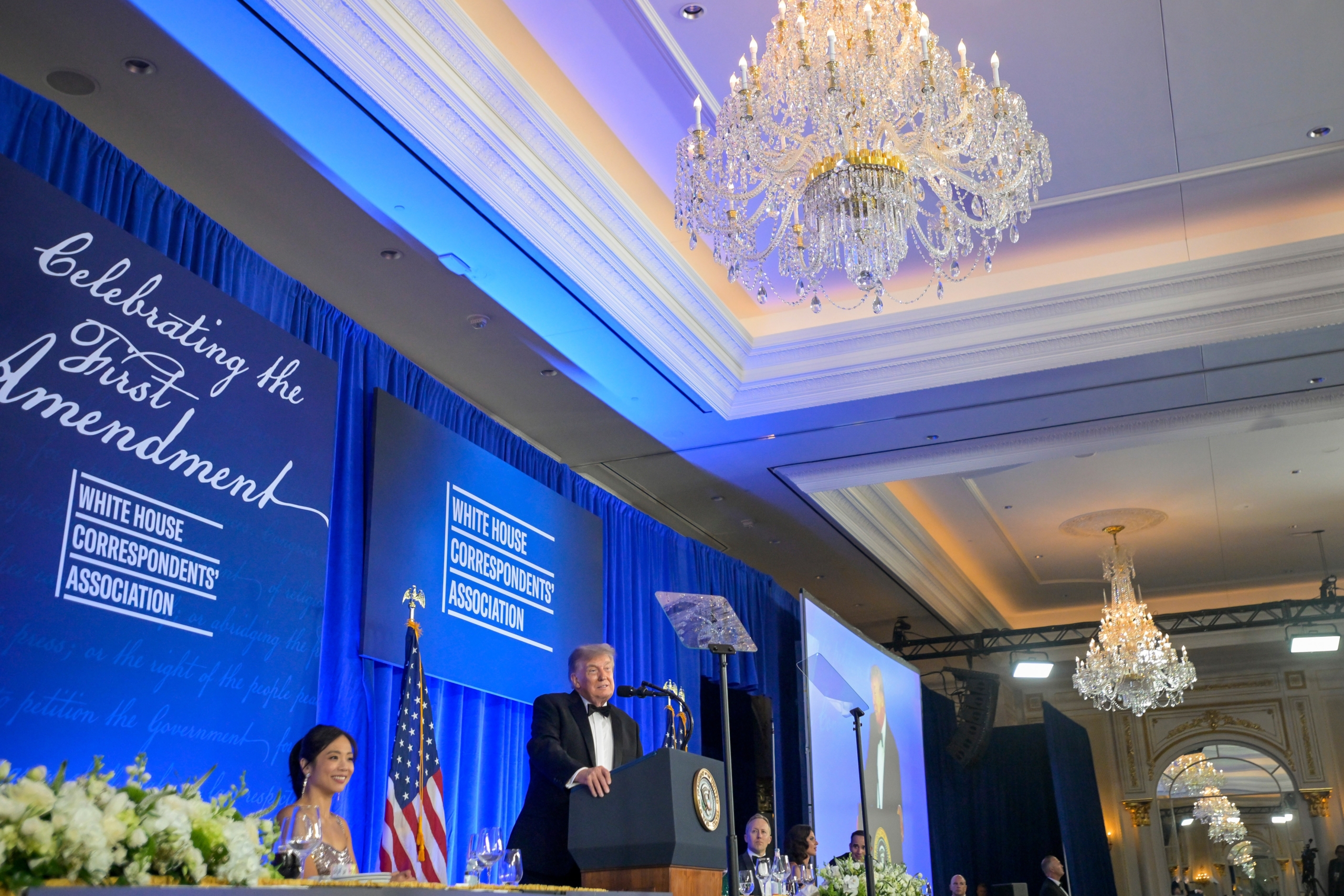
On Friday, the WHCA staged a redo, this time at Washington’s Waldorf Astoria. Once guests shuffled into the hall and took their seats, Trump was forced to endure an awards ceremony that celebrated journalists for critical reporting on him and his administration. Kaitlan Collins, of CNN, and Josh Dawsey, of the Journal, were lauded for their White House coverage, as was a team at the Journal who reported on Trump’s relationship with Jeffrey Epstein. “Trump quickly filed a twenty-billion-dollar lawsuit against the Journal, revealing reporter Khadeeja Safdar’s home address,” CNN’s Wolf Blitzer said as he presented the award. Trump threw up his arms and grinned. That got a tepid laugh. “Her family had to be relocated,” Blitzer continued. Trump stood up to shake the winners’ hands. He also embraced the incoming WHCA president, Jacqui Heinrich, of Fox News.
When it was his turn to speak, Trump joked, “This has not been an easy evening, all these awards.” In the course of more than an hour, Trump mocked the “fake news media.” He said the event was “the largest group of Trump derangement syndrome people ever put together at one time.” He flung personal attacks at journalists and others, including Dawsey and Collins. The crowd fell into an awkward silence. People exchanged glances. It was an embarrassment. No one, though, appeared to walk out in protest.
When I watched these painful scenes play out, it was impossible not to wonder: What exactly did the White House Correspondents’ Association expect? “After months of insisting the dinner was worth reviving in the name of the First Amendment and civil discourse, the Weijia Jiang–led organization instead handed Trump a nationally televised platform to demean the very journalists it exists to represent,” Jon Passantino wrote for Status. “Far from showcasing the importance of a free press,” the evening “left the association looking naive.”
Jiang, who is the senior White House correspondent for CBS News, told Skalka that, “while we have an advocacy role for our members, we also have a diplomatic role. When I became president, last July, my goal was to restore and normalize the relationship with the White House. We have to have a functioning relationship so that our members can do their jobs.” Is this what “functioning” looks like? After the dinner, when Politico’s Dasha Burns asked Trump by text how the event went, he reportedly said: “GREAT!”
Two speeches: one handled with care, the other a total mess. It remains a mystery to me why this assortment of White House journalists agreed to play the role of passive targets in Trump’s crude performance. (A desire for glitz? An inability to resist feeling close to power? A misplaced belief that the president and the press could put aside their daily hostilities?) But perhaps something positive can come from this absurd evening. Trump said he planned to attend next year’s event, teeing up another embarrassment. A proposal: Why not make 2026 the last White House correspondents’ dinner of all, and banish that sickening feeling for good?
Other Notable Stories …
By Jem Bartholomew
- On Thursday, the Justice Department withdrew subpoenas that sought grand jury testimony and phone records from a team of New York Times journalists, in an alarming case that I recently wrote about for CJR. The subpoenas came in response to an article in which the Times reported on security concerns about a plane donated by Qatar and used by Trump as Air Force One. According to the Times, at a hearing on Thursday, Judge Arun Subramanian of the US District Court for the Southern District of New York grilled prosecutors for almost an hour, and said: “Either we can quash the subpoenas, or you could withdraw the subpoenas.” David McCraw, the Times newsroom lawyer, said in a statement: “We are pleased that the government finally conceded that the subpoenas violated the law, but they should never have been issued in the first place.” One of the subpoenaed reporters, Tyler Pager, was honored at the WHCA dinner while Trump looked on.
- A federal judge on Monday ordered that Paramount Skydance’s 110-billion-dollar takeover of Warner Bros. Discovery be paused after a group of state attorneys general argued the deal would unlawfully decrease competition. Later in the week, Paramount reached an agreement with the state AGs to postpone the merger until June 1, 2027, or five days after an antitrust trial is complete, whichever comes first, Variety reports. No trial date has been set yet. For more on the chances of stopping the merger, see Amos Barshad’s piece for CJR.
- In June, Riddhi Setty, a Delacorte fellow at CJR, visited a Midtown Manhattan office building. She had been trying to lift the veil on a mysterious media company linked, according to sources she interviewed, to around forty thousand dollars in unpaid compensation owed to freelance contributors as of December of last year. Her visit led to a police report being filed against her, legal threats, and nonsensical attacks on her journalistic credibility. As she followed the trail, things got increasingly bizarre. “The whole winding tale is worth your time,” and is “a display of journalism’s often trying, essentially human work,” Betsy Morais, editor in chief of CJR, wrote on Saturday.
- Cecilia Vega, a former correspondent for 60 Minutes who was fired in May, spoke out about her final months in the newsroom under Bari Weiss, the editor in chief of CBS News, at the National Association of Hispanic Journalists (NAHJ) Conference & Expo on Thursday, Oliver Darcy reports for Status. “Vega detailed three instances in which she said management attempted to interfere with her stories,” Darcy writes, citing “an onstage interview with ABC News correspondent John Quiñones, of which Status obtained an audio recording.” Vega joins other former 60 Minutes correspondents who have made similar accusations—including Scott Pelley, who said Weiss put “a thumb on the scale on behalf of the administration”—which I wrote about for CJR in June.
- Outlets including Wired, the Wall Street Journal, and NJ.com are setting personal subscriber renewal prices based on algorithms, according to a report from Nieman Lab’s Hanaa’ Tameez. Dynamic pricing is not illegal in the US unless it is “deployed deceptively, discriminates against protected classes, or violates antitrust laws,” Tameez notes. A lawyer from Clarkson Law Firm, which has filed a class action lawsuit against the Washington Post alleging that it failed to disclose dynamic pricing, told Nieman Lab that “this kind of AI-driven price gouging gates essential information behind a paywall that moves simply depending on who you are. It undermines public trust in one of the core pillars of democracy.”
- And in the UK, law enforcement has been ordered to pay a former BBC journalist, Vincent Kearney, twenty thousand pounds (about twenty-seven thousand dollars) for illegally accessing his phone records. The Investigatory Powers Tribunal (IPT), an independent judicial body that oversees the UK intelligence services and other public bodies, ordered MI5, a domestic intelligence agency, and the Police Service of Northern Ireland (PSNI) to pay ten thousand pounds each in damages to Kearney after they subjected him to secret operations aimed at discovering who his confidential sources were. The surveillance took place between 2006 and 2014, while Kearney was reporting for the BBC in Belfast. Kearney and the BBC brought the case, which led to what is thought to be the first-ever ruling in which MI5 has been ordered to pay compensation to a journalist. “I am delighted the court has penalized those responsible for breaking the law,” Kearney said in a statement.
Has America ever needed a media defender more than now? Help us by joining CJR today.