Sign up for the daily CJR newsletter.
It was around 8:30pm on Saturday, a few minutes after President Donald Trump had taken his seat at the White House Correspondents’ Association dinner, at the Washington Hilton. Weijia Jiang, the WHCA’s president, welcomed the evening’s guests. Then a series of distant booms could be heard in the ballroom. They were followed by the rattle of falling cutlery and the music cutting out. “Shots fired!” someone shouted. Armed Secret Service agents appeared and began dragging Trump and his cabinet members to safety. “A sense of danger spread across the room like a wave,” Michael M. Grynbaum, of the New York Times, wrote. C-SPAN cameras, trembling slightly, captured guests starting to crouch under tables for cover, though at that moment, as appetizers were meant to be served in the ballroom, C-SPAN’s coverage had cut to a studio debate about Trump’s relationship with the press. “Just a second, we have an issue here at the head table,” Peter Slen, the host, said on air. “We understand that shots were fired here at the dinner, and, uh”—he let out a long sigh—“and we’ll find out what’s going on here shortly.”
This was, as soon became clear, another entry in the annals of American political violence. The suspect, a thirty-one-year-old guest at the hotel who was described by DC’s interim police chief as armed with a shotgun, handgun, and multiple knives, rushed a security checkpoint in the Hilton and ran toward the ballroom. He was apprehended by law enforcement personnel before getting close to the dining room, and will face federal charges today. No one was seriously hurt; a Secret Service officer was shot, Trump said later, but had been saved by a bulletproof vest. CNN’s Wolf Blitzer had been walking toward the ballroom as the blasts rang out. “When the cops saw me, only a few feet away from the shooter, they threw me to the ground and got on top of me to protect me,” he told CNN from the hotel later that night. “I think I heard at least three, maybe six gunshots—boom, boom, boom, boom.” The scene, Blitzer added, was “very frightening.”
Suddenly, hundreds of political journalists found themselves at the center of a crime scene, and began covering their own story on live blogs, social media, and on air. Megan Messerly, White House reporter for Politico, said she wandered around the ballroom barefoot (“heels are horrible for reporting”), interviewing people about their brush with an active shooter. “You know, what we do isn’t about a big, fancy dinner party. In some ways, what happened tonight is actually a much better reflection of what it is we do,” Jiang said on CBS News, where she is the senior White House correspondent. “I saw many reporters reporting live from in the room, and tweeting from in the room, and having no idea whether their lives were at stake, because they didn’t know if there was an ongoing threat. And that’s what reporters do, and that was on full display.”
She was right to note that many of them didn’t know exactly what was going on. (“It was so quick,” as Jiang put it on air.) In addition to scene reports based on correspondents’ firsthand experiences in the room, the initial coverage included misinformation, as people rushed to break news about their unfolding circumstances. At about 8:45pm, Kaitlan Collins, CNN’s chief White House correspondent, called from the dining hall, telling viewers: “Now, we do have Secret Service telling us—obviously I want to note this is only one Secret Service member—but a member of security is here telling us that there is a shooter who has been confirmed dead.” (Collins posted the same inaccurate information to her 1.3 million X followers at 9:15pm.) Shortly before 9, TMZ began reporting something similar: “A shooter was killed in the lobby at White House Correspondents’ Dinner,” it posted on Facebook to its ten million followers. That report, in turn, was picked up by other outlets, including Drop Site News. And CBS News reported live on air that “the gunman was apprehended and shot and killed.”
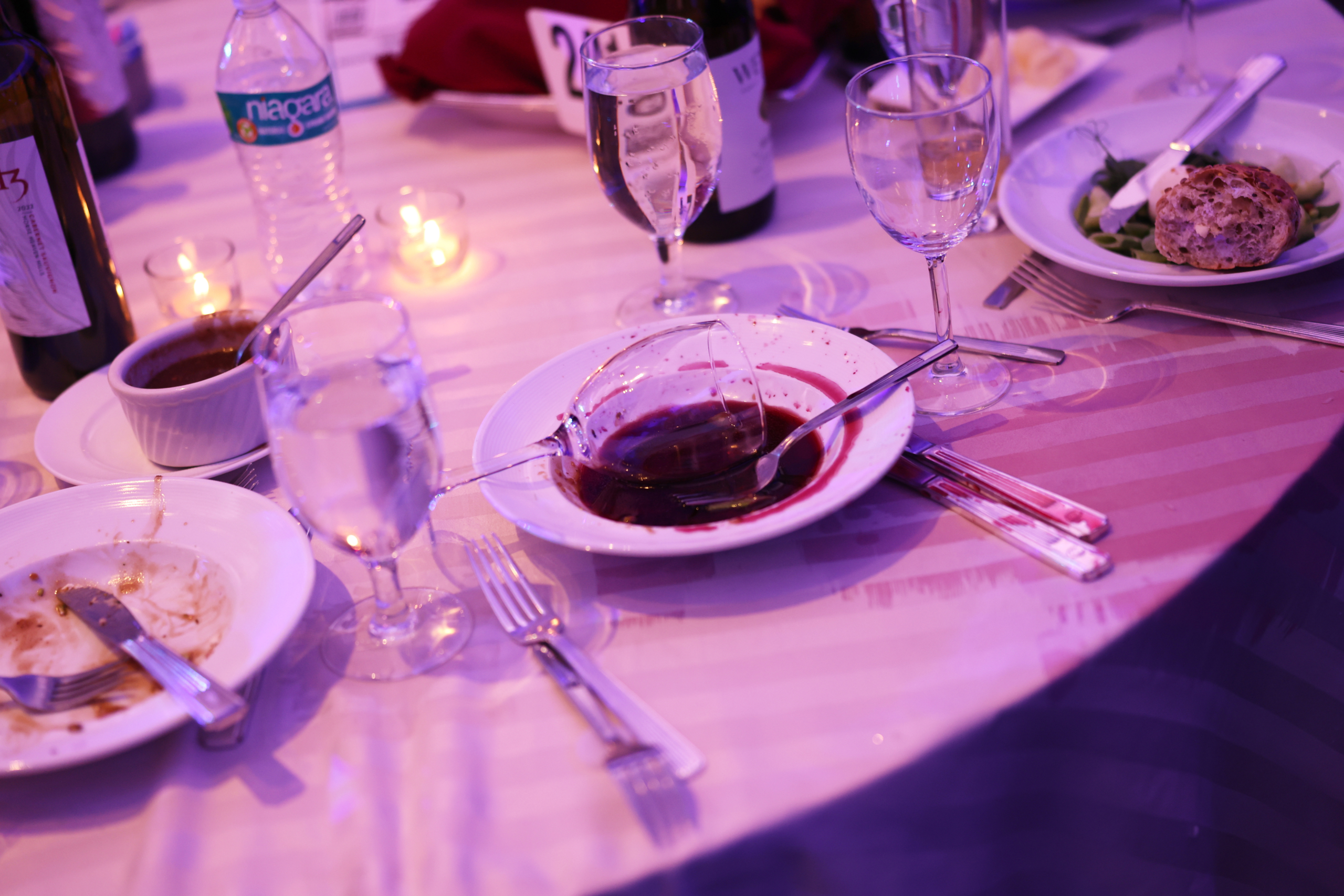
Was this an assassination attempt? A foiled mass shooting? An attack on the press? Around 10pm, as the ballroom emptied, hundreds of plates of half-eaten starters lay abandoned on tables. A half hour later, Trump posted images on Truth Social of the detained suspect with his face pushed into the carpet. Trump said that he’d tried, unsuccessfully, to persuade his security detail to “LET THE SHOW GO ON.” Instead, two hours after the gunfire, Trump took center stage at the White House, holding a news conference in his tux to a press corps in evening wear. He struck an uncharacteristically conciliatory note. “This was an event dedicated to freedom of speech, that was supposed to bring together members of both parties with members of the press, and in a certain way it did,” he said. “I saw a room that was just totally unified—it was in one way very beautiful, a very beautiful thing to see.” Jiang gave her take on CBS: “The White House Correspondents’ Association serves as the bridge between the White House press corps and the administration,” she noted, and credited Trump for being “quite reflective.” Cut to the next night on 60 Minutes, Trump speaking about the press: “I don’t know how long it’ll last,” he said, “the relationship, the friendship, the spirit after a very bad event took place.”
Leading up to the dinner, the media hype had billed the event—attended by Trump this weekend for the first time as president—as a glitzy showdown between the president and the media. Earlier this month, Darrin Gayles, a US district judge from the Southern District of Florida, threw out a defamation suit that Trump brought against the Wall Street Journal and its bosses, over a story on his apparent birthday letter to Jeffrey Epstein—the very same story the WHCA planned to honor with an award Saturday night. There was talk that anticipation of the dinner had hit a “fever pitch,” that uninvited insiders had “FOMO,” and that there was a “bigger scramble for tickets” than people could remember for the “Nerd Prom,” as the event is known. Administration officials mischievously fueled a showdown narrative: “I’m anticipating that the president is gonna put on a big performance,” Robert F. Kennedy Jr., the health secretary, told a reporter on the red carpet, “and probably offend some people in the press.” Some decided to skip the dinner, such as Don Lemon, Jim Acosta, and outlets including HuffPost and the Times, the latter of which sends reporters to cover the event but has not bought seats since 2007. (At the time, Frank Rich labeled guests “captive dress extras in a propaganda stunt.”)
Trump’s ongoing campaign of repeated, aggressive, escalating, and often unconstitutional attacks on journalists, whom he regularly blasts as “enemies of the people,” led to some complex feelings about how the night actually played out. As Jodie Ginsberg, the chief executive of the Committee to Protect Journalists (CPJ), put it on Sunday, “There were journalists in that room who have been kidnapped, wrongfully detained, and shot at. Journalists who have been violently arrested. Journalists who cover politics here in the United States who—along with their families—are subjected to daily death threats. Journalists who have been assaulted at protests and political rallies,” she wrote. “They, like me, know how much more dangerous it is to be a journalist in this current moment—in part, and this is where it’s so hard to untangle the emotions of the last 24 hours, because of the words and actions of the very individuals in power who may well have been the target of the attack.” A letter signed by the Society of Professional Journalists, the National Association of Black Journalists, and other groups called on the WHCA “to reaffirm, without equivocation, that freedom of the press is not a partisan issue” and that the association will “fight back against any officeholder who has waged systemic war against the journalists whose work the dinner celebrates.”
At the White House presser, Trump thanked the media for its “very responsible” coverage of the incident. He speculated about the suspect, about whom no motive had yet been ascertained, with typically flamboyant descriptions (“a lone-wolf whack-job” with a “distorted” brain). Later, reports emerged of a note, allegedly sent to family members ahead of the attack, in which the suspect wrote, “I experience rage thinking about everything this administration has done” and “I don’t expect forgiveness.” (On 60 Minutes, Trump attacked the media as “horrible people” when CBS correspondent Norah O’Donnell brought up that note.) On Saturday night, though, Trump had another message for the press corps: he announced his desire for a redo of the dinner within thirty days. He’d reportedly hired joke writers to roast the crowd, and was planning to “really rip it,” he said. But now “I don’t know if I can ever be as rough as I was gonna be tonight,” he told the room. “I think I’m gonna be probably very nice. I’ll be very boring the next time.” In the meantime, Jiang and her colleagues will be back in the press room, doing what it is they do.
Other Notable Stories …
- Last Monday, Kash Patel, the director of the FBI, filed a defamation lawsuit against The Atlantic and its reporter Sarah Fitzpatrick, alleging that a story published on April 17, which accused Patel of “conspicuous inebriation and unexplained absences” and cited “more than two dozen people,” had defamed him. The magazine said it intends to “vigorously defend” its reporting from a “meritless lawsuit.” (Before the WHCA dinner on Saturday, Politico reported that Patel’s dismissal was “only a matter of time.”) In related news, last week the New York Times reported that in March, the FBI started an investigation into Elizabeth Williamson, who reported for the Times on Patel’s girlfriend. (The FBI told the Times it was “concerned about how the aggressive reporting techniques crossed lines of stalking” but that “no further action” was taken.)
- On Wednesday, a “double-tap strike” by Israeli forces in Southern Lebanon killed five people, including Amal Khalil, a journalist for the newspaper Al Akhbar, in what the CPJ classified as a “murder”—which it defines as “a targeted killing, whether premeditated or spontaneous, in direct reprisal for the journalist’s work.” Khalil and another journalist—Zeinab Faraj, who survived—were on assignment when the air strike left them trapped under rubble. A week beforehand, Avichay Adraee, the Israel Defense Forces’ Arabic-language spokesperson, shared a post on X calling Khalil a “‘devil’ who is playing the role of the compassionate heart.”
- Ahmed Shihab-Eldin, an independent journalist arrested and detained in Kuwait on March 3, was acquitted of all charges on Thursday, according to the CPJ. Shihab-Eldin, an American-born Kuwaiti citizen of Palestinian descent who has worked with outlets such as PBS Frontline and the Times, was charged with “spreading false information, harming national security, and misusing his mobile phone.” Ginsberg, CPJ’s chief executive, said in a statement: “We are relieved that Ahmed Shihab-Eldin has been found innocent after 52 days in detention.”
- This week in job losses: The Financial Times is offering buyouts, according to the Times’ Ben Mullin; payouts will be determined by length of service, with a cap on individual payments of £120,000 ($162,000). Over at Condé Nast, a statement from the workers’ union claimed that sixteen job cuts at Self (which is closing), Glamour (whose international editions in Germany, Spain, and Mexico are ending), and Condé Nast Entertainment were “heartless” and “threaten to undermine the quality of the content.” The Condé Nast Union, part of the NewsGuild of New York, also said that recent layoffs are “disproportionately affecting our members of color as well as queer and trans members.”
- On Thursday, Warner Bros. Discovery said investors had voted to approve its 111-billion-dollar deal with Paramount, bringing the Ellison family’s takeover of a second major movie studio and global news network, CNN, one step closer. (Netflix pulled out of its bid for parts of Warner Bros. Discovery in February.) The decision comes as David Ellison—the chief executive of Paramount Skydance, which owns CBS News—reportedly held an intimate dinner on Thursday, attended by Trump, “honoring the Trump White House and CBS White House correspondents.”
- And Shelly Kittleson, an American freelance journalist kidnapped by a militia group on March 31 in Baghdad and held captive until April 7, wrote about her experience for The Atlantic. “I was in excruciating pain from what I later learned were several broken ribs, but I tried not to cry out; I had been told that I would be killed if I made any noise,” she wrote. Since she had arrived, in 2014, reporting on all facets of Iraqi society, “the respect I had earned had helped keep me safe before,” Kittleson wrote, “but it had not prevented this.” Kittleson was flown to Europe for medical treatment after her release. She said she intends, at some point, to return to Iraq, as there are many “important stories” there that “deserve the attention of experienced journalists who know the country well.”
Has America ever needed a media defender more than now? Help us by joining CJR today.