I’ve spent the past two months on the conference circuit. I spoke to groups of journalists in San Francisco, Boston, New York, and Alaska. And I’ll confess something to you: Even though I love working in media and mostly love the other people who do, too, it got to be really depressing. Question after question focused on limitations, ranging from “What if my editor doesn’t get it?” to “How are we going to pay for it all?”
There was the journalism professor who complained to me that his students won’t read more than 1,500 words at a time. The book publicist who declared she didn’t have time for Twitter. Young journalist after young journalist whose editors loved the Pulitzer Prize-winning, multimedia New York Times feature “Snowfall” but didn’t want to divert any resources to hire a programmer or two. I understand why all these journalists are worried and bummed out. I get it: Staff jobs are at a 30-year low, freelancing is tough, and there’s no one model, no silver bullet to solve what most people agree is a resources crisis.
But.
I’m in a minority of reporters and editors who are genuinely excited to be working at this moment in history and not in the past. Again and again, I found myself playing the role of cheerleader, trying to convince tired and broke journalists to get excited about the future of media. Here’s the case I’ve been trying to make:
—You have access to a world of sources. Sure, there were always a plethora of interview subjects out there. But it’s never been easier to find and reach out to anyone. Folks who were once tough to reach by telephone are now more likely to have a smartphone on them and can shoot you a quick reply.
—Consumers have access to a world of media. Decades ago, you may have had a secure staff job that you knew you could hang onto until retirement. But your work was reaching a much smaller group of news consumers. Don’t you want your journalism to have the widest possible reach and impact? (Incidentally, this is also the case against paywalls. But that’s another column…)
—And you have direct access to news consumers. Gone are the days when you had to rely on only the most engaged readers and viewers to provide you with feedback. Now you can easily send your work directly to people who are likely to care about it. You’ll hear from them on social media, in comments, in your inbox. I know a lot of journalists hate this, but it’s a good thing. Again, don’t you want your work to have reach and impact—and don’t you want more ways of gauging and measuring what that impact is?
—Chaos is good for creativity. When traditional paths to professional success are closed, those of us who love journalism so much we’d never give up altogether are forced to redefine success—and our methods of seeking it. Luckily, at a moment when everyone is hungry for new models and solutions, there are more ways to gather and disseminate the news than ever before.
Here’s a little secret: Even if I’m wrong and it’s not the best moment, we’d all be well-served to operate as if it is. Because you know what? The old models aren’t coming back. Lamenting the death of classifieds and display advertising and annual subscribers isn’t serving anyone. The sooner journalists start seeing disruption and technology as opportunity, the better off we’ll all be.
This final lesson didn’t really hit home for me until late April, when I was a speaker at MoxieCon, a one-day conference in Chicago where designers and entrepreneurs got together to talk about the intersection of business and creativity. While peppered with presentations on practical legal advice and some reality checks about finances, most of the day was about how to take smart, creative risks. And it struck me that professional journalists could learn a lot from these designers. Creative risk-taking is now a core journalistic job skill, and it needs to be prioritized.

If companies can't make money doing good journalism, then we won't get much good journalism-- even if modern technology makes it theoretically possible. It appears that what makes money in this era is BuzzFeed and Huffington Post-style lists about celebrities.
Paywalls are easy to hate, but they come about because companies need to receive pay for their work, not because journalists don't want people to read their stories. I had thought that companies like PayPal might enable a dime-per-article type of model, but I was apparently wrong about the viability of that idea. Unfortunately, nothing in this article suggests a viable business model.
#1 Posted by reflectionephemeral, CJR on Thu 9 May 2013 at 09:02 AM
Great post. Journalism forgot what creativity was all about - now we're having to discover it again. Terrifying but brilliant.
#2 Posted by anne gould, CJR on Thu 9 May 2013 at 09:10 AM
It's just too bad none of this is emphasized in J-school - we were barely taught pitches, told nothing about invoicing or building editor relationships or self-promotion, and were actively discouraged from linking to external articles because the online prof was confused by markup and didn't get that listing links in a word doc is so not how this works. Using a CMS? HTML? No, clearly we need another lecture about the uses and pitfalls of twitter. Because those are the real 'tools' of online journalism, and we don't need to know pitching because there are so many staff jobs out there.
/rant. J-school, you're drunk, go home.
#3 Posted by lilly, CJR on Thu 9 May 2013 at 09:22 AM
Where have the advertisers gone? When this question is answered, the way forward becomes clear -- maybe not the direction you want, but the direction you need.
#4 Posted by trixie, CJR on Thu 9 May 2013 at 11:18 AM
Advertisers now have the same tools to connect with customers as journalists do--so they no longer need to rely on newspapers to get their message out. The news content now (more than ever) needs to be inherently valuable (or otherwise appealing), not just an advertisement delivery system.
#5 Posted by Kerry, CJR on Thu 9 May 2013 at 12:36 PM
@Kerry has nailed it.
The sooner journalists regain their edge and work on *real* news which is - in Kerry's words - "inherently valuable", rather than rehashing media releases and slavishly reporting on stage managed press conferences, maybe subscribers will start to pay for the content.
Reuven Frank, NBC News: "News is something someone wants to suppress. Everything else is advertising".
#6 Posted by Mark Laudi, CJR on Thu 9 May 2013 at 01:35 PM
GREAT WORK!
#7 Posted by @REBTASK, CJR on Thu 9 May 2013 at 01:37 PM
Ever wonder why "news" about a similar topic is everywhere? Because it is all a highly coordinated PR cycle. MSNBC runs a story in the morning and NPR has the same topic running midday, then the nightly news runs the same story. It's also in the newspaper that day. To the passive news consumer, it is coincidental but if you start paying attention, it is a well-planned campaign. Sure, you get disruptions like Boston bombing or 9/11 and stuff like that, but for the most part "news" is a cycle -- like retail sales. After a few cycles, it get tedious but fortunately we keep making the next generation who thinks it will be different. It never is.
#8 Posted by Gerard McLean, CJR on Thu 9 May 2013 at 01:53 PM
ooh boy.
first, I'll start with something I agree with.
"it’s never been easier to find and reach out to anyone."
that is true. the flipside is that you now have to wade through a bunch of losers who think they are social media gurus (because they're on The Twitter) or experts on a topic (because they write a blog). so the time you save trying to find actual experts is spent weeding out the fakes.
"Don’t you want your journalism to have the widest possible reach and impact?"
absolutely. but unless I'm on the top of Reddit, the home page of Yahoo, or the #1 story in Google News, I'm gonna get 12 people reading it. there are too many sources for the same or similar information, and 90% of the traffic goes to those who win the Google Lottery. even if you do original research that's wholly your own, you still have to hope people find it.
"Now you can easily send your work directly to people who are likely to care about it. You’ll hear from them on social media, in comments, in your inbox."
and then you'll want to shoot them, yourself, or both. I don't know a single writer/editor who isn't sick to death of dealing with a**holes in the comments. this is not a conversation, it's character assassination.
"chaos is good for creativity."
true. for your bank account, not so much.
really, all the usual suspects who like to jump onboard the 'get over it you dinosaurs and jump aboard the webtrain' aren't actually trying to make a living at doing this. they've got jobs outside the industry or trust funds.
cynically yrs.
dt
#9 Posted by dan tynan (@tynanwrites), CJR on Thu 9 May 2013 at 02:13 PM
Couple years ago, on a panel of alumni at Syracuse U's Newhouse School. students predictably wanted to know about the job market. My advice then -- only reinforced since then -- was that there ultimately would be more opportunity for them as independent contractors than as staffers. What that also means, as we're seeing unfold, is that a journalist needs to be more business-minded than ever before. I can think of no better example of how high and far that can take you than one of my '70s-era Newhouse classmates who also was on that panel, who founded and sold MarketWatch to CBS, and today is Publisher/CEO of USA Today: Larry Kramer.
#10 Posted by Bruce Apar, CJR on Thu 9 May 2013 at 03:39 PM
Yep. Kerry nailed it. Everything else in these comments, and the article, is simply a nice jog in the periphery.
#11 Posted by Just me, CJR on Thu 9 May 2013 at 04:42 PM
Even if journalism's future is bright, its present is undeniably dark. The numbers of vanished jobs leave that beyond dispute.
Unless and until mass-market consumers accept that, 1. journalism isn't free. 2. journalism is essential to their lives, the Dark Ages of the craft will continue to darken.
The advertising model is in a death coma, but the assumptions about cheap/free journalism it bred are alive and well. I encounter people on a daily basis who simply don't know that advertising allows them to consume journalism at a fraction of its cost. And why would they understand?
They are still getting tons of news for free because so many of the biggest providers are still protecting their market share by giving it away or are still producing on the ad model.
Sure, the initial reaction to paywalls is stunned and/or self-righteous outrage and boycotting. But that's based on the reality that much of the information can be had elsewhere for free. No wonder consumers think of journalism like they think of water at a public drinking fountain.
Without free access to a news stream, most twitterers would have nothing to twitter and most bloggers would have nothing to blog.
Until the consumer consensus is that the journalism is no more free than a can of beer or a manicure or a Lexus, the working environment for journalists will not improve.
#12 Posted by Dave McCombs, CJR on Thu 9 May 2013 at 06:06 PM
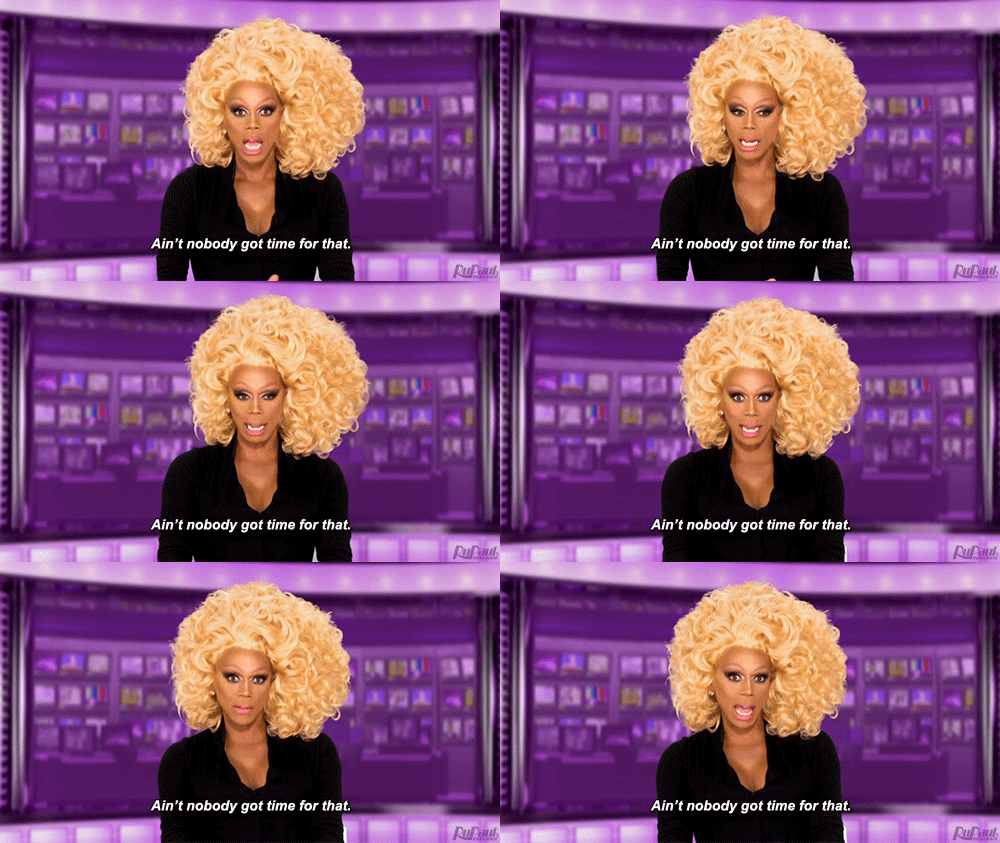
Rue Paul was imitating Ms. Sweet Brown, interviewed by news media after a fire.
http://www.youtube.com/watch?v=8cT_Ulmcrys
#13 Posted by Loret Steinberg, CJR on Thu 9 May 2013 at 08:00 PM
A personal motto that has served me well through multiple recessions and technological changes is: “First figure out what you want to say, and then figure out how to make it pay.” When this business starts getting easy it is usually about to blow up.
#14 Posted by Roger Wilson , CJR on Thu 9 May 2013 at 10:56 PM
Good post. I think there are plenty of journalists trying to get excited, but it's challenging when the business models are blowing up underneath them. It's more corporate inertia than individual apathy, IMO. Another opportunity: brands are hiring more journalists for their content marketing/brand as publisher efforts. Just posted about that here: http://www.emediavitals.com/content/4-career-transitions-journalists
#15 Posted by Rob O'Regan, CJR on Fri 10 May 2013 at 06:35 AM
I see a bright future for freelancers so I will agree on that.
But as someone who was in the daily newspaper industry it's downright awful right now. I continue to hear stories of colleagues who are overworked and underpaid. You can only go for no raises and pay cuts for so long. The pay is a huge issue that's being missed here.
#16 Posted by Holly, CJR on Fri 10 May 2013 at 08:15 AM
Stuff like the Ru Paul video is one reason why can't take seriously a lot of what passes for "journalism" these days. It's stupid and distracting. Can't you just write a serious, substantive work, or does everything in the "new journalism" have to be flashy! exciting! gimmicky! appealing to those crazy kids! Just report well, and write well. Those are the fundamental skills of journalism that are being lost, and it's one of the saddest casualties of the whole mess. Oh yeah, and the whole "fourth estate" public service function, which was the noble reason many of us "old-timers" went into journalism into the first place. Making the most of new opportunities is great, but don't forget what really matters -- and that's what is happening, unfortunately.
#17 Posted by Amyeb1, CJR on Fri 10 May 2013 at 08:46 AM
It's easy for you to say--you've got a job and are earning a living. For those of us who have been laid off and are getting paid less for freelance work than we did in the 1980s, and getting less work, not so much.
#18 Posted by zyxw, CJR on Fri 10 May 2013 at 09:14 AM
If your display advertising is dead, it's your fault for cutting the guts out of your editorial content. We're pumping out more content in print and not giving it away for free onliine. The advertisers are calling us with money. What's not to love?
#19 Posted by Mark, CJR on Fri 10 May 2013 at 12:48 PM
From MediaGazer today:
Tough times at Columbia Journalism Review; as an editor departs, others are laid off, and funding looks shaky
http://www.capitalnewyork.com/article/media/2013/05/8529901/tough-times-columbia-journalism-review-editor-departs-others-are-laid-
#20 Posted by LouGrant1, CJR on Fri 10 May 2013 at 04:13 PM
Hold on, there, Pollyanna. The view might look dandy from the ivory tower, but it's less appealing down here in the trenches.
We newspaper writers and editors don't lament our industry's demise because the ways we interact with readers and sources have changed - we lament because we're asked to do the jobs of two or three people, because we can never take time off without screwing over already-overburdened co-workers, and because we're not sure we'll have jobs in the future.
Our concerns don't involve our place in the rapidly changing landscape of modern media. They're far more elemental: We're looking to stave off starvation and homelessness.
#21 Posted by Ben Bromley, CJR on Fri 10 May 2013 at 05:42 PM
After two layoffs and seeing my salary, which wasn't that high to begin with, halved, then halved again (but this time with no medical) and then wasting half a year in digital media development training (where I found out that sixth graders are learning Adobe Premiere, and that I could make upwards of $12/hour stringing) I've come to the conclusion that it's time to reinvent myself. Or win the lottery.
#22 Posted by outofhere, CJR on Fri 10 May 2013 at 06:48 PM
Given the layoffs that just happened at CJR, I imagine even they no longer wish they had run this piece.
#23 Posted by Dan Gainor, CJR on Sat 11 May 2013 at 06:31 AM
Articles like this remind me of the Death Valley pupfish, a species which manages to eke a living out of one of the most inhospitable locations on earth.
Eons ago, it belonged to a large, freshwater lake. As the lake dried up, the remaining water became hot and hyper-salty. Either you found another habitat, or died, or in the case of the pupfish, adapted to the aftermath.
Such is the achievement of the journalist who decides to stick to her calling. Even gutsier than sticking it out in a shrinking pool of opportunity is to leave it altogether. Who knows? You may die, but you might find the ocean.
#24 Posted by oodoodanoo, CJR on Tue 14 May 2013 at 10:08 PM
While it is an exciting time to be a journalist, I don''t see the writer making a good connection between the many ways to do journalism now and a sustainable model for local news.
Criticizing large papers for unwillingness to hire programmers to pursue innovative projects like "Snowfall"is fine as far as it goes. Friedman's background is in magazines, which probably benefit from similar innovation.
What would she do if she was running a 15,000 circulation daily newspaper in a suburban or rural county? Is there a sustainable online model for newsgathering for small populations, such as newspapers that serve one or two counties but rely on AP for state and national news?
Friedman's column is kind of like a newspaper story touting the size of the Powerball jackpot. She wants people to put money and time into an endeavor where there are very few payoffs.
#25 Posted by Barbara Phillips Long, CJR on Wed 15 May 2013 at 08:10 PM
—You have access to a world of sources. Sure, there were always a plethora of interview subjects out there. But it’s never been easier to find and reach out to anyone. Folks who were once tough to reach by telephone are now more likely to have a smartphone on them and can shoot you a quick reply.
carpet cleaning london
#26 Posted by roger, CJR on Thu 13 Jun 2013 at 04:23 PM
In the era of balanced journalism and unaccounted opinions working as the interchangeable terms, your omission of negatives (such as diminished accountability, sensationalism-before-fact and fact research results in under 140 characters) may just prove one more failure: we have no more patience for the truth.
#27 Posted by Mark Bajkowski, CJR on Thu 1 Aug 2013 at 02:10 PM