Sign up for the daily CJR newsletter.
Northern Mississippi was under an inch of ice, in the middle of a stretch of subzero January temperatures, when a meteorologist named Matt Laubhan heard from the public service commissioner that residents were starting to run out of water. The official said the region was looking for generators that could power pumps to keep municipal water flowing in towns where the ice had knocked out the electricity.
Within a few minutes, Laubhan was interviewing the commissioner on his livestream, Mississippi Live Weather, which goes out on YouTube, X, Facebook, and apps for smartphones, Roku, and Apple TV. Soon some viewers started offering up generators, helping local water associations keep the pumps flowing. “In those breaking weather situations, information is the commodity that’s the difference between life and death,” Laubhan told me.
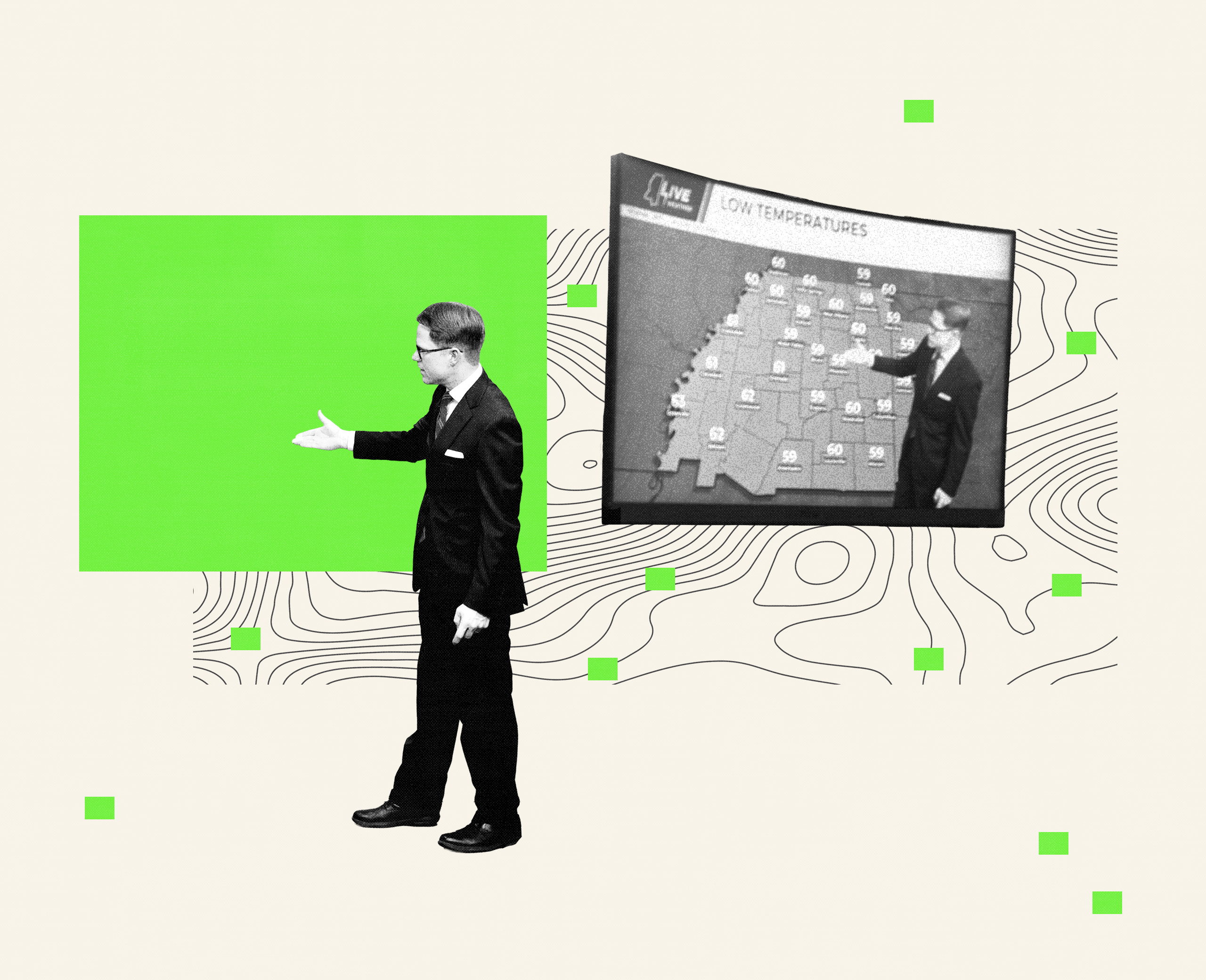
The ice storm of January 2026 was the first major weather event that Laubhan covered via his independent platform, which he’d started in July after spending fourteen years as chief meteorologist for WTVA, Tupelo, Mississippi’s NBC and ABC affiliate. Weeks later, I visited his small studio in an office park. Laubhan explained that in his new role, he’s finding viewers where they are, often quite literally. When there’s a tornado warning, he said, people don’t bring their televisions to their shelters. They bring their phones. “This isn’t a giant jump for them, it’s just a giant jump for us as broadcasters,” he said.
Laubhan hadn’t planned to leave his job at WTVA. But last January, he learned that he would be laid off, part of a move by the station’s owner, the Allen Group, to replace local forecasting at stations across the country with centralized coverage via the Weather Channel. Laubhan was shocked. He is so popular that in 2023 the city of Smithville, Mississippi, named a road after him. “That’s a pretty safe place to be in this business,” Laubhan said. “And if I’m fireable, anybody’s fireable.”
Amid backlash, the Allen Group quickly reversed plans on the layoffs at some stations, including for Laubhan. But by then he had already developed the seed of the idea for his platform, and soon he connected with the Digital Weather Network, a group of meteorologists who had likewise struck out on their own. The network, which started in 2022, now has nineteen members, including Laubhan and others across the US and Canada, working from well-equipped studios or from their homes. All, so far, are men. Most wear suits. Network members meet and talk frequently, sometimes subbing for one another if someone needs a sick day. Dozens more, including from as far as Japan, have expressed interest in joining.
Laubhan sees providing independent, local weather news as a vital public service. “Nothing touches the kind of bad weather we have here in Mississippi,” he told me. The region has unique weather patterns that fuel severe storms as well as a dispersed, rural population. “So there’s just high vulnerability and high opportunity. And I think those two things combine to where people want and need good weather information,” he said.
He started with a loan and quickly attracted a handful of advertisers. Today he has more than twenty, ranging from a local furniture store to a cement company, which pay between hundreds and thousands of dollars for different ad packages. He employs three other meteorologists, who either stream from home studios or work out of Laubhan’s downtown office, as well as part-timers who help with ad sales and administration. The platform’s stream, which runs 24-7, alternates between weather radar maps, live shots from around the area, and live forecasts delivered by meteorologists at least six times a day. During extreme weather, such as the ice storm, Laubhan provides frequent updates and interviews with officials.
Over the course of the week following the ice storm, his stream and social media attracted 1.5 million viewers. To sustain his work, Laubhan refuses to consider a subscription model that would involve a paywall. He suspects a lot of his viewers might support him with something like five bucks a month, but he senses that many people wouldn’t—or can’t afford to. “They deserve to know whether or not they’re going to die from ice or a tornado,” he said.
From New Jersey to California to Louisiana, weather journalists are leaving traditional TV newsrooms to form all-digital platforms. According to Alan Sealls, the president of the American Meteorological Society and a retired broadcast meteorologist himself, more professionals like Laubhan are considering this route because technology makes it possible to produce and distribute weather news without the constraints of a TV station. “The ability to do your own, to be your own boss, is way higher than it ever was,” he told me.
As Ben Luna, who helped found the network Laubhan joined when he went independent, put it, “More often than not, people don’t have time to sit down and read the newspaper. They don’t have time to wait till ten o’clock to get the latest news in the evening. Therefore, local content that is accurately, professionally, and fairly produced, where people can go on their time and be given a modern format, ensures the survival and forthcoming thriving of local journalism.” Luna began streaming video forecasts in April of 2020, inspired by a tornado that hit Lawrenceburg, Tennessee. Luna, who studied meteorology at Mississippi State and Penn State, left the local radio station to run his digital platform, and the company has since expanded to fourteen people, covering sports and providing other creative services. “In order to deliver local information you have to deliver it to where the people are,” he said, “and that has evolved.”
For Laubhan, the independent-streamer model is the future, given its flexibility to provide potentially lifesaving coverage from a local vantage point—even if running his own platform has challenges. During the ice storm, when his power went out, he kept delivering updates from home by running an extension cord from his electric F-150 truck.
“No one can beat hyperlocal information,” Laubhan said. “No national entity is ever going to do better than what’s happening right here and the way we can cover that.”
Has America ever needed a media defender more than now? Help us by joining CJR today.