Sign up for the daily CJR newsletter.
In 2022, Sammy Loren published a fourteen-part short story in La Prensa, one of Mexico’s most-read tabloids. He had been living in Mexico City and developed a deep admiration for the country’s yellow press. Later, when he moved back home, to the United States, he reached out to American tabloids, hoping they, too, would want to publish his fiction. “But no one was interested,” he told me. So Loren decided to take matters into his own hands with On the Rag, a literary tabloid he described as a “gossip rag,” a “conceptual art project,” and an “earnest attempt” at a literary journal. (Rachel Kushner, Alexis Okeowo, and Hedi El Kholti are among the editorial directors.) The name, a vulgar reference to menstruation, came before anything else. “It of course has all the rich connotations of when it was a pejorative phrase, but I feel like saying someone is ‘on the rag’ as an insult has faded,” Loren said. Irony is central to his project. “It’s kind of like a performance of doing a newspaper and running a media business, but I am also doing it seriously.”
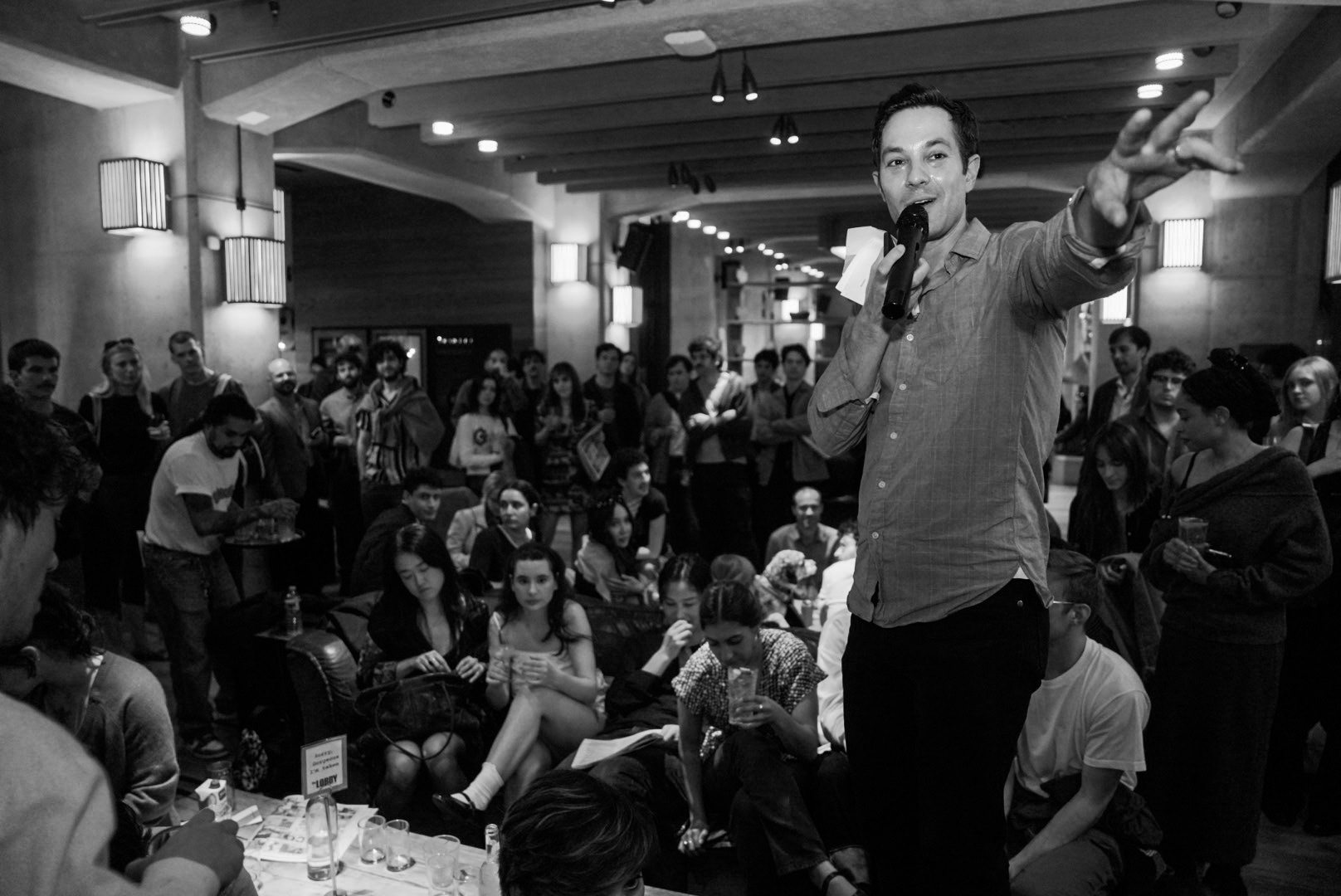
On a recent evening, at the bar of the Ace Hotel in Downtown Brooklyn, a couple hundred writerly types provided proof of concept at a launch party for On the Rag’s second print issue, produced with help from a masthead of more than a dozen editors whose beats include nightlife, romance, and Europe. A few contributors, including Jamieson Webster, a psychoanalyst, and Marika Thunder, an artist, read from their pieces. Attendees crowded around the bar; a few perched on green midcentury couches; one woman was scrolling on Letterboxd. Loren, who is forty-one, circled the room in a coral-pink shirt and dark pants. He said the crowd liked On the Rag because “they recognize the conceptual nature of it.” And because they like gossiping about one another.
Jeremy Gordon, a novelist and senior editor at The Atlantic, who was at the party, agreed. “Writers and journalists are desperate to gossip,” he said. “Journalism, in some regards, is the official, well-sourced version of gossip.” And yet: “Any journalist or writer has been in a situation where they learn something that, you know, couldn’t be printed, but is just too good to keep to yourself.”
Though other countries may have more robust tabloid traditions, the US has something of a scene—one that, lately, appears to be doing reasonably well. In January, News Corp debuted the California Post, the West Coast version of the New York Post, in Los Angeles. A few months later, TMZ, known for its salacious, often unverified scoops, established a Washington, DC, bureau. On social media, the gossipy entertainment accounts PopCrave and PopBase attract millions of followers. This month, the San Francisco Standard announced that it was looking to hire a “Moguls and Gossip” intern. This all makes sense to Loren. America, he said, is, at heart, “reality TV, trash culture, tabloids, gossip.” He views On the Rag as part of that lineage, but also poking fun at it: an “expression of the collapsing state of American media.”
When the project started, in 2024, On the Rag was an online forum for anonymous posts on unrelated topics: the female gaze, sexual escapades, which literary critics are hot. That same year, Joe Bernstein, a New York Times Styles section reporter, came across that last entry, and posted about the tabloid on X: “On the Rag,” he wrote, “is my pick for New Website Most Likely to Cause a Problem.” Loren took it as a compliment. The print edition—with a simple, retro layout and a few classifieds—debuted last year.
At the party, Loren introduced the Seltzer King—a/k/a Seltzer Daddy, a/k/a Jon Posen—a speechwriter, sustainability expert, communications consultant, and former Jeopardy! contestant who published a piece in On the Rag about seltzerology. (“You think your star sign matters?” Posen writes. “The only things that matter are your favorite Mario Kart character and your favorite seltzer.” Examples: “Siphon seltzer? You read way too much Philip Roth. La Croix? Give up, there’s no hope for you.”) “Tuesday morning, I’m nine years old,” Posen said, addressing the room. “Ten bottles of New York Siphon seltzer, fresh and fizzy, ready to be enjoyed, ready for that first pull of the lever, like the bursting of a dam.” The monologue was part Portnoy’s Complaint reference, part The Human Stain, part absurdity. (“I wanted to make fun of myself: a slightly self-involved New York Jew with a penchant for the irreverent word,” he told me later.) The issue contains yet more eroticism and irreverence—an advice column by Kaia Gerber, the supermodel, on “seduction, sex, and love dilemmas”; a pole dancer cartoon strip—paired with an essay by an Iranian writer reflecting on the country’s shifting regimes. On the back page lives a series of anonymous entries, which On the Rag also posts on Instagram. “Which male writer mogs the hardest?” asks one entry. “I feel like Clavicular’s girlfriend,” reads another.
Lake Micah, a deputy managing editor at Harper’s, told me he was there because he considers himself a “devotee of frivolity.” Across the room, Yasemin Kopmaz, a writer, was selling the new issue for ten bucks apiece. (Online it’s fifteen dollars; you can also buy an On the Rag hat for thirty-five.) She didn’t get to see much of what was happening from her seat, positioned behind a makeshift stand piled with copies. But that “worked with the tabloid thing,” she said: gossip often comes from anonymous sources.
Partygoers came and went, many of them talking about one another. Loren said his tabloid was one of the few places that would actually publish what they said. “Everyone knows the media looks big but is in fact a small world, and it’s super nepotistic,” he told me. “People are afraid to burn bridges.” Not so at On the Rag. “We do things with our gloves off.”
Has America ever needed a media defender more than now? Help us by joining CJR today.