Sign up for the daily CJR newsletter.
On a balmy evening in April, the small volunteer staff of Golden Goal—a one-off print magazine and website created to explore some of the World Cup’s many political and financial complexities—gathered in the backyard of a busy Brooklyn bar to drink High Lifes and freak out. The team, all friends and media professionals, includes Alex Shephard, an editor at the New Republic; Miguel Salazar, a researcher at the New York Times Book Review; Andy Tan–Delli Cicchi, an editor at Holt Books; and Billy Lennon, the founder of the Cleveland Review of Books. At our feet was Harriet, Shephard’s little village dog, named after Harry Kane, the England striker, “because she’s deceptively quick and she’s got a big head.”
In an editor’s note announcing the project in February, Golden Goal laid down its marker: “Why the World Cup? For better or worse, no sporting event better embodies and reflects the world as it is now: fractured, corrupt, embattled, adrift.” The ambitious note struck a chord: within weeks, Golden Goal had raised nearly fifteen thousand dollars on Kickstarter and assigned articles. The eventual list of contributors range from a Bolivian novelist to an esteemed literary critic to a New Yorker staff writer. At the bar, the team was working to close the issue in time for the tournament, which kicks off June 11 and will be played primarily throughout the United States, along with cities in Canada and Mexico.
Fronted by laptops, the team answered final design questions, checked edits, and rattled through their print and digital story lineup. That included a profile on Fabrizio Romano, an Italian journalist and social media personality who has successfully turned breaking soccer news into a “corporatized financial product”; an oral history of the World Cup featuring quotes from Jeremy Corbyn, the former head of the UK’s Labour Party, and Sepp Blatter, the former head of FIFA, the governing body of the World Cup, who had been charged with, then acquitted of, corruption; and an essay from an enigmatic Swiss writer recounting the time he walked fifteen miles to see a tiny soccer team in the European countryside. The editorial note on that latter piece, Lennon recalled, was: “If you wanna cook on, like, some Sebaldian-reverie type shit, go for it!” There will also be poems.
Golden Goal is part of a glut of journalism that aims to cover both what happens during the World Cup itself and everything else the tournament touches. Jules Boykoff, a professor at Pacific University who specializes in global sports politics, is publishing a new book, Red Card: The 2026 World Cup, Sportswashing, and the FIFA Greed Machine. Jonathan Wilson, a writer for The Guardian, has started a newsletter called The World Behind the Cup, delving into the politics of the tournament. Working Families Power, an organization dedicated to “building power for the multiracial working class” across the US, is releasing a podcast that will explore the World Cup through an “antiauthoritarian lens.” In April, Equator, a splashy new politics and culture magazine, ran a multi-week online seminar exploring the geopolitics of the World Cup. The Guardian and The Athletic are diligently preparing to cover what happens both on and off the pitch.
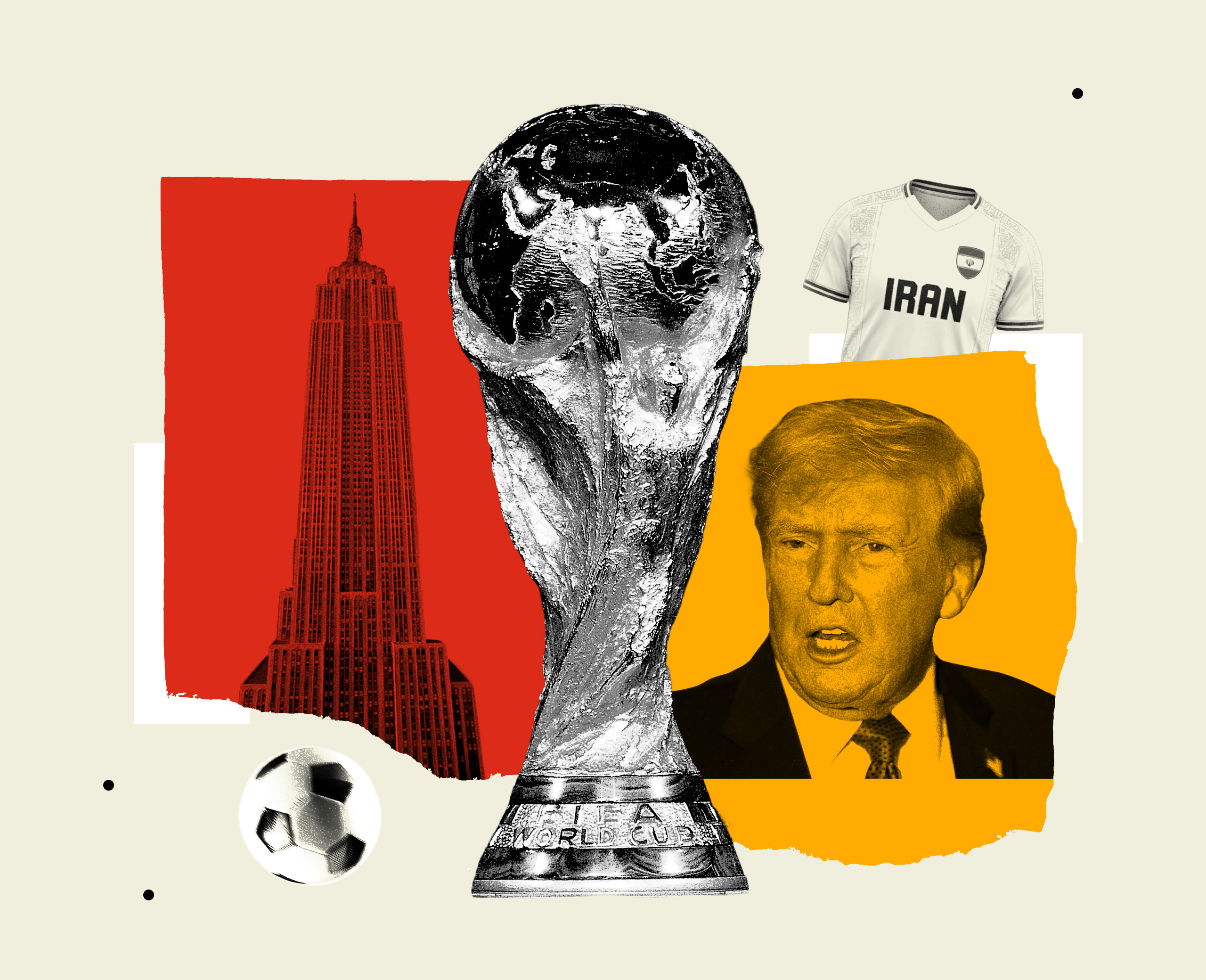
There’s no shortage of material. Will Donald Trump’s immigration enforcement ensnare traveling fans or players? Will Iran, a country the US and Israel have spent the past few months heavily bombing, be allowed to compete? Can anyone curb the exorbitant ticket prices filling FIFA’s coffers? Can Trump’s kleptocratic government handle the whole thing? (The executive director of the White House Task Force on the World Cup is Andrew Giuliani. Yes, Rudy’s son.) Even the fight over press freedom has become a World Cup concern: warning of potential repercussions for reporters doing their work, the Committee to Protect Journalists has compiled resources for covering the tournament, including a legal-support hotline and a direct email in case of emergencies.
The collision of politics and sport at the World Cup is nothing new; one of the most infamous examples is the 1978 edition, in Argentina, then under the control of a murderous military junta. But for most of the journalists covering the tournament today, everything changed in 2018, when Russia, that year’s host, successfully shifted focus away from controversial domestic policies like its anti-gay “propaganda” law. “That was the key one,” said Laura Williamson, the international editor in chief of The Athletic. “After Russia, you felt a responsibility to cover the issues.”
A few years later, the Department of Justice filed indictments alleging that FIFA officials had accepted bribes in exchange for votes to grant Russia hosting rights. The DOJ brought similar allegations in relation to the process behind Qatar’s winning bid to host the 2022 tournament. And though coverage of that tournament brought significant focus to allegations of widespread exploitation of migrant laborers, it’s unclear whether it had any lasting impact. If you asked someone about the 2022 World Cup, “they probably wouldn’t jump to a report in The Guardian about Qatar’s use of slave labor to produce the infrastructure the tournament required,” as Golden Goal noted in its editor’s letter. Instead, “they would almost certainly talk about the final. It would be hard to blame them—it was a fantastic final.”
David Conn, an investigative reporter for The Guardian, told me that the countries that host the World Cup know exactly what they’re buying: “The reflected joy and glory of football. That’s why football is such a valuable pursuit.”
At The Athletic, preparations for the World Cup began more than a year ago, with a big meeting at the New York Times headquarters with all of the company’s senior soccer editors from the US and UK. (The Athletic was founded in 2016 and acquired by the Times in 2022.) The staff covering the World Cup will number over a hundred people, including reporters stationed across the tournament’s host cities, a podcast team for both the East and West Coasts of the US, and social media and video crews. “It’s the biggest thing the company has done to this point,” Williamson said. “And, oh my goodness me—it’s expensive.” (The Athletic declined to say how much it has spent on its World Cup preparations.)
The plan is maximalism. The Athletic will cover every kick of every game as well as “all of the off-the-pitch incidents,” Williamson said. She highlighted Henry Bushnell, a senior soccer writer for The Athletic, who has effectively turned reporting on the mind-boggling ticket prices in the run-up to the tournament into a beat. Thanks to FIFA’s use of dynamic pricing, under which prices can surge depending on demand, tickets for the final are going for as much as thirty thousand bucks. As Bushnell has reported, FIFA also controls the resale market for World Cup tickets, taking 15 percent from both the buyer and the seller on those transactions. Prices have become a political conflict: just weeks before the tournament began, Zohran Mamdani, the mayor of New York, successfully pushed FIFA into releasing a small batch of fifty-dollar tickets for the city’s residents.
Williamson also pointed to The Athletic’s extensive reporting on Gianni Infantino, the president of FIFA, and his knack for leveraging “political relationships” across the world—including a “bromance” with Trump—to secure friendly business terms for his organization. (FIFA estimates it will generate thirteen billion dollars in revenue from the 2026 World Cup.) When covering Infantino’s slick political maneuvering, just as when covering any manager a team might hire or fire, “we try to cut through the noise and explain how this impacts fans,” Williamson said.
Much of that noise is likely to come from the Oval Office. During one of Infantino’s many White House visits ahead of the tournament, Trump riffed on the notion of punishing Democrat-controlled cities by taking away their World Cup matches. He’s already exploited a FIFA tournament for self-promotion: in the summer of 2025, after the final of FIFA’s Club World Cup in New Jersey, Trump gallivanted around the stage with Chelsea, the winners, much to some players’ evident confusion.
As Trump scrambles for a resolution to the Iran war, the presence of the Iranian national team in the tournament remains an open question. In April, Marco Rubio, the secretary of state, insinuated to reporters that the team might use the World Cup as cover for some covert military operation. “They can’t bring a bunch of IRGC terrorists”—an inflammatory reference to Iran’s Islamic Revolutionary Guard Corps—“into our country and pretend that they are journalists and athletic trainers,” Rubio said. Iran is now planning to stay in Tijuana, Mexico and commute into the US for its games.
The Trump administration’s policies toward international fans have likewise sown distress and confusion. In March, The Athletic reported that a government policy required travelers from five countries that qualified for the World Cup—Algeria, Côte d’Ivoire, Senegal, Tunisia, and Cape Verde—to submit bonds of up to fifteen thousand dollars to enter the US. Responding to the news at the time on social media, the writer Zito Madu called the tournament “a World Cup that’s hostile to the world.” In May, reportedly after pushback from FIFA, the Trump administration announced it was waiving the requirement. But the reality is more complicated: the State Department will still require some fans, namely those who purchased tickets after a certain cutoff date, to submit bond payments.
In a statement to CJR, the State Department boasted of “President Trump’s commitment to hosting the biggest, best, and safest sporting event in World Cup history,” adding that, “at the same time, the Administration will not waver in upholding U.S. law and the highest standards of national security and public safety in the conduct of our visa process.”
Like The Athletic, The Guardian is planning to take the off-field news as it comes. “We really have even less of an idea of what will happen off the field than what will happen on the field,” said Alexander Abnos, the senior sports editor for The Guardian US. “This country has a lot of problems that are potentially going to manifest at the world’s biggest sporting event.” As the tournament rolls on, Abnos will be ready to rely on his colleagues from elsewhere in the newsroom. “If things escalate where we need someone with a lot of expertise on policing, we have those voices in our newsroom,” he said. “Those reporters understand that the World Cup is now a news event as much as it is a sporting event.”
When I spoke with Abnos, in March, he predicted that the paucity of public transportation options in the US would become a hot topic. He pointed to Arrowhead Stadium in Kansas City, his hometown, which will host World Cup games despite being famously located in the middle of nowhere. “I can already see the tweets,” Abnos joked. “Some group of Belgians is going to try to bike or walk to Arrowhead, and it’s either going to be the worst or the best day of their lives.”
About a month after we spoke, European soccer fans online did indeed start to ask, at least in part facetiously, whether it was possible to get to New Jersey’s MetLife Stadium from New York City on foot. The discourse was sparked by New Jersey Transit raising the price of a round-trip ticket to MetLife from thirteen to a hundred and fifty dollars during the World Cup, which itself spurred a conversation about FIFA’s penchant for forcing its host cities to shoulder the tournament’s sizable costs, logistical burdens, and security challenges, all while extracting maximum revenue. In response, the New York–New Jersey Host Committee issued a statement: “For the safety of all World Cup attendees, pedestrian access is strictly prohibited on the roadways surrounding MetLife Stadium. These are active, high-traffic corridors where walking creates serious risks for both pedestrians and motorists.”
Conn, of The Guardian, is a pioneer of off-the-field soccer reporting. In 1997, he published The Football Business, which explored the impact of a recent influx of corporate money on the sport—at the time, a novel topic. His muckraking reporting on the Hillsborough disaster, a 1989 stadium crush in which nearly a hundred people were killed, helped tear down a false narrative. For decades, the police had blamed the fans for causing the crush that led to the deaths; a government inquest created in the wake of Conn’s reporting brought relief to the grieving families by determining the fans were victims of gross-negligence manslaughter by the police officer in command.
Conn, clearly, believes in hard-hitting sports journalism. But he also knows the score. “In the end, World Cups tend to be great successes for the regimes,” he told me. “The World Cup in Qatar: all those years of critiquing and investigations was worth it for four weeks of the greatest game on earth.” In the upcoming tournament, stories about immigration or price gouging will likely struggle to compete with the games themselves, he said. Boykoff, the author of Red Card, largely agreed. “The critical coverage occurs now, in the lead-in, but once the World Cup starts, the athletes are amazing and they get our attention,” he said. “That’s the pattern.” But, he added, “I’m not so sure that’s going to happen this time.”
Boykoff is confident that the 2026 World Cup will produce great journalism—about the US, its systems, and its collusion with FIFA—that will break through the joy of the game. “The Qataris had a PR game plan, and they were very disciplined about it,” he said, while Trump is “not sticking to any kind of game plan.” And Boykoff’s friends and colleagues—reporters from as far afield as the US, Finland, and Austria—have told him they’re hungry. Meanwhile, news keeps on breaking: just days before the tournament began, the attorneys general for New York and New Jersey subpoenaed FIFA as part of an investigation into ticket prices. “Storylines abound!” Boykoff said. “Journalists are rising to the challenge.”
That includes the team at Golden Goal. In the week after that sweaty night at the bar, they did manage to close the issue, which will be published in early June. But they didn’t stop there: online, they’ve been exploring all manner of synergy between world-shaking political machinations and soccer. Why was Lionel Messi at the White House? And what does it have to do with one powerful Miami family’s decades-long quest to end communism in Cuba? Golden Goal will be publishing all tournament long.
As for soccer fans who’d rather not read about anything beyond the soccer itself, Boykoff said, “I’m sympathetic, but I don’t think we need to consign ourselves to the death of complexity. We can enjoy the tournament and also face the tough questions it raises. Who is benefiting? Who is suffering?
“FIFA is trying to turn it into the plutocrats’ game,” Boykoff added, but it’s “a community good. It’s worth wresting it back and getting a better deal for the rest of us. It’s worth fighting for.”
Has America ever needed a media defender more than now? Help us by joining CJR today.