Sign up for the daily CJR newsletter.
On the drizzly night of October 31, Equator, a new global magazine, held its launch event on the south bank of the Thames. Outside, vampires, devils, and werewolves walked by—the early Halloween crew, totems of America’s cultural hegemony. Inside, the guests, shedding scarves and tote bags, were handed a foldout poster in striking yellow, printed with Equator’s manifesto, which begins: “The end of the West is not the end of the world.”
In many ways, the arrival of a new magazine is like the launch of a new medicine: it inherently involves a diagnosis of the disease blighting the existing slate of media offerings and proposes a cure. Equator’s diagnosis is that the “storied titles of the Anglophone West” have “met an increasingly globalised and interconnected world with boilerplate journalism, facile binaries and an invincible ignorance of other societies and cultures.” Its editorial manifesto argues that the highbrow titles of the Western establishment, for which its founders spent much of their careers writing, have betrayed their own lofty universalist values and are guilty of warping reality. The Equator team is referring, most recently, to coverage of the Israeli war on Gaza; but, longer-term, they contend that the end of the Cold War ushered in an American-centric perspective that infected the West’s publishing culture. Equator promises to be a post-American global magazine of politics, culture, and art that avoids a Western-centric gaze.
When Equator’s website debuted, last week, editors had prepared a slate of fifteen showcase articles. The stories are compelling, the writing engaging, the subtle shift in perspective long overdue—it’s a very strong start from this young magazine. Its success will, of course, be judged over time.
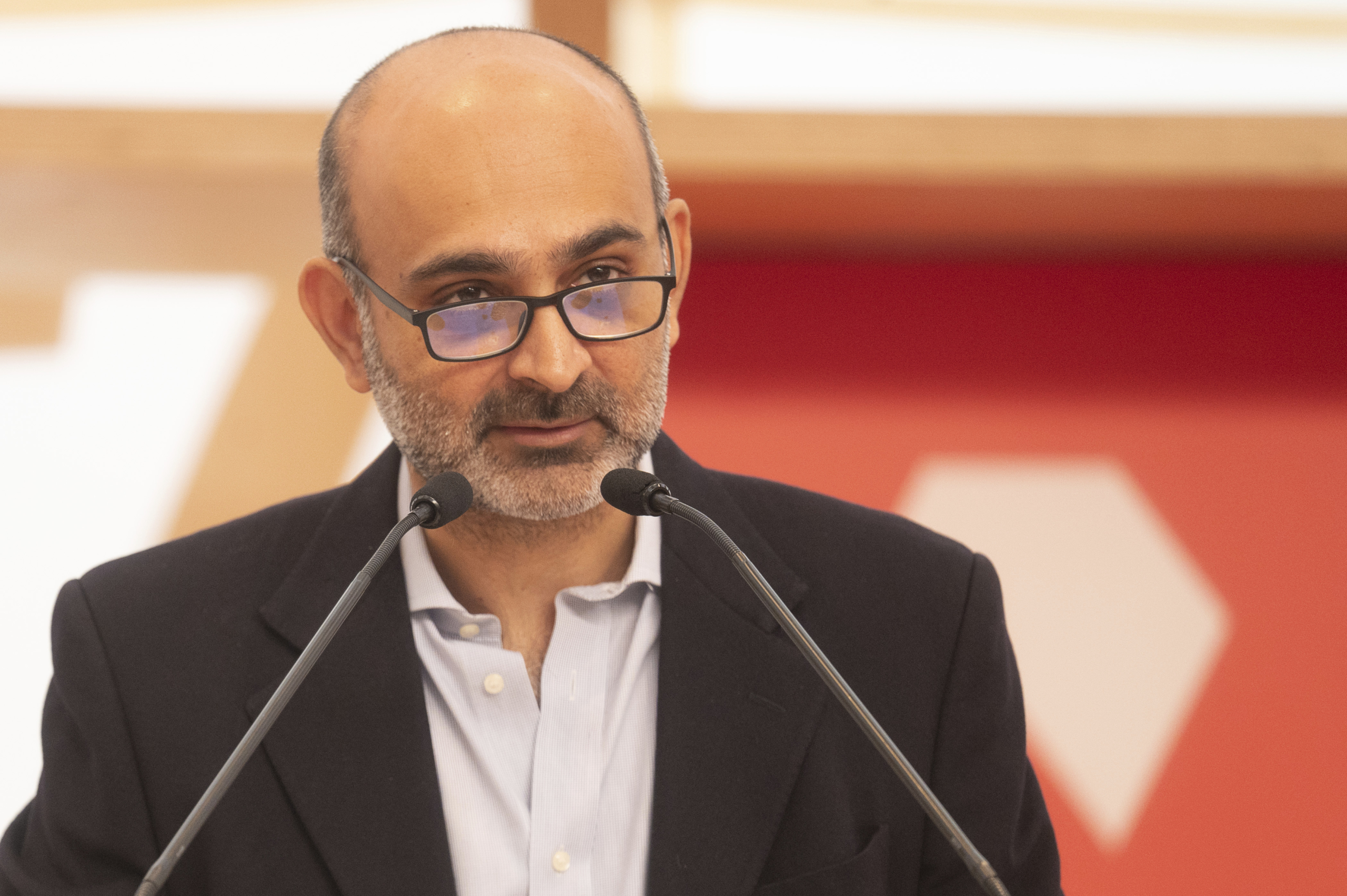
Less is known about the magazine’s funding. Speaking by phone from Lahore, Equator cofounder and novelist Mohsin Hamid told me that the magazine has startup funding from foundations and individual donors but declined to give details. “I don’t want to go into who is giving what and how much people are giving,” he said. “For me, the question of funding is very important, not least because we assume, and I think correctly, that the way something is financed inevitably has an impact on how it is run. And so my hope would be that Equator becomes, relatively quickly, a self-sustaining entity.” Our conversation has been edited for length and clarity.
JB: You and the other cofounders have spoken about your anger and madness as you watched the images coming out of Gaza over the last two years, and how Western leaders have “embraced the perpetrators of this unfolding genocide.” Can you talk about Gaza as the ignition for Equator?
MH: I think Gaza was a very significant factor, but the impetus goes further back. For many people of my generation, who came of age as writers around the time immediately before and after 9/11, there was already a sense that perspectives were being excluded, positions and viewpoints being marginalized, in the prestige Western press—a feeling that the perspective at the most storied, rigorous publications was somewhat skewed. For a while, many people thought this would inevitably get better over time: that there would be changes in inclusivity, editorial stances, and an internationalization of who is deciding what is written about, and for whom. We didn’t really see that happen. And what Gaza, and the coverage of Gaza, marked was the shocking and horrifying realization that not only had the changes one had hoped for not occurred, but in fact, things were in many ways worse than ever before, and the direction of travel was wrong.
You and the other founders write in your opening essay about how the “storied titles of the Anglophone West cannot be internally reformed, nor redeemed.” That speaks to what you’re saying about the impetus for this project, but how will you build trust with your readership at Equator?
It’s worth looking at what one means when talking about a “breaking of trust.” If we imagined that there was a faith that everyone was equal and we believed in truth, rigor, and human rights, et cetera, and we had a shared set of beliefs, as it were, we would gradually resolve our differences and align. But what we have witnessed is the hollowing-out of such claims. In the countries that were claiming the most heartfelt and constitutionally protected defense of free speech, we now see precisely the opposite occurring. And I think it has to do with a geopolitical moment.
There was a confidence in the West following the end of the Cold War, and in that confident moment, there was a notion that these publications aspired to be the publications of the world. That we might all, through them, express ourselves. But as Western countries have themselves retreated into tribalism, these publications have gone along for the ride. They, too, have become evidently tribal. And so for those of us who still believe in the possibility of a cosmopolitan human position—not marked by tribalism but marked by a search for truth, a search for equality—it’s become clear that we can no longer find a home there.
You’ve mentioned truth and rigor. Equator is a magazine with editors around the world, from different places and experiences, but what’s been stressed is a striving for universalism—or claims to truth or rigor—and feeling disappointment, perhaps even sadness, that Western publications didn’t live up to those standards. Can you talk more about that disappointment?
Many of us had enormous respect for the institutions in which we were trained. For me, that formative experience of coming through certain institutions was very meaningful. I had a great deal of faith in these institutions. And now, whether it is the craven response of so much of academia in the US and elsewhere to being silenced, or the positions taken by so many of these publications, there is a feeling of heartbreak, really. And there’s a sort of forlorn wistfulness. But there’s also anger. And more importantly, a sense of hope: that after this period of depression, one inevitably begins thinking, “Okay, if this is broken, and if the values that we all once claimed to believe in are still values that I believe in, how does one now begin to build something that advances those values?”
Speaking of hope, other outlets have launched in recent years claiming to cater to this more global audience, although many have ended up centering the American worldview. How will Equator avoid those pitfalls?
There are two answers to that question. The external answer, which may be more interesting, is: the cultural gravity of America was so great until recently that attempts to craft another global narrative, which wasn’t rooted in an American position, really had to struggle against that power. But now a space has opened up. The external environment is very different even than it was after 9/11, and even after the global financial crisis. We now occupy a moment when so many people are looking for the way forward, and not looking to the West to provide it.
Then there’s the internal side, which is: What might Equator do? I can only speak for myself and my instincts, but one approach to this question is to ask: For whom is this piece written? What do we imagine the audience of this piece to be? When one goes from thinking This is a piece about the world which might interest Westerners to thinking This is a piece that might interest people around the world, that is a very different position.
In your introductory essay you say: “The mission of Equator is to hold up a mirror to a global audience of readers and writers who don’t yet recognise themselves as belonging together.” This implies that you are launching without, necessarily, a clear, existing audience, but rather a project that wants to bring that audience into being, which strikes me as an ambitious goal.
For many of us who are writers, the feeling of being alone has become very powerful and oppressive, and there’s a sense that community is breaking down, in part, because the institutions to which we belonged no longer seem to be institutions that we wish to belong to, or that wish to have us belong to them. There’s a sense of being scattered. But the desire for community is very strong.
When I set out to write a novel, what I’m always trying to do is to write the book that I most wish to read. I’m writing this book because it doesn’t exist yet. Similarly, with Equator, the notion is to try to create the place that I would like to write for, and to try to create the community that I would like to be a member of, and that would be a community of writers, editors, readers, intellectuals.
But there are pitfalls to that, right? There are some risks that you could be seen to be retreading the footsteps of imperial or postimperial projects, catering to an English-speaking elite, a particular slice of the world. How are you thinking about that danger?
I think the danger is real. In terms of how one navigates it, my own aspiration would be that the writers, the editors, the community that makes up Equator, that many of these are not well-known names, and that, in a sense, Equator becomes an opportunity for writers who are earlier in their careers—or more advanced in their careers but just not recognized names—to have access to readers and an audience.
It’s not that Equator can do everything. A magazine cannot do everything. The idea is to introduce into the world a spark with particular tendencies, in the hope that other sparks, with tendencies that are aligned or congruent, join in, and it becomes something bigger. If Equator can demonstrate that it is possible to find a large, robust readership interested in long-form, well-written, rigorously edited pieces that take a look at the world that is not intermediated by a particular Western perspective, then the best thing would be for there to be many, many challengers, competitors, and kindred spirits. Equator is an experiment. Hopefully it will give rise to many other experiments, some of which may do a much better job. If Equator ceases to exist in five or ten years’ time, and there are other publications that are doing what we set out to do, and if we, even in failing, played some role in allowing that to happen, I would count that as a huge success.
I understand that your plan is to rely on paying subscribers. The anger that we spoke about at the start is very powerful, but how do you harness that anger into something sustainable long-term?
First of all, the notion isn’t so much to harness anger. The notion is that there has been a kind of breakup. And when you, in your romantic life, undergo a breakup, there can be anger and sorrow. But also you are left with the desire for something new. You are looking for something.
And so the idea is to put into the world this glow, somewhere in the deep gloom, which hopefully attracts other fish, which will say, “Hey, that’s a cool glow.” And not in an angry, predatory way, where we eat all the small fish who come to us. The notion is that we are not building on anger. We are building, hopefully, on longing. And that is a much more potent and powerful force. It is the longing for a globally human perspective that can start to unite and connect us—in the absence of the hegemonic way in which we were being united and connected before. To me, that is a huge part of it, in terms of the sustainability of the business model. Can you find enough readers to sustain it or not? We don’t know the answer. But my own hope is that you can.
Editor’s Note: This article has been updated to clarify that Equator does not plan to release a list of funders on its website, but will identify “patron” tier members.
Has America ever needed a media defender more than now? Help us by joining CJR today.