Sign up for the daily CJR newsletter.
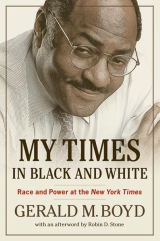
My Times in Black and White: Race and Power at The New York Times | By Gerald M. Boyd | Lawrence Hill Books | 402 pages, $26.95
The entire arc of Gerald Boyd’s remarkable life is contained in the first few pages of his posthumous memoir, My Times in Black and White. In the opening paragraphs, he sketches out his duties as second-in-command in the newsroom—a job that had once seemed unimaginable for “a little black boy from the streets of poor St. Louis.” We are still in the prologue when Boyd is summoned to the fourteenth-floor suite of Arthur Sulzberger Jr., the paper’s publisher, one afternoon in June 2003.
 By this point, only one dream remained for the fifty-two-year-old Boyd: to ascend to the post of executive editor. This would be the final, defining triumph in the classic life of an American striver. Instead, he was abruptly dismissed as managing editor, and cut loose by the institution that had defined his life, The New York Times.
The Jayson Blair scandal had exploded earlier that spring, and Sulzberger was desperate to shield the Times from further damage. Unfortunately, two separate feeding frenzies had already been set in motion. One involved the schadenfreude of industry competitors, who were delighted to see America’s greatest newspaper being brought low by a reporter who plagiarized and made things up. The other fueled a head-hunting expedition within the company itself, whose goal was to bring down a hard-driving (and now widely hated) executive editor—and along with him, his deputy, a black man who had dared to dream about reaching the very top.
As recounted by Boyd, the scene in Sulzberger’s office is brief, yet it packs an electric tension. In sum, the publisher did little explaining. Boyd, like his boss, Howell Raines, had to go. At the time, the dismissed man was unable to muster even a single question.
In retrospect, Boyd (who died prematurely of cancer in 2006) imputes his downfall to a crude act of racial association. Both he and Blair, the troubled young reporter at the heart of the plagiarism scandal, were black: if Blair were guilty, then Boyd must have been guilty of something, too.
Many people will be drawn to this book for its implicit promise of behind-the-scenes gossip about the Times. Their curiosity is understandable—although the paper is an institution committed to openness, transparency, and accountability in public life, its own internal workings can be often as difficult to parse as, say, procurement at the Pentagon.
Many others, of course, will consider this story old news—to the relief, one suspects, of various higher-ups at the paper. Boyd himself gained clarity on many things during his final, ruminative years. But perspective about the lasting importance of the Jayson Blair affair was not one of them. He seemed to imagine that historians would long remember the scandal that brought him down.
They will not. The industry has undergone such radical transformations since then, between the rise of the Internet and the gradual, agonizing death of the old newspaper business model, that the details of this episode already feel like ancient history.
This observation takes little away from Boyd’s book, which strongly deserves to be read. My Times in Black and White manages the rare feat of pulling off at least three distinctive narratives without any of them feeling forced or contrived.
The first of these is an affecting up-from-poverty story of the sort that used to be common in American letters. Boyd traces his family from places like Itta Bena, Mississippi, where they were Delta cotton farmers, to inner-city St. Louis, where the author wore painstakingly patched clothing and played with toys from the Salvation Army.
Boyd’s trajectory was lifted by Upward Bound, a forgotten element of Lyndon Johnson’s War on Poverty. While he was still a teenager, Boyd was placed in an integrated summer program on a college campus, where he became the layout editor of the program’s newspaper.
“I had always liked writing, but I had never experienced the high that came from having my words in a newspaper,” he recalls. “I could be angry or didactic or whimsical and light-hearted. And I could hide behind my byline, engaging and enraging readers as I saw fit. . . . I knew what I wanted to do with my life.”
Boyd next attended the University of Missouri, where he studied journalism on a St. Louis Post-Dispatch scholarship and met his first wife, Sheila Rule, who would precede him in building a distinguished career at the Times. At this point, the coming-of-age tale, so redolent of the late civil-rights era, morphs into a very different but no less effective narrative: that of the ambitious reporter breaking into the industry, learning tough lessons, paying dues, and enduring a series of broken relationships.
Thanks to our peculiar American malady (and to the book’s subtitle), the responses of many readers to this portion of the narrative will be conditioned by their interest in race. That is unfortunate. Boyd’s account of life as a young reporter is one of the best I can recall, and though he is unmistakably black, his tale is utterly universal.
At Missouri, Boyd studied journalism and political science, believing that a second degree would make him more marketable. There he discovered the basic creed common to strong reporters: “A good journalist needs only a keen interest in a particular subject. Curiosity plus legwork becomes expertise.”
In June 1972, following two summers as a copyboy at the Post-Dispatch, Boyd was upgraded to student reporter. On his first day, he asked the city editor where he should sit. “I don’t give a fuck,” came the brusque reply. Retreating to the back of the newsroom, he found an empty desk, and was eventually given an assignment. “My hands were shaking as I began to hunt and peck the keys to type my first story,” he writes. “Don’t let me screw up, I offered a silent prayer to God. Don’t let me screw up.”
After graduation, Boyd was hired. Strolling into the newsroom, he was still nervous, but already harbored ambitions “to win a Pulitzer Prize, to make a million dollars, and to grace the cover of Time magazine—all in my first year.” His editors had other plans, assigning him to a succession of fires and homicides. A mentor told the discouraged novice that talent matters, “but it is never the sole factor in success,” preparing him for a prolonged immersion in office politics.
As it happened, professional breakthroughs would come quickly for Boyd. After a mere two years at the paper, he became the first black reporter to cover city hall for a mainstream St. Louis publication. Soon after, he was named journalist of the year by the Post-Dispatch and the Globe-Democrat—another first for an African-American. By 1978, he was working at the paper’s Washington bureau. In quick succession, Boyd would cover the Reagan White House, win a Nieman Fellowship (youngest ever), and be recruited by The New York Times.
His job interview with the legendary Times editor A. M. Rosenthal went off without a hitch. But when Boyd was ushered into the office of Rosenthal’s deputy, Jimmy Greenfield, to discuss salary and other details, he was served up with an instant indignity: “I really enjoyed your clips—they’re so well written. Did you write them yourself, or did someone write them for you?” On the heels of this exposure to what he calls “the ugly underside of life at the Times,” Boyd (like other black reporters of this era, myself included) was assigned to the euphemistically named “urban affairs” beat.
There would soon be other slights, including those that came in the form of compliments. “You’re our Jackie Robinson,” Boyd was repeatedly told by his superiors. When he was promoted to the Washington bureau, an editor asked him if he were “ready” to begin reporting. Later, when offered the post of Atlanta correspondent, Boyd was told he was perfect for the job, since he could “cover the South as a black man.”
Nonetheless, Boyd continued his remarkable rise. When he was assigned anew to the White House, he writes, “I did not feel as if my race had anything to do with my getting the post.”
Here the narrative enters its trickiest territory, for if race worked to undo Boyd’s career, it had just as clearly helped make it. He had been the beneficiary of a special brand of affirmative action, fast-tracked by a management suddenly sensitive about its own stark lack of diversity.
This, of course, was unfair to the highly capable Boyd from the start. As his colleague Bernard Weinraub recounts, he was saddled with a double burden: “to represent his race and create the best journalism.” Boyd’s leapfrogging ascent in an intensely competitive environment stirred powerful resentments, which found in the Blair scandal the kind of socially acceptable cover it needed to surface.
As a younger African-American peer of Boyd’s, I know something of the dynamics of racial resentment at the Times. When I was assigned to cover the Caribbean in 1990, certain white colleagues grumbled openly that I owed my promotion to affirmative action—even though I spoke French and Spanish and was busily learning Creole, and had done successful stints in Haiti amid outbreaks of political upheaval. Later, my very first conversation with a new foreign editor consisted of a telephoned shouting-down about calling the newspaper racist (I had not) over its Africa coverage.
Someone who did not know him well might well be surprised to learn of Boyd’s student militant phase, when he briefly adopted the name Uganda X. By the time he became entrenched at the Times, he had shed common manifestations of black identity in favor of the corporate culture. He armored himself with a firmly buttoned-down style, ironic repartee, and an inscrutable poker face, of which he was proud. “I became proficient at getting more from others than I gave to them,” he writes.
An abiding irony of the Blair scandal—and of the rap that Boyd had been his “rabbi”—is that he was always leery of being cast as the “editor for blacks.” Nor was he especially involved in nurturing people of his race, not that this should have been required. A newspaper more serious about diversity would have shared that responsibility widely throughout management.
There are moments in this book where Boyd rues having allowed the Times to so dominate his identity. In the end, his strategy of being the consummate company man proved to be a dubious survival technique.
Still, his account provides a timely opportunity for a beleaguered industry to think deeply about diversity. The Times seems to favor blacks who don’t make whites feel uncomfortable—as even Boyd did from inside his cocoon of inscrutability. In practice, this suggests that only the most thoroughly assimilated minorities (politically, culturally, some would even say physically) get in the door or get ahead.
If this is diversification, one might wonder, what’s the point?
Has America ever needed a media defender more than now? Help us by joining CJR today.