

Sign up for the daily CJR newsletter.
It is rarely a good sign when the New York Times standards editor fires off an email to you at the end of the day. That’s especially true when that email arrives after your reporter published a “scoop” that was based on a shaky anonymous source and that was rapidly denied by key figures in your story.
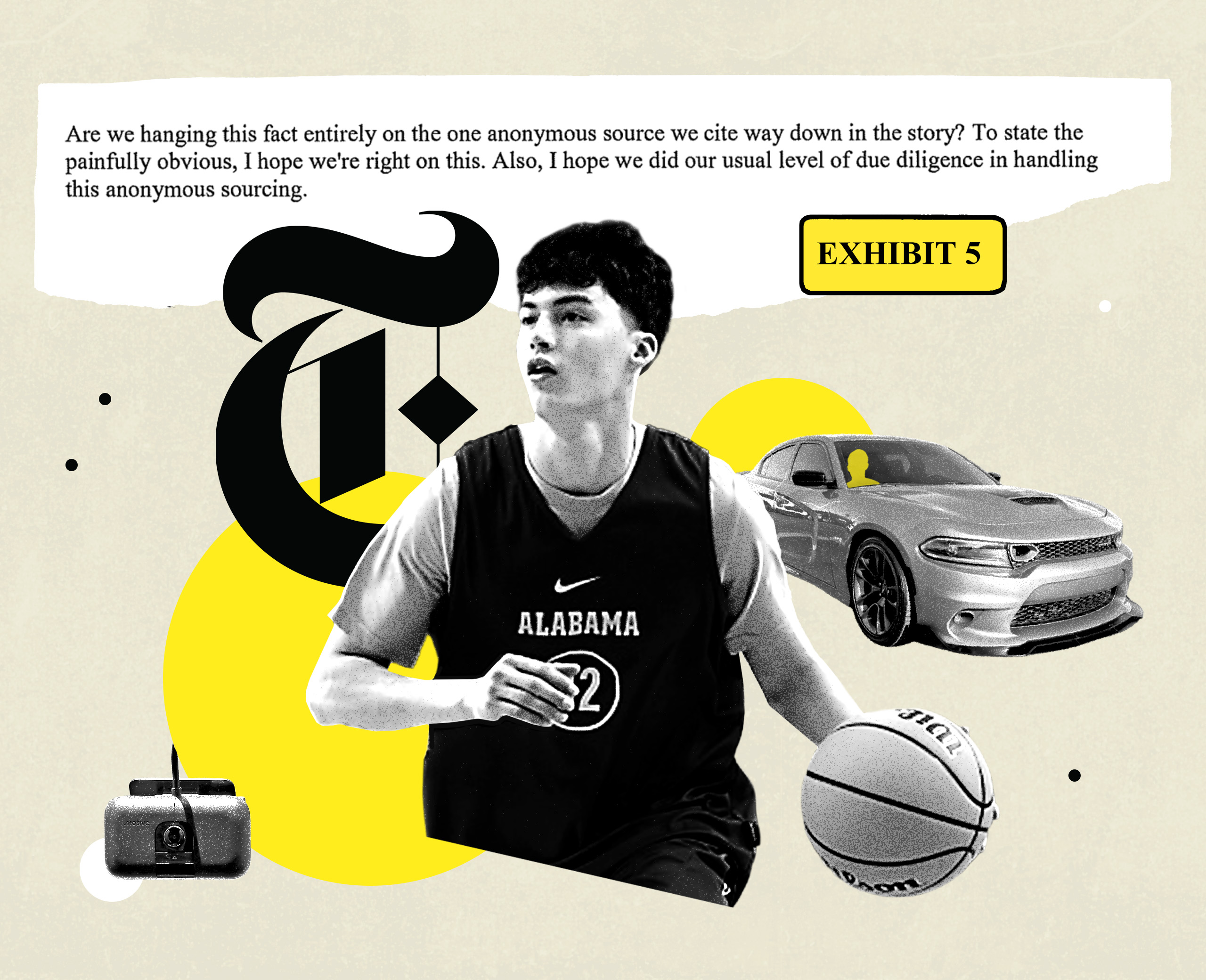
But such was the scenario on the evening of March 16, 2023, when Phil Corbett, who was then the associate managing editor, wrote this to the leaders of the Times’ Sports section: “To state the painfully obvious, I hope we’re right on this. Also, I hope we did our usual level of due diligence in handling this anonymous sourcing.”
Corbett’s instincts were justified. The Times’ story was a bad misfire—one that resulted in the paper’s first defamation trial loss in a United States court in more than fifty years. When the trial ended last month, in the United States District Court for the Northern District of Alabama, a jury awarded 9.25 million dollars to a former University of Alabama basketball player named Kai Spears, because the Times had mistakenly placed him as a passenger in a car that was at the scene of a tragic shooting death.
I’ve examined hundreds of pages of depositions, court briefs, and news stories about the case, and interviewed key figures. At almost every turn, Times journalists misplayed their hand, whether in a brief interview with Spears, or in the seventy-nine days that it took to correct the error, or in Corbett’s email—which became part of the court record only because he took Times legal staff off the chain, thus removing the privilege that attaches to attorney-client correspondence.
The Times calls the erroneous story “an honest mistake,” says it is reviewing its legal options, and has already won one concession: on August 31, Annemarie Carney Axon, the US district court judge, trimmed the award almost in half, to 4.75 million dollars, upon determining that the jury’s punitive-damage figure was too high.
For Spears, the verdict was vindication. The Times piece, he said, caused him profound anguish: When his team, which was top-ranked, got back on the floor, fans “were calling me a murderer and a killer.”
The events leading to the shooting were never in much dispute. Several hours after a game in January of 2023, players and their friends went out in Tuscaloosa—to the Houndstooth Bar, Moe’s Original BBQ, a Waffle House. Sometime after midnight, a few of them peeled off and got into an altercation, which resulted in shots being fired and the death of a twenty-three-year-old mother who was an innocent passenger in one of the cars. The gunman was convicted of murder. Darius Miles, a teammate of Spears’s, was accused of providing the gun used in the killing. He has pleaded not guilty and is awaiting trial on a capital-murder charge.
Local reporters soon learned that an unidentified person associated with Alabama’s basketball program was in one of the vehicles the night of the shooting. “After working a few sources,” wrote Ryan Phillips, a Patch reporter who covered the case extensively, “it became clear pretty quick that the other individual was an Alabama basketball manager who had been cleared by police”—in other words, not a player, as Spears was.
Two months later, as the NCAA championships were about to get underway, Billy Witz, a veteran sports reporter at the Times, wrote a story about how the shooting had affected the team. A few days after that, he visited Tuscaloosa to review documents on the killing. He also interviewed someone—identified in court documents only as “Source A”—who said that Spears was at the shooting scene, in a car that belonged to Brandon Miller, Alabama’s All-American forward.
In July of 2024, when Witz faced Stephen New, Spears’s lawyer, he said that Source A showed him documents and a “surveillance video” of the shooting. But that evidence wasn’t conclusive. “Kai Spears is not depicted in that surveillance video, is he?” asked New. “I don’t believe so,” Witz replied.
After visiting Tuscaloosa, back in 2023, Witz headed to Birmingham to meet with the basketball team. He managed to get a brief locker room interview with Spears, who was then eighteen, which was recorded:
Witz: “Kai? Hey, I’m Billy Witz with the New York Times.”
Spears: “Nice to meet you.”
Witz: “Hey, I know this is a touchy subject, but I understand you were in the car on the night of the shooting, and I could only imagine—I saw the video of it—I mean, I could only imagine, like, how terrifying that must have been. I mean—can you just describe, like, kind of what—”
Spears: “I’m sorry. I’m not going to be able to speak on that matter.”
Witz: “Okay. Okay. Okay. Like, anything? Or—okay, all right. Okay. Sorry. Thanks. Okay.”
That’s it. At no point does Witz directly ask Spears if he was in the car. It’s not clear what Spears would have said, since players were under instructions from the university to keep their mouths shut.
That interaction came up repeatedly in the deposition, which stretched over ten hours. New grilled Witz in a way that would make any reporter squirm. Here are excerpts from a much longer exchange:
New: “Just so that we’re clear, nowhere in your speaking to Kai Spears do you ask him whether he was the passenger in the car, correct?”
Witz: “Yes. That’s true.… I believed that he was, and so I was most interested in asking him about his reaction to—or his—you know, as I alluded to, I saw the video, and it was terrifying.… It became clear that he didn’t want to talk at all about this, so rather than belabor it, I think I just said thank you and went to talk to somebody else.”…
New: “Maybe if you would have asked an artful question, like ‘I’m giving you a chance to tell me whether you were the passenger in Brandon Miller’s car’ instead of bumbling, stumbling, fumbling through, as we heard, you might have gotten a good answer. Is that fair?”
Witz: “It’s hard to say what would have happened.”
New: “If he told you, ‘That wasn’t me, wasn’t me,’ what would you have done?”
Witz: “I don’t think we would have run the story.”
Nevertheless, the story did run, just hours later, with the headline “A Fourth Alabama Player Was at a Deadly Shooting, in a Car Hit by Bullets.” It was a team effort. Shortly before the article was published, Witz and his editor, Oskar Garcia, were “in the file together,” Witz said. Hours later, Garcia provided Witz a draft of an email that his reporter would send, almost verbatim, seeking answers from a university representative: “Why has the university been less than transparent?” Garcia wrote. The questions assumed that Spears was in the car; the Times did not ask directly whether that was, in fact, true.
The article, which appeared in print and online, attracted almost a hundred and sixty thousand page views by the next day and was picked up by other national outlets. That fourth player, Witz stated without attribution or ambiguity, was “Kai Spears, a freshman walk-on whose presence at the scene had not been previously reported.” Nine paragraphs later, the Times attributed this information to a “person familiar with the case” who “spoke on condition of anonymity to discuss sensitive matters.” The story included Spears’s no-comment quote and added that “Alabama athletic officials did not immediately respond to messages seeking comment.”
Within hours, a deluge of denials ensued, including an email late that night from New to the Times calling the allegation “demonstrably false and libelous.” The university issued a statement saying the story was an “inaccurate report.” Spears posted on Instagram that Witz “had complete disregard for the truth.” Christian Spears, Kai’s father, who was then the director of athletics at Marshall University in West Virginia, said, “We are exploring all legal options.”
The Times soon began updating the story with the denials, including one from the university that didn’t appear until the eleventh paragraph. Some Times colleagues reached out to Witz. One of them, Andrew Das, sent a text: “You feel OK on the Alabama stuff? Been thinking about you. It never feels great when they turn on reporting but if you’re confident your right then that’s all that matters.”
“Yeah, it’s been weird,” Witz responded, and referred to New as a “hillbilly ambulance chaser.” Witz then added, ominously, “My source has been steadfast but there’s some equivocation about how the source knew. Another source told me yesterday I’m likely wrong but won’t elaborate or go on the record. I’m continuing to dig.”
Separately, Corbett, the standards editor, sent his email to Witz’s bosses with concerns about the way Source A had been cited in the story. “Even assuming we are confident and correct—I’m not sure it was a good idea to give the ID as an unequivocal fact at the top, with no attribution at all, if our basis was one anonymous source. Seems as though we should have at least attributed it from the get-go.”
The denials from Alabama did not dent the Times’ certainty. “You were told by everybody except Santa Claus that your article was wrong, and yet you and the New York Times continued to say, ‘We stand by our reporting,’ right?” New asked Witz. “Yes,” he responded, “we did have a number of people telling us we were wrong, but we were working to find out more details about the case.” And publicly, the paper stood firm. A few days after the article ran, a spokesperson told al.com: “We’re confident in our story and we stand by it.”
The record was corrected only after May 30, 2023, when Spears filed his lawsuit. Spears’s lawyers eventually disclosed that it was Cooper Lee, a student manager of the basketball team, who was in the car during the shooting. The Times assigned Steve Eder, an investigative reporter, to set the record straight. On June 2, 2023, the Times ran Eder’s piece, “Alabama Basketball Manager Says He, Not Player, Was at Deadly Shooting.” The original story was corrected and given a new, tamer headline: “A Shooting That Ensnared Alabama Players Could Have Been Deadlier.”
Charlie Stadtlander, a spokesperson for the Times, told me that the company did make diligent efforts to correct the record during those two and a half months: “After receiving denials, Mr. Witz immediately sought to confirm Mr. Spears’s whereabouts and reexamine his own reporting, reaching out to multiple sources including the university and Spears’s representatives. No one was willing to provide an alibi or other information to support the denials, leaving the Times unable to confirm a correction was needed.” Garcia, when asked in his deposition to explain why it took so long, replied, “We pursued information immediately, as soon as we could. There were a lot of people who weren’t willing to engage with us at all, other than saying ‘Your story is inaccurate.’”
Despite the corrected story, the suit went forward. Michael Bell, an Alabama attorney representing the Times, called the story an “honest mistake” and characterized Witz as a “hard-working journalist busting his tail to get to the truth.” Times journalists sought to defend the process that led to the story’s publication. “Yes, we got a fact wrong, but that doesn’t mean we did anything wrong before publishing the story,” testified Garcia, the editor who worked with Witz on the piece. When Witz took the stand, he was contrite. New asked him if he’d like to say anything to Spears, who was sitting in the courtroom. Witz told him, “I’d like to apologize for misidentifying you in the car. That was a mistake, and I want to own up to it and say I’m sorry.”
The jury needed about five hours to decide that Spears had been defamed and deserved a 9.25 million dollar payout. His family was exultant. “Our goal was a simple retraction,” Spears’s father told Patch. “Instead, the Times defended its inaccurate article and continued to distort facts rather than acknowledge the harm they caused.” This was the Times newsroom’s first loss in decades, apart from some overseas litigation that included a case filed in a Russian court by an associate of Vladimir Putin. In those instances, according to the Times’ deputy general counsel, David McCraw, no damages were paid.
Anyone who has edited stories on deadline knows how difficult it can be to weigh a source’s credibility, especially when that person is someone, like Source A, who hasn’t established a track record with editors. We also know that just because an institution like a major university says your story is false, that doesn’t mean you run a correction right away.
But it does mean that editors should exert the same due diligence for a retraction request as they would for the original story. And when almost every major figure in a story says you got it wrong, while your sources are getting skittish about the original claim, you need to assign whatever resources you can to get to the truth.
Has America ever needed a media defender more than now? Help us by joining CJR today.