How much has Apple’s Newsstand increased sales of magazine apps. It’s hard to say, but Peter Kafka posts a chart showing Popular Science, at least, has clearly benefited:
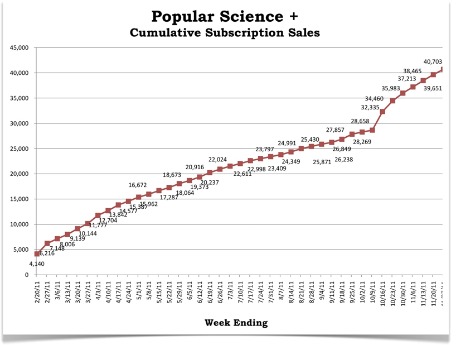
That spike toward the end coincides with the launch of Newsstand, which looks to have sent Popular Science app subscriptions roughly a quarter to a third above the trendline. As it stands, the magazine has more than 40,000 digital-app subscribers.
— Jeff Jarvis proposes a reverse paywall for The New York Times, where the site’s heaviest readers would earn credits for visiting it instead of “taxing — and perhaps turning away — the valuable users.” That sounds fine to me, if a bit pie in the sky, but the idea that papers shouldn’t want to charge your heaviest users is a bad one.
While The New York Times paywall is an unqualified success, adding (in the first four months or so) about 424,000 to the paper’s paid circulation and more than $60 million in new revenue (by my rough estimate), all while keeping digital ad revenues flowing, Mathew Ingram says, for instance, “paywalls feel wrong because they penalize a site’s most loyal readers.”
Say I’m one of my local taco stand’s most-loyal customers. I suppose I should be offended that they’re “taxing” me and “penalizing” me by charging me because I pay more for eating their food three times a week than someone who pops in twice a year?
Yes, the marginal costs of distributing an additional copy of The New York Times are virtually nil, while the marginal costs of making another taco are high. But production costs matter too. If you’re only collecting $4 for a taco plate that costs you $5 to produce, then you have to raise prices or cut costs. If you’ve already cut labor costs to the bone, and the next round would start bringing you down toward Taco Bell-type quality, you’d better start charging for that extra dollop of guacamole or salsa.
(Adding) I forgot to note the anti-paywall Steve Buttry’s prediction:
I will re-offer last year’s predictions, since they largely didn’t happen in 2011…
At least one high-profile news organization will drop its paywall.
That surely won’t happen, but even if it does, many more news organizations will be adding leaky paywalls in 2012 than dropping them. The only question for them is how leaky to make the paywall in order to optimize revenue.
— The Wall Street Journal’s Jessica Silver-Greenberg follows up on her excellent report on debt collectors harassing spouses and relatives of dead debtors.
She reports that Capital One has engaged in aggressive and illegal collection practices, going after debts that have already been discharged in bankruptcy.
It wasn’t the first time the company went after its customers for debts that had been snuffed out in bankruptcy, even though the practice is illegal. A court-appointed auditor concluded earlier this year that Capital One pursued 15,500 “erroneous claims” seeking money previously erased by a bankruptcy-court judge.
More than 800 of those borrowers have filed lawsuits or other legal actions against Capital One, the auditor said in a Dec. 6 court filing…
Debt collection is a major component of Capital One’s business that gets little attention from analysts and investors. As of Sept. 30, Capital One had $2.7 billion in net income so far this year on revenue of $12.22 billion, but it also was forced to write off $2.9 billion in uncollectible loans.
Very, very interesting.
— The Audit will be back on January 4.
Happy Holidays to Bill O’Reilly and Merry Christmas, Happy Hanukkah, and Happy New Year, etc., to everybody else.

News isn't tacos.
The value in the media business isn't all encased on content. Ask Facebook, which understands the value in relationships and data about them.
Read my post again. I argue that readers who bring more value to a media site should be valued more.
#1 Posted by Jeff Jarvis, CJR on Fri 23 Dec 2011 at 08:48 PM
Well, I'm a New York Times subscriber. Because, yes, it's that good. I hit the max many times over every single month, and especially when something is really going on. For example, on this day you would have hit the max in six hours with their magnificent coverage of this stop-the-presses event. 150+ journos all over the world working every source they had all through the night produced all this by 6 am -- that's something that new media simply could never do. It takes an institution to cover the big stuff -- one with standards and with full time paid staff all over the world with a century or more of collective professional experience and the tradition and wherewithal to protect these journos from lawsuits, government intrusion, and danger abroad.
I get much more out of my monthly subscription than I pay. And I do feel valued -- I get answers to my emails, I get a carefully moderated comment stream that adds value to the stories, I get perhaps the finest journalism and the finest web team in the country -- their graphics are innovative, informative, and relevant without being superficially flashy. And they actually do solicit content from their readers -- check out their feature The Lives They Loved - Interactive Feature - NYTimes.com. Just stunning.
But the journalism itself is much much more than anything that Facebook can do, or anywhere else on the web can do, for those of us who value the news and value journalism. For that, Facebook and most of the web add no value whatever. Sure, all news media, new and institutional, fall short of their standards and of their ideal every single day. Paying talented people a fulltime salary to do journalism, giving them the space to birddog the corrupt city council or to garner sources in Pakistan, you're right, isn't tacos. It's much, much more than Facebook or tacos, and worth paying for. They don't need to pay me anything to read and link their content; I do it because it's good.
So I don't understand that statement "The value in the media business isn't all encased on content." Huh? It's all about content. If not content, then what? What the hell do I care about a "relationship" with Facebook?
#2 Posted by James, CJR on Fri 23 Dec 2011 at 10:43 PM
James,
The way for the *media organization* to realize value is through the relationship; that's what I argue in my post. Facebook uses content as a tool to establish and add to relationships and gather data about them for making content and advertising more relevant and effective. Yes, content has value to Facebook, but as a tool.
If we think all the value is encased in the content and that we must sell our content that doesn't work in an abundance-based economy where we have endless competition, don't we know?
The value has always been in the relationships: We used content as a lure to get people to see the ads we sold to advertisers. Facebook finds new and better ways to do that. So should media. Thinking always in old models won't do that.
See also: http://www.buzzmachine.com/2011/06/23/studying-the-link-economy/
#3 Posted by Jeff Jarvis, CJR on Sat 24 Dec 2011 at 09:22 AM
I like Jarvis's reverse meter idea, but there are two obvious problems.
1. Facebook is evil.
2. Patch/AOL is obviously trying Jarvis's model (in terms of database and relationship-building), with so-far disappointing results.
#4 Posted by Edward Ericson Jr., CJR on Sat 24 Dec 2011 at 12:46 PM
Mr. Jarvis
It has always been the content that brought the eyeballs to advertisers. That's why people have been willing the buy newspapers over the decades and not the Pennysaver.
The stuff on Facebook has no intrinsic value. At best, it may contain a rare nugget of fleeting interest. People might be drawn to Facebook to make and/or maintain relationships. That's fine. It is a fine tool for doing that. That actually is not relevant to what the New York Times does. The NYT does journalism. It does news. The mission of the newspaper and the social media is in no way comparable. The former produces content, hopefully of value. The latter is only a tool that produces no value in and of itself.
And what the NYT does, in my opinion, is worth paying for. Facebook is not worth paying for, to me. That's why it's free, like Pennysaver. You mistakenly conflate the mission of a journalistic endeavor with social media. They are not at all comparable.
I think what you and your colleagues are trying to say, with all due respect, is a lot of gobbledegook. It bears no relationship to what is important in my life, which is very full, thank you very much. I don't have the time or inclination to waste the valuable hours of my life paddling through the mountains of worthless garbage on Facebook and Twitter for the occasional nugget "Dude! My plane just slid off the runway!" I don't have the need to know stuff like that immediately. Others do, I'll concede. In fact, I rely on Robert Mackey to do that for me, and to write a blurb on the Lede, after he has confirmed it is not a hoax, if that little nugget proves of any importance. Because I have, truly, better things to do.
But the value is in the content, not in some artificial relationship that only serves to facilitate advertising, as you contend. The content worthy of paying for is produced to interested people, and financed by selling a portion of that attention to advertisers. You have that whole idea exactly wrong.
#5 Posted by James, CJR on Sat 24 Dec 2011 at 03:06 PM
Mr. Jarvis has a hard time with balance sheets. Page 22 of the NYT 10k (that's an annual report, Mr. Jarvis) shows that the paywall has more than covered the losses in print advertising at the flagship paper. In short, the only thing saving the paper right now is the paywall, a feat that nearly every dilletante theorist derided. The new BH paywall and the NYT paywall will probably cover the losses in print at the entire company.
Relationships are neato, but I prefer cold, hard cash. Plenty of paywall relationships are one sided. I cough up 60 bucks to watch Floyd Mayweather, cause he is the best. Yeah and i dont have a relationship with him. I read the NYT cause its the best. The paywalls WILL do over 120m for the NYT this year. I would stake my life on it.
#6 Posted by Stephen, CJR on Sun 25 Dec 2011 at 08:11 PM