

If nothing else, Katie Couric’s earlier-than-expected departure from the CBS Evening News should call into question the superstar anchor system for television news.
And if CBS executives can’t see the end of her $15-million-a-year contract as an opportunity to add to its news-reporting staff, I feel sorry for those geniuses.
How many producers, assistant producers, and other journalist types could $15 million pay for?
Well, let’s say they average $150,000 each, including benefits—and that’s being generous for an average—you get one hundred reporters and editors. That’s a newsroom right here, and maybe an overseas bureau thrown in, if you low-ball them.
Simplistic, you say? Reductive? Naïve? I’ll get to that.
But listen, it’s not just Couric, and certainly not just anchors, that are dragging down news operations.
Check out what her boss, Les Moonves, made in 2007: $36 million. Ka-ching. Put it this way, Moonves’s bonus—$18.5 million, cash money— is more than Couric’s entire (and entirely) gross annual pay.
That’s up 28 percent, by the way, from 2006, according to the Los Angeles Times’s enterprising Meg James, who pulled the data from CBS’s latest proxy filing last week and found someone to put it in perspective.
“That goes against the trend. We are seeing no increases and even reductions in salary,” said James F. Reda, a New York-based consultant on executive compensation. “To have a 28% increase is really unusual.”
For an executive-comp consultant—the always-careful-not-to-offend people who helped bring us this out-of-whack, back-scratching executive-compensation racket, whoops! I mean “system”—to say something is “against the trend” and “really unusual” is the equivalent of a normal person saying, “That’s un-%#@$&-believable!”
It’s sad, by the way, that a reporter has to go find an expert to tell us, in the mildest possible language, that something is “really unusual,” when even Moonves 2006 compensation of $26 million—let’s call that the “usual” pay —makes no damned sense.
Oh, and here’s how CBS explains Moonves’s raise:
In the proxy, CBS explained the increases, saying that the company raised its dividend payment to stockholders by 25% to 25 cents.
So, let’s see if we can follow the logic on this one. At a time of media industry upheaval, when great innovation, investment, and imagination are required, CBS is returning to shareholders their own money because it can’t think of another use for it. And somehow, that justifies a raise. That’s nuts.
And how about this part of the company’s justification:
It also exceeded its targets for operating income and free cash flow.
I notice “net income,” that pesky bottom line, was not among the metrics cited. That was down 15 percent in the fourth quarter, as The Wall Street Journal’s Merissa Marr reported:
CBS generated significant cash but little growth in its earnings, fanning ongoing concerns about the long-term prospects of its traditional businesses. TV and radio were both weak, with radio’s operating income plunging 22%, as the sale of stations and softer ad sales took a toll.
James of the LAT puts Moonves’s pay in perspective:
The disclosure comes at an awkward time for CBS, which has been pummeled by steep declines in prime-time television ratings and softness in advertising sales at its radio and TV stations. CBS revenue declined 2% in 2007 to $14 billion, and net income fell 24% to $1.25 billion.
CBS shares, meanwhile, fell 21% from their peak in July 2007 to the end of the year, and have tumbled another 21% since January.
To shave costs, CBS last week laid off more than 160 news anchors, reporters and technicians from its TV stations across the country. The move followed cuts last year in the radio division.
Cuts in the newsroom. Now that’s a brilliant strategy. And how well it seems to be working. Why didn’t Dow Jones think of that one?
What other strategic initiatives has Moonves run up the flagpole?
On top of that, Moonves just moved CBS’ top West Coast executives from their longtime home at Television City in the Fairfax district into lavish, multimillion-dollar offices in Studio City.
All right, then.
Not surprisingly, CBS investors are not as impressed with those “operating income” and “free-cash flow” numbers, or, for that matter, the dividend, as CBS’s compensation committee apparently is. Here’s CBS compared to its peers:
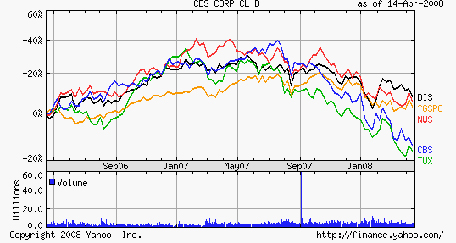
All I can say is, thank goodness for Time Warner, a true disaster.
But listen, we’re talking about Couric and news budgets and all that. Officially, by the way, a CBS spokeswoman says no changes are planned:
We are very proud of the CBS Evening News, particularly our political coverage. And there are no plans for any changes regarding Katie or the broadcast.
Moonves gave Couric a vote of confidence of sorts last December, the LAT reported :
“I think our product’s as good as anyone’s,” Moonves said as recently as December, speaking at a media conference. He added about Couric: “I still believe in her. Hardest worker in town.”
See, but it just seems to us up here at the Columbia Journalism Review—and really, when’s the last time we rode around in a black Town Car making important strategic decisions about far-flung media properties? It’s been years, if ever—that the “product” that CBS Evening News produces is, like, um, news, you know, in the, ah, evening.
And—again, just blue-skying it here, L.M.; stay with me—that perhaps additional news reporters, or “producers,” or “product producers,” or whatever they’re called in TV—anyway, additional journalists—might actually produce a journalistic product that is, um, qualitatively of, ah, a higher, err…what’s the word?… quality, you know, product-wise, productivity-wise, as measured by focus groups, and, um, page-views, and “hits” and whatnot and so forth. But again, we don’t know high finance or any damned thing up here, let alone TV.
But let’s get down to brass tacks, L.M. Your spokeswoman won’t comment, but a person familiar with situation tells us that the so-called “newsgathering budget” for all of CBS News, including salaries, travel, camera people, technicians—not including 60 Minutes and 48 Hours, which have separate budgets, for some reason—is about $300 million. CBS News employs around 1,100 people, this person says.
But remember, those figures include the whole ball of wax. An increase in the news budget of $15 million, $10 million, or even $5 million is not a marginal number. It means more boots on the ground, more reach, more foreign-based reporting, more travel, and especially, more time—time for thought, for the extra calls, for investigations, and, importantly, time for stories to fall through if the facts don’t really support them, as they didn’t for a half-baked 60 Minutes piece on supposedly marauding hedge funds that were actually in the right .
All this, to me, makes the news more authoritative, credible, powerful, and relevant.
I understand, by the way, that Couric’s salary probably didn’t all come from the Evening News budget and that, indeed, the news budget probably grew to accommodate her pay and the revamping of the show.
But this is about emphasis: Spend less on the star system, less on gimmicks. Spend more on building up the newsroom.
Don’t like that idea? Okay, but Moonves’s anchor-focused strategy clearly didn’t work. I don’t mean to downplay the anchor’s job; it’s clearly important. Couric may not have seemed entirely comfortable in the role, but she’s obviously a big talent. It’s pretty clear that CBS’s biggest mistake was attempting to reinvent the evening news around her, as the Journal’s Rebecca Dana reported in the scoop that started all this:
When she started on the show in September 2006, Ms. Couric incorporated longer interviews, occasionally conducted in front of a fireplace, and chatty asides into the broadcast. For the first few days, curiosity drove more than 10 million viewers to tune in, but in the months that followed, Ms. Couric’s ratings plummeted to a low for the broadcast, bottoming out to around five million in the spring of 2007—well below the seven million viewers the show was drawing before Ms. Couric’s arrival.
Since then, the network has scaled back its ambitions drastically, returning to a traditional format. Ratings have ticked up modestly, but Ms. Couric’s show is still placing a distant third.
It strikes me as a significant data point that Couric’s show never made it to the levels achieved by Bob Schieffer, who took over after Dan Rather’s ouster.
Is Schieffer better than Couric? No.
Media competitors and analysts have been baffled by growing circulation and revenue at the Economist and the Financial Times, while the rest of the print industry is falling apart. Sure, those are financial publications, and the economy is of interest right now. And yes, I have problems with both of them, journalistically, for reasons I’ll get into in another post.
But think of it this way: they both offer information readers find relevant in a straightforward manner. They don’t rely on gimmicks. They’re not reinventing anything. They don’t talk down to readers. Both offer a lot of international coverage, too, come to think of it.
I believe that a straightforward approach to news reporting and presentation is the way to go. Report. Write. Do the work.
Will that make the CBS Evening News more popular and therefore profitable? Well, to put it in Moonves’s terms, you’ve got to believe in the product. The product is the news.
Dean Starkman Dean Starkman runs The Audit, CJR’s business section, and is the author of The Watchdog That Didn’t Bark: The Financial Crisis and the Disappearance of Investigative Journalism (Columbia University Press, January 2014). Follow Dean on Twitter: @deanstarkman.