Gannett says “we need to take further steps to align our costs with the current revenue trends,” so it’s laying off 700 employees in its newspaper division—about 2 percent of the company’s total workforce.
Poynter’s Jim Romenesko is good to note that Bob Dickey, the guy who announced the “extremely difficult and painful decisions,” got paid $3.4 million last year.
And he’s not even the CEO.
That’s Craig Dubow, who raked in $9.4 million.
And $3.4 million Dickey isn’t even No. 2 in the Gannett lottery. Chief Operating Officer Gracia Martore took home a whopping $8.2 million. Plus, the struggling newspaper company (redundant, I know) had at least three other multimillionaires on the payroll: CFO Paul Saleh, who made $2.9 million; USA Today publisher David Hunke, who got $2.5 million; and president of broadcasting Dave Lougee, who got a mere $2.2 million. These folks are kidding, right?
Those are the only million-dollar-plus paydays disclosed in the company’s 2010 proxy. There may be more.
Look, running Gannett Company Incorporated isn’t easy these days, but it isn’t the roughest thing in the world, and I haven’t heard anything that makes these folks seem like they’ve got any kind of grasp on where to go in the splintered media age. And those salaries are awfully high for a company barely hanging on to its Fortune 500 status and dropping fast.
Hmm, how could we preserve more value for long-suffering Gannett shareholders (not to mention longer-suffering Gannett readers, but really—who cares about them?) both in the near and the long terms?
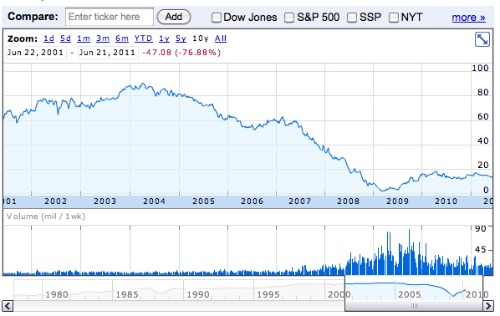
Here’s a thought experiment: If all six of these Gannett executives worked for a million bucks a year would they work less hard? I doubt it. That’s still a whole lot of money. So why not try it and take the money saved and hire some of those workers back? Heck, we’ll even give the CEO $2 million to salve his ego and pay for whatever it is he needs so badly to make it through the day. That will keep quality from deteriorating further at already gutted Gannett papers and perhaps even retain some of the energy, experience, and ideas that are needed to help find a way out of this morass. Might even give morale a shot in the arm, too. What’s the alternative? Throwing it down the executive-suite sinkhole? No, thanks.
I’m not a Gannett shareholder, thank God. But if shareholders had exercised their say-on-pay (Just kidding. I know that doesn’t work, but bear with me!) and reined in executive pay along the lines I’m talking about, that would net us $22 million. How many jobs could generous Gannett execs save by making their paychecks somewhat less obscene?
Let’s guess that Gannett’s cost-per-employee it’s laying off is about $75,000 each. That’s $53 million. So Dubow & Co. could fund the salaries of 40 percent of the fired by becoming lowlier millionaires.
But that presumes they’re interested in stewardship. If so, time’s running out. This carcass is getting mighty lean.


I will agree that these executives are likely overpaid, as they're probably as incompetent as any other media executives, particularly in the newspaper business. But I hate to break it to you, executive pay is not the reason the newspaper business is going under. Newspapers are going under because they've been cloistered from competition for decades and are now facing new tech that's completely disrupting their business, ie the internet, that they're totally unprepared for. News and all media are being transformed into tech businesses, where software and continually coming up with new ways of delivering information are an integral part of the basic enterprise, yet I have not seen a single media company that fully appreciates this. No current media company, from Disney to the WSJ, will survive the coming wave, so quibbling about the executive deck chairs on the Titanic seems a little pointless. ;)
#1 Posted by Ajay, CJR on Wed 22 Jun 2011 at 05:04 AM
Ryan wrote: How many jobs could generous Gannett execs save by making their paychecks somewhat less obscene?
padikiller responds: Since when is it a corporations responsibility to "save jobs"?
The truth is that (for profit) corporations exist to make... profits! Not jobs.
The duty of a corporation is to employ the fewest number of people it can and to pay them the lowest fair market wage possible in order to maximize profits.
If I were a Gannett shareholder (and I'm not) I'd be pissed off at the executive compensation... But Ryan is mixing apples and oranges - the people who are losing money to executive compensation are the shareholders - not the employees. If there isn't enough work for 700 people to do, then these people need to go, no matter how much the executives make.
#2 Posted by padikiller, CJR on Wed 22 Jun 2011 at 09:46 AM
I take it paidkiller isn't a journalist or a reader of journalism. These newspapers -- you know, the actual product Gannett is allegedly selling to make it's money -- were barely staffed as it was. Layoffs have decimated the quality, size and value of said product, making it less appealing to consumers. The employees were each doing the job of three or four people. It wasn't that they "had nothing to do" -- it's that Gannett doesn't care about its product anymore.
#3 Posted by Mandy Jenkins, CJR on Wed 22 Jun 2011 at 11:26 AM
In response to the first couple of comments ... Making profits surely is the point of running a business. Still, there is a business reason why you would shave executive pay to continue to employ 700 minions -- to put out a product worth buying. When reporters who used to cover one beat now cover three or four, when spaghetti dinners are deemed more newsworthy than city council meetings, when reader-submitted photos dominate the newspaper websites, when coverage of an issue stops at the press release, the product isn't worth buying anymore. Then, the death spiral will be complete. Maybe Gannett's real plan is to suck out every last dollar before engineering its own kamikaze-style demise.
#4 Posted by Bert Dalmer, CJR on Wed 22 Jun 2011 at 11:48 AM
Funds that could be used to improve the news products -- print and online -- are instead going to deadbeats who enrich themselves and each other while driving the company to its destruction. News companies have myriad and systemic problems, of course. Their failures are often suicides. In Gannett's case, the only reasonable explanation is that its leaders are trying to kill off the newspapers. When a newspaper like the one I used to work for (the Home News Tribune in Central Jersey) are filleted to mere skeletons, readers no longer have good reasons to pick up the paper or visit the website. Advertisers have no reason to put their money there.
#5 Posted by Carrespondent, CJR on Wed 22 Jun 2011 at 12:22 PM
It's so obvious this is just a way of maximizing SHORT term profits and keeping the stock price high. The long term plan is the "beast will die" and the top Gannett brass will have done everything in their powers to increase their own personal wealth. It won't take much more of this.
#6 Posted by One of the 20,700 laid off, CJR on Wed 22 Jun 2011 at 01:17 PM
Dead tree journalism is to 2011 as blacksmithing was to 1911.
That's just how it is, guys.
Evolve or die.
The people who huge run companies make gobs of money. Not because they steal it, but because investors give it to them. They either earn it or they get canned.
Journalists, like other tradesmen, only get paid what they're worth... Which in the free market is not a lot. Any typist with a Thinkpad and the ability to write at the 8th grade level can be a "professional journalist". There is no license (unlike true professionals, like plumbers or steamfitters). No minimum education or experience (like doctors or lawyers). No certification (like professional welders). Nada.
See you lucky ones on the Ipad, guys!
#7 Posted by padikiller, CJR on Wed 22 Jun 2011 at 04:46 PM
padikiller: You are truthful in saying that corporations exist to make profit, but while that is the base of the equation that keeps the shareholders smiling if there is no fostering of product or business innovation that profit will eventually die out. Gannett was in an international, cross-media, capitalized position, way back when, where a climate that fostered innovation and investment into the digital age might have made them a leader. Instead, they kept twisting and squeezing the same business model until its inevitable death. Inevitable, because its leaders could never imagine a transformation, but patted themselves on the back each time they were able to keep profit alive just a little bit longer and were rewarded well for it.
#8 Posted by begreenwithnv, CJR on Wed 22 Jun 2011 at 06:48 PM
@begreen: You'll get no argument out of me that Gannett has been poorly run.
I was working for their East coast press operation when USA Today started and I saw the energy drain from the company all the way until they moved out of Rosslyn and into Tyson's Corner.
This slow death is natural selection at work.
The investors paid these guys big bucks to make stupid decisions and the investors are paying the price. The money will flow (in the free market) to the guys who make the right decisions and make a pile of money.
The commie/liberals who post here can't tolerate the free market. It really, really drives them nuts to see people making gobs of money. They want "equality" in compensation, without equality in ability, effort or risk. In short, they want what commie/liberals always want... Somebody else's money for nothing.
If only the "rich" would give up money to the "poor", all would be good in the world, they claim. The result of this stupidity is plain to see in the public housing projects, the trailer parks, the government schools, and the prisons all over this country. We have created a permanent, dependent underclass in our society that has no greater aspiration than to procreate its way into the maximum mooching it can affect upon the taxpayers.
Thanks, Great Society!...
#9 Posted by padikiller, CJR on Wed 22 Jun 2011 at 08:24 PM
Padi,
Your assertion that "truth is that (for profit) corporations exist to make... profits! Not jobs" is not necessarily true. It is for most companies in the U.S. in the age of shareholder capitalism, which sees share returns as the only point. But stakeholder capitalism takes into account the needs of investors along with what's good for the workforce. And even in the U.S. the shareholder value model hasn't always been ascendant.
But if corporations exist solely to make profits, you'd think that the corporation would not just try to squeeze labor costs from the mass of workers it employs, but also from the managers at the top. And that's not the case--at all. By contrast, companies are being looted by their managers and boards--and shareholders have hardly any say in it. That not only affects workers, it hurts profits too.
And anyway, as I said here:
"That will keep quality from deteriorating further at already gutted Gannett papers and perhaps even retain some of the energy, experience, and ideas that are needed to help find a way out of this morass. Might even give morale a shot in the arm, too."
By firing 700 people and paying its executives millions of dollars, Gannett is almost certainly going to earn lower profits than it would by cutting executive pay and retaining about half of them. Fewer ad sales staff, even lower quality papers=lower revenue and lower profits. It's not like there's a lot of fat left in the newspaper business, particularly at a company like Gannett that's juiced its newspapers for crazy profit margins for decades.
#10 Posted by Ryan Chittum, CJR on Thu 23 Jun 2011 at 12:31 AM
"I was working for their East coast press operation when USA Today started and I saw the energy drain from the company all the way until they moved out of Rosslyn and into Tyson's Corner."
Wow. That must have affected your paper route.
#11 Posted by Thimbles, CJR on Thu 23 Jun 2011 at 12:37 AM
I must say, it is strange to see a company with healthy 8-12% margins firing so many of their employees. I think the execs probably want to keep margins up to keep their shareholders around, who are used to fat, fat margins from newspapers historically. However, it is silly to aim for historical margins in a new, highly competitive environment. Another reason is that revenues are down 30% over the last 3-4 years, so maybe they figure it's time to cut some costs too. Ultimately, who cares. Whether they do it for good reasons or bad, no current newspaper can survive the onslaught of the bloggers, so it hardly matters what the reasons are. These companies, whether the NYT or WSJ, will all be bankrupt like the Tribune Co within a decade.
#12 Posted by Ajay, CJR on Thu 23 Jun 2011 at 12:57 AM
Ryan wrote: But stakeholder capitalism takes into account the needs of investors along with what's good for the workforce
padikiller responds: "Stakeholder capitalism" is nothing but latest commie/liberal buzzword - it's just socialists doing their best to creep into the business world. In the real world - business exists to make profits, and maximizing profits is the chief goal of the business. There are other goals, to be sure - preserving and increasing capital and market share - and certainly social altruism, to the extent that it is consistent with sound business practice, is among these goals. But the job of company executives is to look out for the bottom line.
Looking out for employees usually makes business sense. It usually isn't inconsistent with making money. But sometimes it is, and when these interests conflict, the shareholders come first.
Ryan continues: Companies are being looted by their managers and boards--and shareholders have hardly any say in it.
padikiller: "Looted" is loaded language that belies your bias.
Peyton Manning makes a salary of $17 million to chuck leather three hours a week for 16 weeks. That's more than the CEO of Gannett and more than the CEO of Pfizer, a company that employs more than 100,000 people and makes life-saving drugs. What happens if Peyton Manning screws up? He gets canned. Just like CEO's do. What's the difference? Is Peyton Manning "looting" the Colts? Hell no! He's getting paid what he's worth in the free market.
Gannett is company with operating revenue of a BILLION dollars. Executive compensation is a drop in the bucket.
And of course shareholders have a say in CEO compensation - they vote in the directors who set executive compensation. Your assertion to the contrary is ludicrous.
Finally, just like it isn't easy to find a quarterback to take you to the Super Bowl, it isn't easy to find an executive to lead a global company with tens of thousands of employees. You have to pay these guys well. Talent costs money. Does it always pay off? Of course not. Witness Ryan Leaf...
Ryan concludes: By firing 700 people and paying its executives millions of dollars, Gannett is almost certainly going to earn lower profits than it would by cutting executive pay and retaining about half of them.
padikiller responds: Says who? You?
Maybe you're right, maybe you're wrong. However, the elected board of Gannett thinks you're wrong and unless you have some management experience that we don't know about, why is there any reason to believe that you know how to run a company better than its executives do? At any rate, it isn't your decision, it isn't my decision, it's the company's decision, and that's the way it should stay.
It isn't the province of the people to tell others what to do with their own property, aside from collecting taxes...
Speaking of which..
Gannett paid $137 MILLION in income taxes each year... You want to save jobs, Ryan? Do the math... That's almost $200,000 for each laid off employee.
You want to save jobs? Cut taxes.
#13 Posted by padikiller, CJR on Thu 23 Jun 2011 at 10:16 AM
padikiller, I'm sitting here trying to figure out how communists are also socialists - but if it makes you feel better mindlessly throwing out a bunch of conservative buzzwords, that's your bag, I guess.
#14 Posted by Jay, CJR on Thu 23 Jun 2011 at 09:49 PM
Jay wrote: padikiller, I'm sitting here trying to figure out how communists are also socialists
padikiller elucidates: Ask and you shall receive, Jay. Socialism is the precursor to communism, at least as envisioned by Marx and Engels.
"The Marxist conception of socialism is that of a specific historical phase that will displace capitalism and precede communism. The major characteristics of socialism (particularly as conceived by Marx and Engels after the Paris Commune of 1871) are that the proletariat will control the means of production through a workers' state erected by the workers in their interests. Economic activity would still be organised through the use of incentive systems and social classes would still exist, but to a lesser and diminishing extent than under capitalism."
http://en.wikipedia.org/wiki/Socialism
#15 Posted by padikiller, CJR on Thu 23 Jun 2011 at 10:42 PM
"Gannett paid $137 MILLION in income taxes each year... You want to save jobs, Ryan? Do the math... That's almost $200,000 for each laid off employee.
You want to save jobs? Cut taxes."
How would that save jobs. We've tried cutting taxes in the past and it just goes into the gullets of shareholders and executives. Layoffs still happen, unemployment still goes up, demand still contracts, and the vicious cycle continues.
Without conditions on the tax cuts, tax cuts are less than useless.
PS. where do you get your figures for a $137 million
Because they don't show up in any filings I can see:
http://biz.yahoo.com/e/110504/gci10-q.html
"The Company's effective income tax rate for continuing operations was 29.9% for the first quarter of 2011, compared to 32.0% for 2010. The higher rate in the prior year primarily reflects the additional income tax charge taken in 2010 for the change in tax status of Medicare subsidies."
In fact the only number I can find which slightly resembles your math is from this:
http://yahoo.brand.edgar-online.com/displayfilinginfo.aspx?FilingID=7906117-84836-92742&type=sect&dcn=0000950123-11-044647
in which pretax income is stated as $136.742 million for the quarter and the provision for taxes is stated as about 28% of that.
Care to explain?
#16 Posted by Thimbles, CJR on Fri 24 Jun 2011 at 02:48 AM
Actually.. You're right, Thimbles..
I've miscalculated the taxes...
Gannett's 2010 net income (according to Wikipedia) was $588.2 million. It's net income tax rate in 2010 was, as you point out from the annual report, 32 percent.
Doing the math... $588.2 million times 32% = $188.2 million in income tax instead of $137 million.
So let's get this straight...
In Liberal La La Land, money that goes to pays taxes doesn't cost jobs... But money that goes to pay executives does cost jobs...
Gotcha!..
Who could argue with this kind of ironclad logic?
#17 Posted by padikiller, CJR on Fri 24 Jun 2011 at 03:21 PM
When Newspapers hooked up with Wall Street it created a disaster in our industry.
#18 Posted by Steve Hadland, CJR on Fri 24 Jun 2011 at 03:31 PM
"Journalists, like other tradesmen, only get paid what they're worth... Which in the free market is not a lot. Any typist with a Thinkpad and the ability to write at the 8th grade level can be a "professional journalist". There is no license (unlike true professionals, like plumbers or steamfitters). No minimum education or experience (like doctors or lawyers). No certification (like professional welders). Nada."
See you lucky ones on the Ipad, guys!
OK, enough of the reporter bashing.
I spent 17 years working as a reporter for a series of weekly/daily papers in the Boston area before I made the jump into full-time freelancing in the fall of 2008. I've doubled my income writing/reporting for both print and online publications. I'm hardly alone. You may not need a license to become a reporter/journalist, but you sure as heck need to know what you are doing to work in the field and have any success at it.
If newspapers are going to survive, the solutions are going to come from the bottom up, not from the top down. The complacent and overpaid executives running today's fast-shrinking newspaper empires don't have a clue how talented and motivated their workforces are. Despite low pay, newspapers have long been able to attract bright, talented and creative people willing to work long hours out of sheer love of the craft. With the industry's back against the wall, publishers should be turning their newsrooms into media laboratories, giving editors and reporters the power to experiment with different ways of writing and covering their communities, both in print and online. Instead, Gannett and other newspaper companies are kicking their future out the door and creating miserable work environments where only the inexperienced or lazy will stick around.
#19 Posted by Scott Van Voorhis, CJR on Fri 24 Jun 2011 at 06:20 PM
@Scott - I'm not "reporter bashing".. I'm just calling it like it is.
Anyone can be a reporter. Sure some are better at it than others, but the internet has doomed dead tree journalism and there are, as you so rightly note, many "bright, talented and creative people willing to work long hours out of sheer love of the craft"... for free...
Video and realtime blogging, tweeting, texting etc are the way of the future. No need for any analysis.
#20 Posted by padikiller, CJR on Fri 24 Jun 2011 at 06:29 PM
padikiller, I agree with you that many journalists are going to see a decline in pay, although the top 10% might actually go up a lot, because they now face intense competition that they never had before. I strongly disagree that what makes a journalist or any other professional is licensing, certification, or education though. Most of the people who you claim will work for free will have none of those qualifications anyway. Yes, there will be a lot of blogging and online video, but if there's anything the internet does much better than broadcast media, it's analysis. I think the solution is that online content creators will get paid through micropayments, so I certainly don't think it all goes free, but nobody has built that technology yet. I'm trying my hand at building out some micropayments tech myself, so let's see what happens. :)
#21 Posted by Ajay, CJR on Fri 24 Jun 2011 at 07:15 PM
@Ajay
Twenty-five years ago, if you were smart and if you wanted to make a point, you had one option - a letter to the editor. That was it.
Now, there are millions of ways to be heard. The "news" reporting creates the news - as in the Facebook wars of the "Arab Spring". By the time print journalists hammer out copy, the net journalists will have 50 videos on YouTube. For free.
Sure, columists and analysts will have a place, but even here we see sites like HuffPo and Powerline brimming with smart and capable volunteers.
Professional journalists will go the way of the telephone operators, I believe. I guess we'll have to let time tell the story.
But I am glad to see that you are bucking my prediction and I hope it works out for you.
#22 Posted by padikiller, CJR on Fri 24 Jun 2011 at 08:33 PM
padikiller, I'm not sure how much we disagree. I definitely think there's a lot of scope for part-time journalists online, as separate from full-time, "professional" journalists. However, most anyone producing quality work, whether on a part- or full-time basis, is going to want to get paid for that work and that's where micropayments come in. For all the talk of user-generated content, people still watch mostly TV shows and professionally-produced music videos on youtube and other video-sharing sites. What's holding back both the part-time podcaster and the blogger who wants to report the news full-time is that online advertising pays peanuts, as Ryan has reported before. I think micropayments solve this problem, whereas you seem to think we'll devolve into some sort of gift or attention economy, where everything's free with maybe some ads. However, I'm confident that paid approaches, perhaps starting with subscriptions but eventually turning into micropayments, will win out. That may be where we disagree.
#23 Posted by Ajay, CJR on Fri 24 Jun 2011 at 09:23 PM
The micropayment idea is as old as the web. IBM and Digital rolled out micropayment programs that fizzled in the 90s. I was actually involved with a (doomed) streaming media startup here in Virginia in 1999 that looked to micropayments to fund the expensive bandwith of the time.
It seems more likely to me that if anything will work, the bulk of paid news content will be delivered through centralized portals like AOL, Facebook or Google, once they buy out, consolidate and fund the news media blogs - a process I give 5 years to see begin in earnest, though AOL has tried to get the jump start with HuffPo.
Facebook's model of ad "cash" (usable only to buy Facebook services) seems interesting - currently ads fund most of this cash, but the future surely holds a hybrid ad revenue/customer funded model that could both satisfy demand and actually pay for some content. I can see, for example, a Facebook paywall, where free headline news content available to everyone generates ad revenue, while in-depth news junkie coverage generates some sort of subscription revenue, or is paid from credits earned by viewing ads elsewhere on the site.
But in the end, I don't think the payment system is the problem or the solution. The problem is the competition. You have millions of people who were always capable of writing, but who never had the ability to do so before the internet age. Plenty of these people are willing to write for free and the internet gives them the soapboxes they need. When it comes down to it, who's going to pay for written content if they don't have to?
#24 Posted by padikiller, CJR on Fri 24 Jun 2011 at 10:30 PM
Hmm, I'm unaware of IBM or Digital ever getting very far with a micropayment effort: did you mean DigiCash? Yes, micropayment is an old idea, which makes it all the more remarkable that the techies have been too dumb to get it right. ;) You seem to think it will take the muscle of a Google or Facebook to push paid systems through, I don't think it will take that. Btw, AOL is a laughing stock that will never go anywhere, the HuffPo purchase is a huge joke. There will always be a little advertising, but I think it will be for one very small niche, the poor.
Payment is the key, though we agree the competition will be intense. What stopped those same silent millions from putting together a newsletter on their PC, printing up a bunch of copies on their home printer, and then distributing their thoughts for the last couple decades? Yes, that would have cost more than starting a blog, but now it just costs more to get anyone to even hear about your blog when it's drowning in an ocean of other blogs, so you lowered the distribution costs but raised the marketing costs. Your assumption is that free volunteers can produce the same quality without getting paid anything for their time. I do think the future will be crowd-sourced, but most quality work will still have to be paid for.
#25 Posted by Ajay, CJR on Sat 25 Jun 2011 at 12:01 AM
Ajay wrote: Your assumption is that free volunteers can produce the same quality without getting paid anything for their time. I do think the future will be crowd-sourced, but most quality work will still have to be paid for.
padikiller responds: I agree, but at what price?
Look at medical transcription. My mother made a great living as medical transcriptionist 30 years ago. Now, the MP3's are emailed to India and the transcripts are emailed back a couple of hours later for pennies a page. There are millions of educated and skilled people willing to produce quality work for nothing.
Look at computer programming. Same thing. When you visit a website, the odds are good that the content is being served by a webserver written by volunteer programmers. Companies who need custom programs are shipping the work off to Bangalore.
I don't think the problem is a lack of demand (free vs. paid content). The problem is indeed the competition.
#26 Posted by padikiller, CJR on Sat 25 Jun 2011 at 08:23 AM
Ajay asked: I'm unaware of IBM or Digital ever getting very far with a micropayment effort: did you mean DigiCash?
padikiller responds: Digital's micropayment system was called "Millicent" and the streaming media project with which I was indirectly involved in 1999 intended to use it to fund bandwith from Quest communications.
Ultimately the system failed - the overhead costs were too high.
Here's the Digital press release:
http://www.cardweb.com/cardtrak/news/cf3_12a_97.html
#27 Posted by padikiller, CJR on Sat 25 Jun 2011 at 08:35 AM
Now the Democrats are insisting on tax increases...
Let's see... We need private sector jobs... Lots of them...
How exactly will tax increases make jobs?
#28 Posted by padikiller, CJR on Sat 25 Jun 2011 at 10:50 AM
padikiller, Oh yeah, I had forgotten about Digital's involvement with the genesis of Millicent. However, Millicent always struck me as a blueprint that wasn't deployed much. It would be interesting to know why it didn't take off then and if the same reasons apply now.
"padikiller responds: I agree, but at what price?"
Ah, that's the critical question. Even with pennies, those Indian transcriptionists are being paid, nobody's working for free. The beauty of micropayments is that all such online work can be paid for. If an Indian transcriptionist is willing to transcribe your podcast for pennies, it will be easy to pay him with micropayments. If Ryan is willing to write a blog post for $100, then has 1000 readers each wiling to pay 10 cents to read that post, a micropayment system allows those transactions to clear.
As for the notion that competition still drives the price to zero, Apple makes billions writing software for mobile devices, Google makes billions writing search algorithms, and Microsoft makes billions off their web server, IIS, and associated software. There will always be customers willing to pay for quality, they just don't want to pay for a subscription up front right now. If we deploy micropayments, they don't have to pay one content creator up front. You are right that competition will lower prices for easily commoditized work, but the price of content will never go to zero.
#29 Posted by Ajay, CJR on Sat 25 Jun 2011 at 07:56 PM
Ajay wrote: Millicent always struck me as a blueprint that wasn't deployed much. It would be interesting to know why it didn't take off then and if the same reasons apply now.
padikiller responds: I can only speak to what I know from experience garnered 10 years ago. And "full disclosure", I was in the position of cutting losses then, not in the position of figuring out how to make micropayments work...
In 1999, the issue was the overhead... There was simply no way to charge a customer a 20th of a cent without incurring 3 cents in overhead. I suspect conditions have only worsened in the intervening years. Who can process a payment for pennies for nothing?
There is a "floor" price for a transaction that involves real money... A price that makes money for the people taking the risk in processing the transaction, and I haven't seen anything happen in the last 10 years to deal with the cost of this risk.
That being said.. Who knows? I have moved on. My attention now is focused on intellectual property, so I haven't kept up with the industry to the extent necessary to render a definitive opinion on micropayments. I spend a lot of my time in the air, looking at boring contracts and option offers.
It sounds like you have researched a mechanism to make money - and there is no question that people will pay for news, at least indirectly through advertising. Direct payment is uncharted territory, but if you can make it work, I'm all for it.
Hope for the best, expect the worst... That's where I am.. And I hope that you can make the "pay for content" model work.
#30 Posted by padikiller, CJR on Sat 25 Jun 2011 at 10:55 PM
The overhead of transaction costs has a well-known solution, in fact, iTunes uses it now. Apple simply doesn't charge your card till you've bought enough 99-cent singles for the charge to make sense. Similarly, a micropayments system would require $5 up front, then dole that out to the disparate content creators' accounts in 5 cent increments, when someone reads their blog post or listens to their podcast, only paying out once they hit some minimum, say $5. That's how Google's Adwords program works now, in a sense, it is a micropayments system if you squint just right. Costs have definitely gone down in the last decade, Amazon will now do that 20th of a cent transaction for a quarter of a cent. ;)
#31 Posted by Ajay, CJR on Sun 26 Jun 2011 at 02:36 AM
@Ajay: I came across this article. It looks like Facebook is trying to give Apple and Google a run for their money in the mobile apps business. It will be interesting to see how it shakes out.
http://www.technologyreview.com/communications/37875/?mod=chfeatured&a=f
#32 Posted by padikiller, CJR on Mon 27 Jun 2011 at 09:14 PM
Facebook's been rumored to be getting into payments or micropayments for years now, but all that's come out it so far is their little experiment in virtual currency, Facebook Credits, mostly used by the games on their platform. If they were smart enough to do micropayments, they'd have done it by now: color me skeptical. As for their mobile apps end-around, eh, I don't expect it to go anywhere.
#33 Posted by Ajay, CJR on Tue 28 Jun 2011 at 06:17 AM
Yesterday I telephoned a local newspaper owned by Gannett regarding my deep concern on their slanderous reporting. On multiple occasions they have claimed and named my 18 year old son rubbed his genitals on a sports team mate.
Never, not in a police report, not in a DA report, is my son accused of such an action. He is accused of this activity by the unsupervised anonymous bloggers to this rag and now the so-called journalist is writing front page, above the fold articles making the same accusations as bloggers.
The assistant Editor seemed flabbergasted that I was somehow bothered by this.
Mr. CEO, I will take your $9.4 million. My 18 year old's life is far more valuable than that and your company has in excess of $800 million in cash...seems I am far more reasonable and responsible than you and those you employ.
#34 Posted by Very Concerned Parent, CJR on Thu 17 Nov 2011 at 01:04 AM
Well I agree with what you have to say. I thought about it and think the problem here is knowing what the dedication level is, what is their level of knowledge of their specific job or task and how important is the following they have built of lower level employees.
If these execs took large pay cuts they will be reporting home to a wife/husband girlfriend/boyfriend who is going to look at them and say--hey, it's just not worth it anymore, you work a lot of hours, you already have over $10,000,000 saved in the bank, why not retire and start that volunteer work you have been dreaming of. While their jobs are not rocket science, losing one of them to this type of human logic could have large ripples throughout the organization.....not that losing 700 of your fellow co-workers doesn't. Sad situation...
#35 Posted by Tommy Paine, CJR on Sun 2 Dec 2012 at 11:49 AM