Nicholas Carr has a fascinating book excerpt in this month’s Wired looking at what the Internet does to how we think. He’s critical, as you can tell from his title: The Shallows.
Carr points out—uncontroversially, I thought, when I first read it last week—the downside of embedded links.
Research continues to show that people who read linear text comprehend more, remember more, and learn more than those who read text peppered with links…
A 2007 scholarly review of hypertext experiments concluded that jumping between digital documents impedes understanding. And if links are bad for concentration and comprehension, it shouldn’t be surprising that more recent research suggests that links surrounded by images, videos, and advertisements could be even worse.
In a blog post yesterday, he expands on the downside of linkage:
Sometimes, they’re big distractions – we click on a link, then another, then another, and pretty soon we’ve forgotten what we’d started out to do or to read. Other times, they’re tiny distractions, little textual gnats buzzing around your head. Even if you don’t click on a link, your eyes notice it, and your frontal cortex has to fire up a bunch of neurons to decide whether to click or not.
There can be no doubt that this is true, and the fact that Carr is getting hammered for bringing it up is bizarre.
Here’s Matthew Mathew Ingram, in what’s either an exercise in snarky point-missing or an unfair distortion of Carr’s argument:
As I mentioned to a number of other people who were discussing Nick’s piece, including Chris Anderson and Vadim Lavrusik, I think not including links (which a surprising number of web writers still don’t) is in many cases a sign of intellectual cowardice. What it says is that the writer is unprepared to have his or her ideas tested by comparing them to anyone else’s, and is hoping that no one will notice. In other cases, it’s a sign of intellectual arrogance — a sign that the writer believes these ideas sprang fully formed from his or her brain, like Athena from Zeus’s forehead, and have no link to anything that another person might have thought or written. Either way, getting rid of links is a failure on the writer’s part.
As I said in a comment on Nick’s post, I fully expect his next move will be to remove links of any kind — and then to ban comments as well, as “thinkers” such as Seth Godin have, since they just get in the way of all that pure thought. And then, perhaps, Nick will finally decide that the internet itself is rather over-rated, and will retreat to his books, where no one can argue with him. And that would be a shame, because arguing with him is such fun.
That’s like saying anybody who thinks drilling for oil in a mile of water is a bad idea really just wants to ban drilling for oil, period.
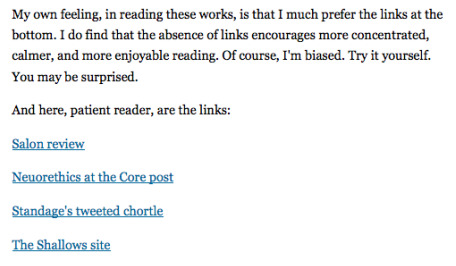
The whole point Carr is making is that embedding links in the text distracts from reading and understanding the text. It’s a reader advocacy thing, not a writerly cover-your-ass gambit. That’s very clear from the fact that Carr posts links at the bottom of the piece:
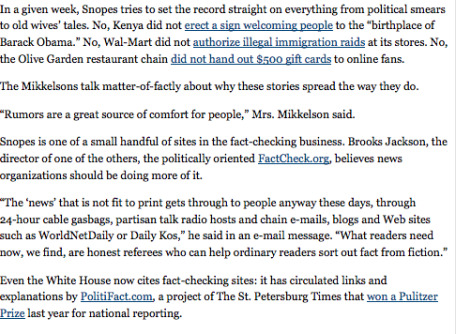
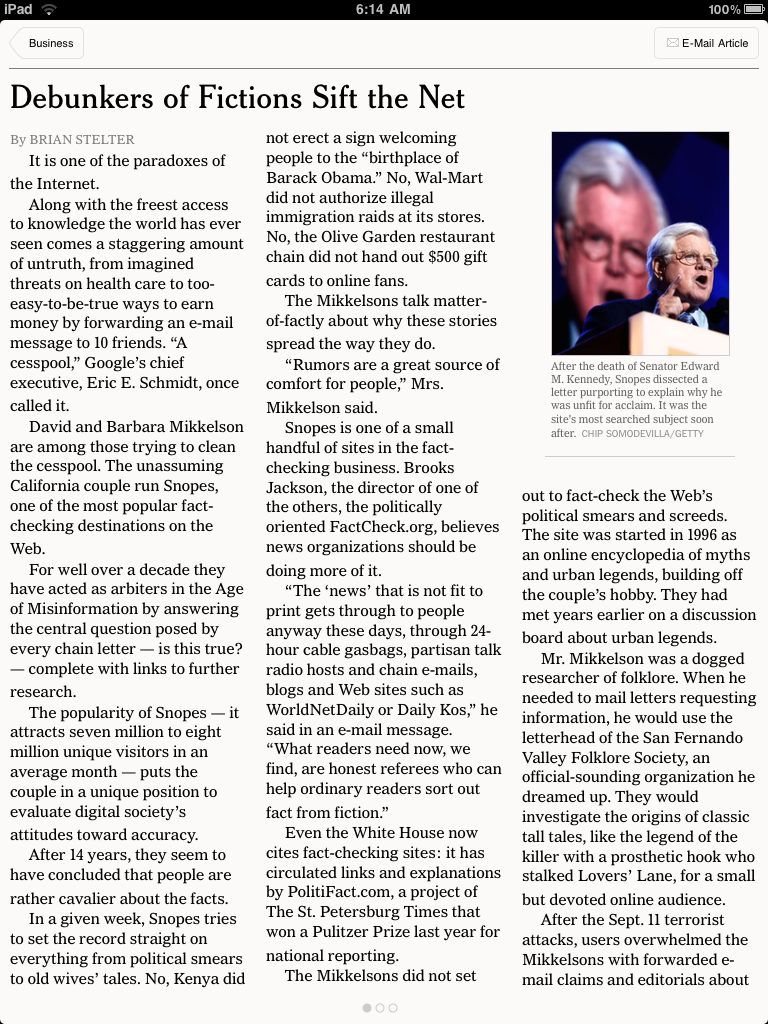
The distracted-by-links thing has long been an annoyance for me—particularly when they’re not specifically selected links. For instance, here are a few paragraphs from a New York Times column today:
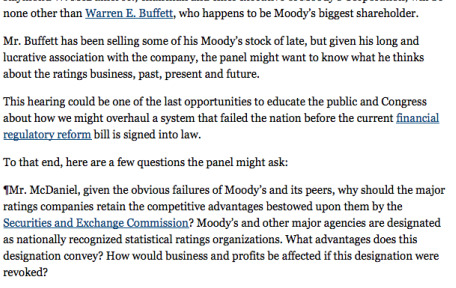
Think about reading a newspaper pre-Web that decided it wanted to turn a few words blue here and there. Isn’t that in itself distracting? Now think about how many times you jump in and out of a story to follow some link. It can’t not be distracting.
It’s not a trivial question to ask what the Internet is doing to our attention spans. I know mine, for one, is shot to hell. And my suspicion (totally unproven and based only on personal observation!) is that you scan more than you read on the Internet. With a printed publication, you read more than you do on the Web. Why is that? Well, you’re not distracted by hypertext for one.
- 1
- 2
Ryan -- first of all, "readability" is subjective. I prefer the first Times version you present. You obviously prefer the second. Don't project your preferences on the universe.
I wouldn't dismiss Carr's points as "anti-link nonsense." I do think he makes assumptions about us, about readers in general, that underestimate our own ability to make choices for ourselves. A good browser will let you present links any way you want. (See Mark Bernstein's post.)
I guess to me the idea that links are so tempting that they prevent us from focusing on the text in front of us just seems to assume that we have precious little interest in the text in the first place. Say I'm sitting in my office next to a groaning bookshelf, reading a text that mentions lots of other books. I might be tempted to put the book down if it was dull and pick another book off the shelf. Do we blame the shelf or the dull book? Should I read in an empty room so I can focus better?
It seems to me that if we want to analyze distractions on the Web the first and biggest problem is the convention of Web advertising, which -- with the exception of Google text ads (unsurprisingly, the single most successful ad format in this medium) -- have evolved into an extraordinary array of interruptions, flashing banners, interstitial delays and popunder surprises. Next to the collected toolset of the online advertiser, the "cognitive load" of the little link looks pretty puny.
#1 Posted by Scott Rosenberg, CJR on Tue 1 Jun 2010 at 10:55 PM
I don't reckon I projected my preferences on the universe. Had I, I would have said "everyone in the universe agrees it's not even close." But I do suspect that the vast, vast majority would say a block of text in a uniform font is more readable than one with multiple colors or whatever. I'm no designer, but that seems pretty fundamental.
Great re the browser style sheet thing. I'm sure the top 2 percent of geeks (the ones who would never to do such a thing) will be able to go in and reconfigure their CSS files. As for the other 98 percent, forget about it.
Your analogy to books is a real stretch—literally and figuratively. We're lazy beasts. Clicking a link takes about 1/1000th the effort (by my rigorous scientific calculations) as getting up and pulling a book off the shelf.
But these are the types of questions that ought to be sussed out rather than dismissed. That's the point. What's the cognitive effect of, in this instance, hypertext? I suspect the answer is likelier to be net positive than not—even considering deleterious effects on concentration. But I don't know, and neither does anyone else, I suspect, including you or Carr.
On advertising, I don't see that so much since I myself rarely notice ads online--unless they're interstitials or those annoying in-text ads (That's one of the big reasons I don't think ad-reliant models will work for the press online). But I'd certainly be loath to deny that they aren't seriously distracting for many or most people and perhaps, largely unnoticed, to myself.
#2 Posted by Ryan Chittum, CJR on Tue 1 Jun 2010 at 11:49 PM
Ryan, you are right to say that this is an issue that needs attention and I totally agree with you about the NYT (and many other pubs) use of links that just direct you to topic pages - annoys the hell out of me. But I think this is different to Carr's point. I think we definitely need to learn to use links better but it would be wrong to abandon them or even to put them a the bottom of the page.
I haven't seen the study's Carr quotes but I suspect some may be quite old. Usability conventions on the web evolve very quickly. I know that I have adapted to reading and working on screen - I used to have to correct essays in hard copy, I now can easily correct them with Word comment on screen.
I certainly like the look and feel of the NYT iPad app but the lack of key links frustrates me. I think we need to use links in context - because that's what they are: contextual - and I often click on something to test out the credibility of the source as part of my evaluation of the text. So having it there when I want it is a crucial part of my informed decision as to whether I keep reading or not. If used well by writer and reader they are an important part of the argument. If used poorly they are a distraction. But in both cases both writers and readers have to take responsibility for their linking/link using practices.
#3 Posted by Marcus O'Donnell, CJR on Wed 2 Jun 2010 at 02:13 AM
One of my problems with Carr is the one-sided way he presents research. Almost anything you can point to in modern society that provides benefits also has costs -- telephones, automobiles, microwave ovens. There are always going to be trade-offs. As some astute commentators have already noted, some sites have stupid linking policies which are driven by revenue and SEO concerns rather than readers' needs. It would be utterly uncontroversial to attack excessive or useless link practices.
But Carr wants attention from controversy so he's taken a small point and extended it way too far. So including appropriate links causes some TINY amount of extra distraction. It also provides readers with depth, authority and attribution among many other benefits. Are we really to believe that the human attention span is so fragile that people cannot adapt to reading a piece once over and then checking out the links? It's like saying telephone rings cause noise pollution or the clock on your microwave is distracting. It is NOT like saying autos cause air pollution or certain food additives lead to obesity. The cost/benefit analysis comes down solidly in favor of linking.
#4 Posted by Aaron Pressman, CJR on Wed 2 Jun 2010 at 10:53 AM
Links that connect you with more genuine information pertinent to the story are worth the distraction, links that take you to five other sites or pages before you can get to that information are unacceptable, abusive and manipulative.
Those who put one or two links in a story which lead you directly to everything else you want to know about the story, that's efficient and helpful. It's a relatively simple concept if you apply common sense, Socratic analysis and respect for your readers time. I always appreciate those who take that approach. I trust the links of some, while others who test my patience and waste my time, have their links passed over with extreme prejudice.
Most newspapers still don't have a clue how to use links properly, the New York Times, the Washington Post etc. etc. etc., I have an open invitation to any of them, my assistants is yours, but my fee is exorbitant and I insist on absolute editorial control. :-)
#5 Posted by Aaron B. Brown, CJR on Wed 2 Jun 2010 at 11:23 AM
A fundamental thing many (most?) "experts" miss about reading on the net is that they forget half the equation. It's not usersite. It's clientserver.
What does that mean? It means, for example, that Firefox allows you all sorts of client-side goodies (aka add-ons).
For links...
1 - I control link css. With the Stylish add-on I remove underling (underlining only happens on when I hover on links) and I - not sites - control link color. All that underlining is horrible for readability.
2 - For sites like nytimes.com - I use a greasemonkey script to remove the massive amounts of link/garbage inside paragraph tags. I convert the junk links to text.
an example
John Hughes Touch
http://www.nytimes.com/2009/08/08/movies/08appraisal.html?pagewanted=all
Without my script - there are 26 links. With my script enabled - there are 0.
>> Either way, getting rid of links is a failure on the writer’s part.
Thomas Friedman never links. Which means if he says "While I was playing golf with [captain of industry] he mentioned an interesting paper by [obscure guy] on [topic at hand]." - I have to google, and than google some more to try to find that article. Well, I HAD TO. I never read Friedman anymore. I avoid his articles. In fact - I usually avoid all columnists who refuse to include links. Man, it's annoying when there's something like this "In a popular youtube video..." - just give me the link!
testing - do BRs work in here?1
2
3
4
5
#6 Posted by F. Murray Rumpelstiltskin, CJR on Thu 3 Jun 2010 at 12:25 PM