In the appendix of that report on executive compensation and inequality that the Washington Post wrote about the other day, there’s an interesting chart comparing stock market indexes for the U.S., France, and Japan from 1981 to 2006. Check it out (figure 3, page 74):
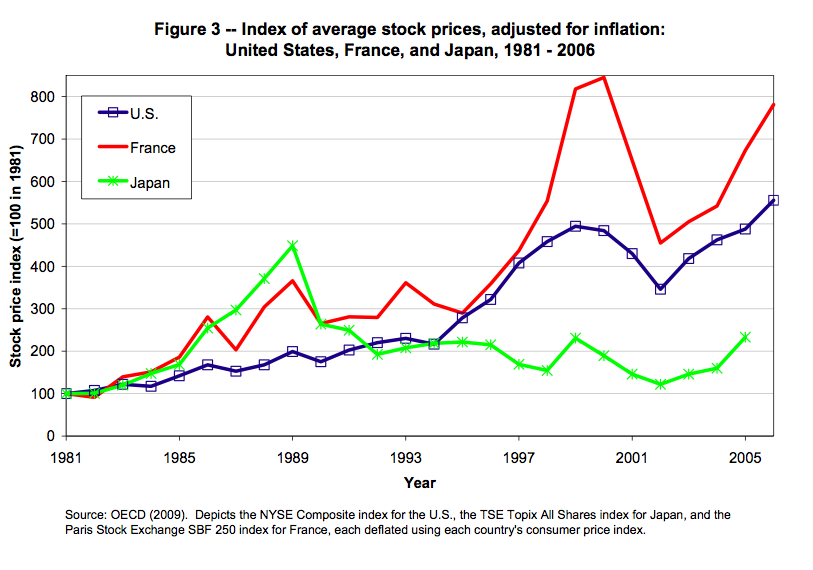
First, applaud the fact that the authors adjusted stock prices for inflation. That’s almost never done. They did it here by prices for each respective country.
The authors cut off the stock chart at 2006 because that coincides with the tax data they were studying. Since then, the U.S. stock market has done a little less worse than French stocks. And it seems as if the researchers just used index averages and not dividends in their calculations, which could change the (while I can’t seem to find historical data on French dividend yields, I’d guess they’re at least comparable to American ones).
But the point is, the ascent of laissez-faire economic policies in the U.S. during the first quarter century following the Reagan Revolution wasn’t enough to outdo French stocks, which faced the heavy hand of government.
Take it for what a single datapoint is worth, but it’s interesting, non? You don’t and won’t hear much about this one in the American business press. And you don’t even want to look at truly socialist Sweden’s stock returns, which have outpaced even France’s.
Want to push back further, to the start of the Nixon administration? Here you go (note that I don’t believe these are apparently not adjusted for native country’s inflation unlike the previous chart):
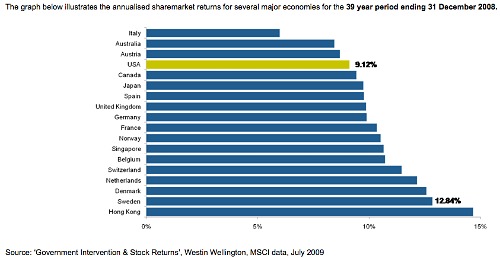
The Markets Are God crowd always likes to tell us that the markets are telling us what we ought to do. What do they think the markets are telling us about “socialism”?


The Markets Are God crowd always likes to tell us that the markets are telling us what we ought to do. What do they think the markets are telling us about “socialism”?
You tell me ... Hong Kong seems to be kicking everyones ass.
#1 Posted by Mike H, CJR on Tue 21 Jun 2011 at 01:46 PM
LOL!...
What's your point, Ryan?
That private capital makes money - even in socialist countries?
That capitalism makes money, even in adverse environments (until the government seizes the market, anyway)?
If so, welcome to the right side of the debate, Brother!...
Of course, this isn't your point. Your point is that in some magical and unspecified way, socialism drives up stock prices somehow. Another day, same old anti-capitalist stupidity...
Cherry-pick a "39 year" lookback window or a five-year old ending date to get the results you seek... Even better, Find some liberal professor who got some paper published somewhere and mooch off of his cherrypicking... Or even better, mooch o
Same thing they do to "prove" global warming is "real".
Tell you what... Let's look at the recent data, shall we? Over the last five years, what do we see?...
NASDAQ - Up 23%
DOW Industrials - Up 10%
BOURSE - CAC 40 - Down 21%
ATHENS Stock Exchange - General Index - Down 72%
ISEQ - Irish General Index - Down 41%
IBEX 35 - Spanish Industrials - Down 11%
FTSE 100 - UKX:IND - Down 0.5%
PSI 20 - Portugal - Down 25%
It's kind of exactly what happens when you look at the "global warming" over the last 15 years... There isn't any... In order to prove that global warming is real, you have to cherry pick a sampling period.
Similarly, all the recent data blows Ryan's commie crack dream apart at the seams.
Go tell the investors in Athens, Lisbon, Madrid, Belfast, Rome, or Paris just how much socialism boosts stock values... Good luck with that!
#2 Posted by padikiller, CJR on Tue 21 Jun 2011 at 04:31 PM
Cure article, but weak argument. The management of the CAC 40 companies will be French, but are they doing their business in socialist or capitalist companies ?! Also, there is a straw-man aspect here, as the authors imply that the meaurement of the competing economic systems is indicated by the performance of the indices. Well, what about access to wealth - e.g., which countries created more public companies and provided the management with access to capital, thus creating more wealth ? Also, how many shareholders were enriched by the different systems ? If you look at French companies' shareholders, many are dominated by families, or other companies. I suspect the U.S. has attracted, created and nurtured far more companies and enriched far more shareholders, thus creating far more wealth - even if the French companies have performed better.
#3 Posted by Trent, CJR on Tue 21 Jun 2011 at 04:50 PM
padikiller, haven't the gains of the past five years in the U.S. overwhelmingly come under the socialist, anti-capitalist Obama?
#4 Posted by grub, CJR on Tue 21 Jun 2011 at 04:59 PM
From Triumph of the Optimists: Annualized real returns on equities 1900-2000: France: 3.8%, US: 6.7%. In general the Anglophone developed economies with freer economic models did much better than continental European economies. (Except Sweden, which did the best.)
Read it for yourself, it's on page 42.
#5 Posted by David Merkel, CJR on Tue 21 Jun 2011 at 05:54 PM
Here goes CJR again, inverting reality to fit a hyper-statist worldview:
"But the point is, the ascent of laissez-faire economic policies in the U.S. during the first quarter century following the Reagan Revolution wasn’t enough to outdo French stocks, which faced the heavy hand of government."
Calling U.S. economic policies laissez-faire is like calling the hunchback of Notre Dame a model of good posture. The unrelenting trend since the Founding has been precipitously more govt intervention and control. The exceptionally few periods in U.S. history wherein there was actually anything remotely resembling a drawback to a more hands-off ("laissez-faire") approach — Jackson to Cleveland administrations, post-WWII (spending cuts, private sector boost, etc.), et al. — were the most prosperous (progressive?) times in U.S. History for those of us not connected to D.C. or Wall Street.
#6 Posted by Dan A., CJR on Tue 21 Jun 2011 at 07:07 PM
"[H]aven't the gains of the past five years in the U.S. overwhelmingly come under the socialist, anti-capitalist Obama?"
Do you mean the "gains" for Obama's buddies on Wall Street, and in the Israeli govt and the MIC? Or the "gains," as in the rising costs of food, fuel, and medicine? Or the "gains" of power and control by the TSA, SEC, IRS, FBI, ad nauseum?
#7 Posted by Dan A., CJR on Tue 21 Jun 2011 at 07:21 PM
Might also be worth noting the amount of GDP each country spends blowing up other countries. Too bad that so much of what could have been new infrastructure here in the good ole' USA is just depleted uranium dust blowing around in the desert...
#8 Posted by Gregory Orr, CJR on Tue 21 Jun 2011 at 07:57 PM
Hong Kong has a close proximity to a billion person economy which has plowed investment into manufacturing in the provinces surrounding Hong Kong. Furthermore, the Hong Kong government has been involved in the economy in providing health care and education well beyond America:
http://www.huffingtonpost.com/nathan-lewis/does-hong-kong-have-the-w_b_299907.html
Also, according to what I've read, the tax system is low but highly progressive. Income taxes and profit taxes of the top brackets comprise the bulk of government revenue.
Love the tag line on the bottom of that Stewart partners study:
"Whilst 39 years seems like a reasonable sample period, it is still short. For every $1 spent by Government, it is $1 less spent by private enterprise. In the long term, we believe in Adam Smith’s statement that, in general, markets should be free of Government influence."
Yeah, we know what our study indicates... but we're convinced that government spending crowds out private spending
http://krugman.blogs.nytimes.com/2009/01/27/a-dark-age-of-macroeconomics-wonkish/
and we believe in an unsourced statement we attribute to Adam Smith, therefore disregard what we said, because we suck...
These people have faith, not facts, as their guide.
#9 Posted by Thimbles, CJR on Tue 21 Jun 2011 at 09:03 PM
Ryan,
For the first graph, alas they are not comparing the same thing ! ;(
Nyse composite index : "all common stock listed on the New York Stock Exchange" = >2000 stocks
SBF250 (first the index started in 1990 !! what did the OECD took before ??) : 250 Bigest cap french stocks. They should have used the "CAC all shares" index (>500 stocks). Alas this index started in 2005 only !
Maybe they could have used CAC40 (starting in jan 1988) vs. DJ30 or SP500. Growth Results (no dividend included and not inflation adjusted!) :
CAC 40 : about 250%
DJ30 : about 500%
SP500: about 400%
Nikkei 225 : about -65% !
I also agree with david merkel's comment above !
#10 Posted by frank, CJR on Wed 22 Jun 2011 at 04:35 AM