The Wall Street Journal editorial board’s Joseph Rago makes a whopper of an error in a column Tuesday extolling Paul Ryan’s plan to turn Medicare into a voucher program that probably wouldn’t cover the cost of old folks’ health care.
Under the 2008 roadmap, seniors would get a straight cash voucher for $9,500 a year (the amount Medicare then spent per person), indexed to a blended measure of general inflation and the rise of health costs…
The 2012 budget, renamed the Path to Prosperity, indexed the payments to general inflation, starting at $15,000 (the amount Medicare now spends per person).
Wow. Medicare costs per recipient have jumped 58 percent in four years in a depressed economy? We’re doomed!
Fortunately, these numbers are just wrong. Medicare spent $10,945 per beneficiary in 2008 and projects spending $12,351 per person this year, according to its trustees:
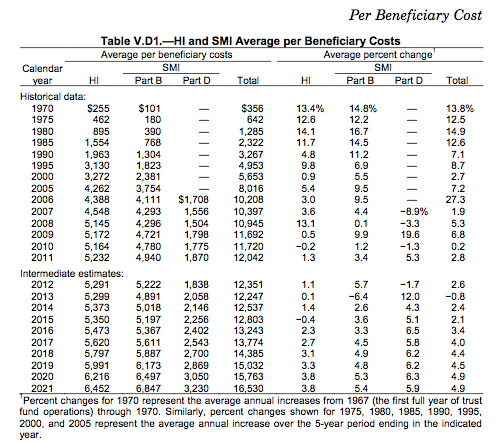
That’s a 13 percent increase, or 6 percent in real terms. Too high, yes, but far from the WSJ’s apocalyptic numbers, and quite a bit less than private-sector costs, which jumped 19 percent from 2008 through last year, nearly twice the growth rate of Medicare’s costs.
So what’s with that $15,000 number? That’s what the Congressional Budget Office projects Ryan’s plan would cost Medicare per beneficiary in 2022, not 2012. That $9,500 was what Ryan pitched for 2009. Big difference.
Those numbers aren’t all that’s misleading here. Here’s Rago implying that Bill Clinton supported premium support/vouchers:
President Clinton’s 17-member Medicare commission, chaired by Louisiana Democrat John Breaux, endorsed the reform in 1999.
But it wasn’t Clinton’s commission, it was a bipartisan one formed by a law passed by the Republican Congress and signed by Clinton. You might as well call it the Gingrich commission. Clinton appointed just four of its 17 members, as many as Gingrich, and all four of them voted against it. Clinton himself immediately rejected the majority’s findings, and the commission itself, far from “endorsing” anything, deadlocked one vote short of the required 11 to approve a report. Or as the WSJ news pages put it back in 1999, “the 17-member Medicare commission met for the final time and failed, by a single vote, to endorse the plan as a formal recommendation to Congress and the White House.”
FactCheck.org was on this back in May of last year, responding to a Paul Ryan claim cribbed from the WSJ edit page, apparently (his office sent out a 2010 WSJ editorial making the claim as a press release), about the commission and premium support.
But any attempt to cast the 1999 report as bipartisan or suggest it was Clinton’s commission is misleading.
The Journal editorial page has done so at least eight times in the last two years in a bid to suggest that privatizing Medicare had more Democratic support than it ever actually did. First reader to prove to me that WSJ is genuinely interested in Bill Clinton’s thoughts on vouchers gets a complete set of Whitewater: From the Editorial Pages of the Wall Street Journal Vols. 1-5.
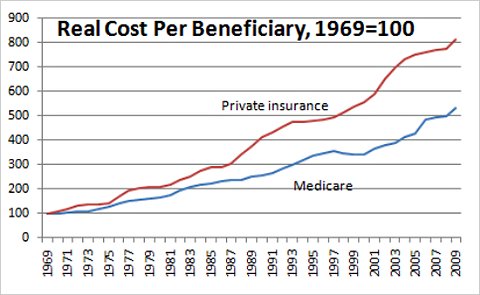
Anyway, the faster rise in private health costs means you have to have a certain amount of cognitive dissonance to claim, as Ryan and the WSJ do, that shifting health-care spending into the private sector would curb medical inflation. Here’s a Paul Krugman chart that shows how much faster private health care costs have risen compared to government-run Medicare’s:


Thank you, Ryan. There's no good evidence that competition between private health plans has controlled health care costs. That's the fundamental assumption of the Ryan-Romney Medicare voucher proposal and it's unfounded. Supporters say the Medicare Part D experience shows that competition between private Part D drug plans has kept costs lower than expected. But there are a number of problems with that argument. The lack of development of major new brand name drugs has slowed drug cost increases. And the government backstops the Part D plans to such an extent that it's not a true competitive market. It's not comparable to comprehensive health plans competing and taking full financial risk for the Medicare population. Of course the Affordable Care Act's state health insurance exchanges also are premised partly on the idea of private plans competing and holding down costs, and that assumption is problematic too.
#1 Posted by Harris Meyer, CJR on Thu 16 Aug 2012 at 01:42 PM
"The Wall Street Journal editorial board’s Joseph Rago makes a whopper of an error in a column Tuesday extolling Paul Ryan’s plan to turn Medicare into a voucher program that probably wouldn’t cover the cost of old folks’ health care."
Ryan,
You are being too kind to suggest that the WSJ has made an error, even if you use the word whopper. Do you rellay think that the editorial board hasn't the same access to fact checkers as do you? The writer of the piece is lying. He hasn't made an error. It is simply a lie. That's the new campaign strategy, lie as much as you need to when you have nothing good to say about yourself. Few people who read the Journal are going to read your critique of that editorial. So a lie is as good as a fact.
#2 Posted by Jack, CJR on Thu 16 Aug 2012 at 03:07 PM
Oh, if only every voter in the red states could and would read this! Thanks, Ryan, not just for the facts, but for your obvious writing talent as well. As a writer myself, it's always a joy to read the work of someone who obviously loves writing as much as I do!
Now if you're looking for a Pulitzer-worthy topic, do us all another favor - do the same kind of fact checking on single-payer healthcare vs. the ACA. I admit to my s-p bias, but I also served on candidate Obama's Healthcare Policy Committee and know that what he had to swallow was not what he wanted or intended the PPACA to be. Of course now he and the Dems are boxed in to the spin, which is sometimes just as bad as the Wrong Right's lies, but he'll get my vote because I believe that his second term, free of the re-election pressure, will go down in history as the most beneficial for the middle class since FDR.
Go to it!
#3 Posted by Sue Saltmarsh, CJR on Thu 16 Aug 2012 at 05:57 PM
Since we're doing fun graphs, here's one from the business insider:
http://www.businessinsider.com/french-healthcare-inflation-vs-us-healthcare-inflation-in-one-devastating-chart-2012-8
Oh neat, but we need to know why does it cost more. Turns out it's something that I've been saying here for a while, not because I'm some fella' of great vision, but because it's a pretty basic insight:
http://www.washingtonpost.com/blogs/ezra-klein/post/why-an-mri-costs-1080-in-america-and-280-in-france/2011/08/25/gIQAVHztoR_blog.html
"There is a simple reason health care in the United States costs more than it does anywhere else: The prices are higher...
The question, of course, is why Americans pay such high prices — and why we haven’t done anything about it.
“Other countries negotiate very aggressively with the providers and set rates that are much lower than we do,” Anderson says. They do this in one of two ways. In countries such as Canada and Britain, prices are set by the government. In others, such as Germany and Japan, they’re set by providers and insurers sitting in a room and coming to an agreement, with the government stepping in to set prices if they fail.
In America, Medicare and Medicaid negotiate prices on behalf of their tens of millions of members and, not coincidentally, purchase care at a substantial markdown from the commercial average. But outside that, it’s a free-for-all. Providers largely charge what they can get away with, often offering different prices to different insurers, and an even higher price to the uninsured.
Health care is an unusual product in that it is difficult, and sometimes impossible, for the customer to say “no.” In certain cases, the customer is passed out, or otherwise incapable of making decisions about her care, and the decisions are made by providers whose mandate is, correctly, to save lives rather than money...
“In my view, health is a business in the United States in quite a different way than it is elsewhere,” says Tom Sackville, who served in Margaret Thatcher’s government and now directs the IFHP. “It’s very much something people make money out of. There isn’t too much embarrassment about that compared to Europe and elsewhere.”
The result is that, unlike in other countries, sellers of health-care services in America have considerable power to set prices, and so they set them quite high. Two of the five most profitable industries in the United States — the pharmaceuticals industry and the medical device industry — sell health care. With margins of almost 20 percent, they beat out even the financial sector for sheer profitability.
The players sitting across the table from them — the health insurers — are not so profitable. In 2009, their profit margins were a mere 2.2 percent. That’s a signal that the sellers have the upper hand over the buyers."
Single payer health care and heavily regulated health care can negotiate with providers to set fair prices for services.
Individuals cannot. When it comes to life extending treatment, the individual doesn't really have the ability to refuse treatment when the alternative is death. Which means the system can extract payment until the patient has no alternative.
This process inflates prices and costs.
#4 Posted by Thimbles, CJR on Fri 17 Aug 2012 at 01:05 AM
It is stunning that in this day of instant research availability, the WSJ and its ilk try this sleight of hand journalism on the important issues. Perhaps the editorial board should be sent to internet school to see how easy it is to check their claims. Or maybe they figure their readers are too indoctrinated or too lazy to bother. Another great catch by real journalists at the CJR.
#5 Posted by p j brown, CJR on Fri 17 Aug 2012 at 10:01 AM
Have to correct a remark by Thimbles. Medicare does NOT negotiate drug prices. The Bush Part D law FORBIDS it!!
#6 Posted by gad, CJR on Sat 18 Aug 2012 at 08:28 PM
"Have to correct a remark by Thimbles. Medicare does NOT negotiate drug prices. The Bush Part D law FORBIDS it!!"
Yeah, Ezra should have mentioned that and then contrasted that with the VA.
http://theincidentaleconomist.com/wordpress/what-if-medicares-drug-benefit-was-more-like-the-vas/
#7 Posted by Thimbles, CJR on Mon 20 Aug 2012 at 01:18 PM
And, of course, if the government or any large pool of health care customers really used their buying power to reduce the cost of treatment and slow health care inflation, the usual suspects would crow about how this would cut into health care R&D budgets. But the fact of the matter is, evidenced by pharma, the inflation has not funded R&D, it's been spent on dividends, compensation, and marketing.
That's the problem with health care in the world's most expensive system, it doesn't prioritize the care of the patients, it's focused on increaseing revenues from the customers.
#8 Posted by Thimbles, CJR on Mon 20 Aug 2012 at 01:26 PM
And Kevin Drum did a post on the expense aspect of this story:
http://www.motherjones.com/kevin-drum/2012/08/american-doctors-hospitals-and-pharmaceutical-companies-are-overpaid
"here's the core of our problem:
We pay our doctors about 50% more than most comparable countries.
We pay more than twice as much for pharmaceuticals, despite the fact that we use less of them than most other countries.
Administration costs are about 7x what most countries pay.
We perform about 50% more diagnostic procedures than other countries and
we pay as much as 5x more per procedure."
Click the link for all the background linkies.
#9 Posted by Thimbles, CJR on Fri 24 Aug 2012 at 10:59 PM