The Wall Street Journal fronts an interesting but seriously flawed story this morning headlined “How Race Slipped Away From Romney.”
You can probably see the conceptual problem here right away: When was it Romney’s to lose? He led in the national polls, which systematically underestimated Obama’s support, for about three weeks in October, but never came close to leading in the Electoral College.
The WSJ’s central point is that Romney, one of the richest men ever to be nominated for president, lost because his campaign didn’t have enough money between the primaries and the conventions. It assumes, and reports as fact, that political machinations are what lost Romney the election, rather than the fact that people liked him and/or his positions less than they liked Obama’s and that the fundamentals favored the incumbent. It’s a classic of the kind of journalism that elevates savvy insider baseball stuff over substance. This isn’t to say that campaign tactics don’t matter or that they don’t influence races—they do. But the Journal minimizes the fundamental things that matter far more.
Implicit in the WSJ’s assumption that it was Romney’s race to lose: How could Romney lose to someone presiding over the worst economy since the Great Depression? It’s worth looking at because it was behind a lot of poor campaign journalism this year. It’s a more sophisticated version of the anti-Nate Silver backlash best summed up by Peggy Noonan’s theory of the election, which held that her feelings, informed by anecdotes like yard signs she noticed in “tony Northwest DC,” were a better picture of reality than “data on paper.”
In reality, this was Obama’s race to lose all along, as you’d have known if you paid attention the scientists who examine current data and historical trends rather than to pundits who read the tea leaves. The New York Times’s Silver is the most famous of these. But the consensus of political scientists was that Obama was likely to win. Here’s Bucknell’s Chris Ellis yesterday:
First, it provides a useful reminder that the more exotic explanations that pundits often spend the most time talking about as being important to election outcomes — debates, campaign strategies, super PACs, the candidates’ races or religions, gaffes made on the campaign trail — all of those things usually are not as important to who wins and loses as the basic factors that tend to drive American elections.
To the political pundits, what mattered too much was that the economy has been terrible for half a decade now, and Obama has presided over most of that. Certainly that hurt his re-election prospects. But as Ezra Klein wrote a couple of months ago in noting how the political conventional wisdom was wrong, “the data… suggest that incumbents win unless major economic indicators are headed in the wrong direction.”
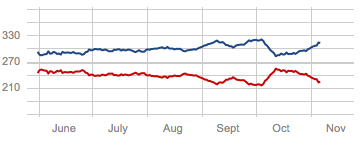
And the economy, while still weak, is recovering. Payrolls are strengthening, the unemployment rate is down, and GDP is up moderately. Best of all, housing, the primary cause of the recession and the weak recovery is finally rebounding and
consumer confidence is up sharply.
Further, it turned out that most American voters understood the unprecedented multiple disasters Obama inherited in the ruins of the Bush presidency: a financial collapse, an epic housing bust, an overleveraged consumer economy, GDP plunging at a 9 percent clip, unpopular bailouts, massive trade deficits, and trillion-dollar budget deficits (not to mention all that foreign policy stuff). We know that deep financial crises have historically been followed by long depressions or recessions. I don’t think the press, particularly the general press, did a good job at all of explaining this, but it seems like voters intuitively understood it.
This isn’t to mention that Romney’s candidacy was hamstrung from the outset by giant political problems. He was an enormously wealthy financier with offshore bank accounts and sketchy taxes running for president at a time when those guys are seriously out of favor. And squaring his moderate Massachusetts record with the need to win over a far-right Republican base meant he flip-flopped more than any candidate in memory.
- 1
- 2

I agree that the wsj *headline* premise is that it was Romney's to let slip away. but IMHO the article itself focuses on how message and swing states were lost by pulling candidate and aides into fund-raising vs. campaigning.
if anything, my biggest gripe with the article is that it didn't back up the contention that Obama had or spent more. they seem within $75M of what candidate+party+PACs spent respectively; is a10% differential really that significant?
~rich
#1 Posted by rich bibbins, CJR on Thu 8 Nov 2012 at 01:36 PM
The entire Republican base are such sunny-day Patriots. They hate the shit out of America if they learn what we actually believe. Considering their base of old fat white men are going to die soon, I wonder if I'll ever see a Republican President again. Romney might have been a suitable President, but with a conservative win comes the backwards social issues. Anti-science, Anti-charity, antiquated rape-apologists. The Republicans deserved to lose. Because they're wrong about our country. Now what do they expect the President to do for them? Liberals are too right-wing for me, I hope he goes all out.
#2 Posted by Regicide Red, CJR on Thu 8 Nov 2012 at 06:09 PM
Of all the articles I've read about the election, I must say, this is one of the best. Well done!
#3 Posted by mj, CJR on Thu 8 Nov 2012 at 11:27 PM
Good article along the same vein here:
http://m.theatlantic.com/politics/archive/2012/11/how-conservative-media-lost-to-the-msm-and-failed-the-rank-and-file/264855/
"Outside the conservative media, the narrative was completely different. Its driving force was Nate Silver, whose performance forecasting Election '08 gave him credibility as he daily explained why his model showed that President Obama enjoyed a very good chance of being reelected. Other experts echoed his findings. Readers of The New York Times, The Atlantic, and other "mainstream media" sites besides knew the expert predictions, which have been largely borne out. The conclusions of experts are not sacrosanct. But Silver's expertise was always a better bet than relying on ideological hacks like Morris or the anecdotal impressions of Noonan.
Sure, Silver could've wound up wrong. But people who rejected the possibility of his being right? They were operating at a self-imposed information disadvantage...
If you're a rank-and-file conservative, you're probably ready to acknowledge that ideologically friendly media didn't accurately inform you about Election 2012. Some pundits engaged in wishful thinking; others feigned confidence in hopes that it would be a self-fulfilling prophecy; still others decided it was smart to keep telling right-leaning audiences what they wanted to hear.
But guess what?
You haven't just been misinformed about the horse race. Since the very beginning of the election cycle, conservative media has been failing you. With a few exceptions, they haven't tried to rigorously tell you the truth, or even to bring you intellectually honest opinion. What they've done instead helps to explain why the right failed to triumph in a very winnable election.
Why do you keep putting up with it?"
#4 Posted by Thimbles, CJR on Fri 9 Nov 2012 at 03:12 AM
The Republican Party lost because they are out of touch. Pure and simple. I used to be a staunch republican until the Bush debacle. Now I'm an Independent. I voted for Obama both times. Until the GOP get their act together and learn to separate church and state, they can kiss my 59 year old, white male, vote good bye!
#5 Posted by Makumazahn77, CJR on Fri 9 Nov 2012 at 09:02 AM
Geez, the popular election results were 50% Obama, 48% Romney. Bush did better than that in his re-election race against Kerry. The House of Representatives, supposedly so hated, returns with its Tea Party cohort intact - the GOP lost a grand total, it looks like, of seven seats. The Democrats did perform spectacularly well in Senate races, but that's the only area where they had a really great night. The GOP has apparently picked up one or two more governorships, resulting in at least a 30-20 advantage.
Chittum's economic stats are impressive, but in an election this close, almost any factor can be cited as the reason a candidate won or lost.
#6 Posted by Mark Richard, CJR on Fri 9 Nov 2012 at 01:07 PM
Tight election, Mark, but they're still counting West Coast votes and it's 51-48 now (rounding up). Obama's win is slightly bigger than Bush's, fwiw.
As far as the House, that's due to gerrymandering. Dem candidates got 600,000 more votes than Republicans so far.
Governors are indeed GOP dominated.
#7 Posted by Ryan Chittum, CJR on Fri 9 Nov 2012 at 02:32 PM
Ryan, your points are taken, but I'll stick by my summary statement. It was too close an election for journalists to draw large conclusions from - but writers gotta write. A 600,000 vote overall edge in House races in a 100-million+plus election strikes me as a virtual tie.
#8 Posted by Mark Richard, CJR on Fri 9 Nov 2012 at 05:15 PM
If anybody cared to look, over the weekend before Tuesday, there were huge lines of voters waiting 6, 7 hours. Not usual, that, and it must be significant.
It is. A lot of people were incandescently angry about Republican vote fraud, women hating, racism and being disrespected by the 53%.
They might not have flooded out to vote against a tax break for the 1% but they did pour out to ensure that nobody stole their vote.
#9 Posted by Harry Eagar, CJR on Mon 12 Nov 2012 at 05:55 PM