Sign up for the daily CJR newsletter.
Somewhere along the way, we began talking about the future of news in terms of salvation. What will save us? we began wondering. Or, more optimistically: How will we save ourselves? The premise of those questions is flawed. The matter isn’t one of salvation. It’s a matter, rather, of evolution. News will continue, but what shape will it take? What will the transition from the analog world to the digital mean for news as we have known it? What changes and challenges will this new medium trigger in the genetic structure of news itself? Where is the business going, and how will it get there?
These are questions that inspire fright, haste, and dyspepsia in the unprepared; questions that tend to elicit snap judgments, quick generalizations, and ill-fitting answers. But it is best not to bluster through such an epochal transition. The challenges faced by modern journalism are best addressed by systematic thinking about the specific functions of the news and the Internet. There is merit in attempting to decouple the medium and the message; in attempting to understand the definite properties of each before trying to understand how they fit together.
To that end, we introduce Press Forward: Dialogues on the Future of News. In a series of essays, interviews, case studies, and roundtable discussions, we’ll explore news’s past as a way of guiding its future. On a more-or-less monthly basis, we will introduce a new unit addressing various topics relevant to both news and the Internet. We’ll question common assumptions and examine orthodoxies—with an eye toward ensuring, above all, that we preserve what’s valuable in journalism as new technologies do their part to redefine the informational landscape. Call it a bid for symbiosis rather than assimilation.
David Clark, a computer scientist at MIT, promotes a theory of computing standards that has become known as the “apocalypse of the two elephants.” Clark postulates that for any given computing innovation, between the flurry of initial research and the point of substantial investment, there is a brief interval wherein useful and logical network standards can successfully be written. As Andrew Tanenbaum writes in the fourth edition of Computer Networks:
If they are written too early, before the research is finished, the subject may still be poorly understood, which leads to bad standards. If they are written too late, so many companies may have already made major investments in different ways of doing things that the standards are effectively ignored. If the interval between the two elephants is very short (because everyone is in a hurry to get started), the people developing the standards may get crushed.
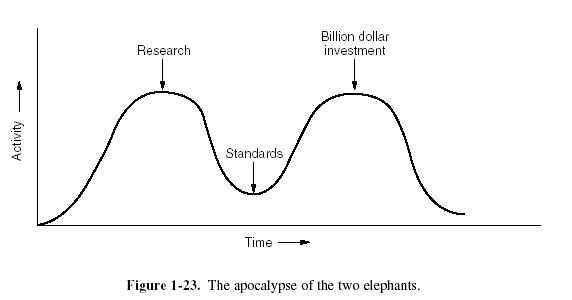
We have a chance now to rethink news. Yet we are soon approaching the point where it will become difficult for existing news organizations to be creative in defining and codifying their online standards. There will be too much money and momentum expended for organizations to reverse course. And the standards they have written in haste—paywalls! micropayments! microblogging! Mouthpiece Theatre!—will be the ones with which, at least for awhile, they are stuck.
Press Forward is an attempt to prevent thoughtfulness, rationality, and foresight from being crushed between two elephants. Nothing in Press Forward is intended to be definitive or comprehensive; the project is intended, instead, to mirror what journalism does at its base and at its best: spark thoughtful and informed dialogue among journalists, media thinkers, and all those who care about the future of the news as we navigate together this new terrain. A provisional list of topics can be found below; if you have thoughts about these, or want to suggest other topics that you would like to see covered, please e-mail us at editors@cjr.org.
“Chaos is our lot,” Clay Shirky recently wrote of the present media moment; “the best we can do is identify the various forces at work shaping various possible futures.” With Press Forward, we aim to do just that. Because news’s future may not need salvation–but it does need some direction.
I. The Purpose of the News and the Purpose of the Net
Common Knowledge – Communal news in a fragmented world
Something to Talk About – The Internet as a communications tool
In Conversation – Megan Garber and Justin Peters talk about the news, the Internet, and the convergence of the two
Further Reading – Annotated reading lists from Megan Garber and Justin Peters
II. Authority and Credibility
Who Says – Narrative authority in a fragmented world
Trust Falls – Lessons from St. Louis on authority, credibility, and online communications
Further Reading – Annotated reading lists from Megan Garber and Justin Peters
III. Professionalism and Amateurism
IV. Narrative and Knowledge Structures
V. The Content/Platform Relationship
VI. Collaboration and Competition
VII. Dissemination and Impact
VIII. Capitalism and Free Culture
IX. Financing News
Has America ever needed a media defender more than now? Help us by joining CJR today.