Sign up for the daily CJR newsletter.
If you’re worried about the future of science journalism, take solace in two fourteen-year-old students named Sam and Naseem who are passionate about science and writing, and hope to combine the two. They are the first high-school bloggers to join Scitable, a teaching and learning website from the Nature Publishing Group.
Sam and Naseem’s blogs—“Green Science: Musings of a Young Conservationist” and “Our Science: Exploring the Mysteries of Everyday Life”—debuted on Thursday, along with another blog, “MedSci Discoveries,” written by two of their classmates. They are the new kids on the block at Scitable, which was created in 2009 and is geared toward college undergraduates, though it attracts a broader audience, from middle-schoolers to professional research scientists.
“How can I help kid’s change their carbon footprint and global warming? I love to write,” said Sam (Samantha) Jakuboski in a recent interview. On her Green Science blog, Sam intends to use examples like the overuse of Styrofoam cups to help explain her concerns about products that might harm the environment and perhaps even the human body.
“I really want to address topics that relate to the actual lives of students, regular questions that kids have. I’m really excited about blogging,” said Naseem Syed, who plans to tackle everything from, “What is mono?” to “Why do ears pop on airplanes?” in her Our Science blog.
“We certainly hope that the launch of these [new blogs] encourages other high school students to consider blogging about science,” said Ilona Miko, the senior editor for life sciences at Nature Education. Billed as a “collaborative learning site,” Scitable provides resources on biology, genetics, ecology, science communication, and science careers, as well as a community network with blogs by college undergraduates, grad students, and professors. The high-school blogs are a “new direction for us,” Miko wrote in an e-mail.
How did these young women go from the classroom to blogging for an international audience at one the world’s most esteemed scientific publishers? They were encouraged by their remarkable ninth-grade biology teacher at New York’s Staten Island Academy, Stacy Baker, who is nurturing a new generation of potential science writers and informed citizens by requiring her students to blog for their class website, “Extreme Biology.”
“I want my students to understand the process of science, not just the facts. I want them to have better analytical thinking and communication skills,” said Baker, thirty-one, who started a blog called “Miss Baker’s Biology Class” when she began teaching six years ago, which was later renamed Extreme Biology. She doesn’t expect most of her students to become scientists, but to her surprise, many have become such accomplished writers that they are now considering careers in science journalism or writing.
Little wonder. Their Extreme Biology blog has taken on a virtual life of its own that resonates far beyond the walls of their small, independent day school. Baker said the site now gets as many as 10,000 unique visitors each month, with comments from educators, students, and even scientists who did the original research the students are blogging about. Recently, for example, there was an online conversation with marine biologist David Shiffman, who blogs on “Why Sharks Matter” at Southern Fried Science.
The students are assigned to write about current news in biology—“Anything they find interesting,” said Baker. “The students are doing what journalists do. A number of kids have said at the end of the year that they were strongly considering science journalism as a career.”
The new venture with Nature Education came about after Baker met Miko at a biology teachers conference and was later invited to ask her high school student bloggers to try out for the Scitable website. “It’s people like her that can show students of a young age how to be involved in science in creative ways, like using social media to create communities around science subjects,” said Miko.
The students’ work was also showcased at the recent ScienceOnline 2011 conference in Research Triangle Park, North Carolina, where they spoke with aplomb to an adult audience of science writers, scientists, educators, and others attending the popular event.
I met Baker and eight of her Staten Island Academy students during a three-hour conference field trip, tramping through the snow-covered grounds of the Duke Forest Teaching & Research Laboratory. We met field researchers studying things that could pose risks to the environment, from global climate change to nanomaterials. Aboard the bus, I talked with Naseem and Sam about their new gig blogging for Nature Education.
“It’s a really amazing opportunity,” said Naseem, a petite, curly-haired freshman with a little-girl voice who was dressed warmly for the occasion in Burberry-style earmuffs and black Ugg boots. Asked about her plans for the future, she replied: “I’m open to the idea of becoming a science journalist, but I don’t really know any science journalists.” (That quickly changed, when she and Sam later found themselves being interviewed not only by me, but dozens of others at the ScienceOnline conference.)
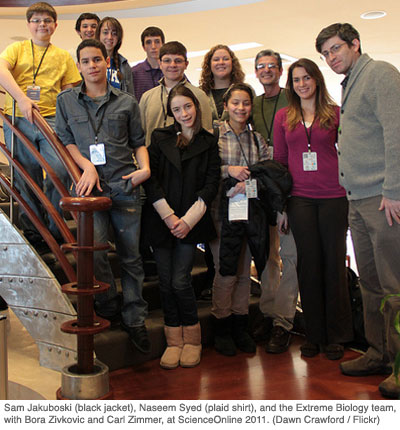
“I want to do something in the field of science – maybe like a neurologist or environmental consultant… or any journalism, maybe related to science,” said Sam, also warmly attired in her own beige Uggs and matching stylish scarf and hat over her long brown ponytails.
Sam later described her trip to the North Carolina conference as an “awesome experience that I will never forget for as long as I live.”
“After meeting and talking to many journalists and writers, I started to think about a career in journalism, especially science journalism,” she wrote in a post that Baker shared with me. “I love to write, and my favorite subject is science, so why not combine the two into a career that I will enjoy when I get older? It seems like a lot of fun, and my blog … Green Science will help me prepare for a later career in journalism if I decide that it is the right choice for me.”
Their ScienceOnline session, “Still Waiting for a Superhero,” involved the students, Baker, and other educators addressing science illiteracy in schools. The Staten Island students, whose trip was underwritten by a grant from a local bank on Staten Island, talked about how their own interest in communicating about science had been triggered by their Extreme Biology blogging for Miss Baker’s class.
“Global warming is a very important topic now. Hopefully my blog encourages readers to understand it,” said Sam during her presentation. “I want to write at a level that children can read too, people my age…. Some newspaper articles, it’s really hard to understand what they are getting at. I’m not going to write at a baby level. But it won’t be as complex.” An audience member responded: “Adults will read your blogs, too, to learn about science.”
Naseem drew praise for her informative Extreme Biology interview of conference organizer Bora Zivkovic, a prolific science blogger and the new editor of Scientific American’s blog network. In it, she asked Zivkovic about declining scientific literacy among American students; why he tweets; and what scientist, dead or alive, he would most like to meet (he chose Charles Darwin).
Some of Sam and Naseem’s classmates talked about the potential for communicating about science to fellow teenagers through podcasts, YouTube, videoblogs, videogames, and wikis—all things that, as one noted, “allow students to express themselves in a way that fits them” or, said another, “in a way that doesn’t feel condescending to us or lectured to.”
Baker, a soft-spoken Southerner, has attracted a following herself, both for her innovative class blog and online social networking, as well as for her efforts to bring several groups of her ninth-grade and advanced placement (AP) biology students to the annual ScienceOnline conference. She earlier taught at the Calverton School in Maryland and at the Mt. Pisgah Christian School in Georgia, and has appeared on NPR’s Science Friday and other media outlets talking about student blogging.
Part of the success of Extreme Biology and the new Scitable blogs, said Baker, is the voice her students bring. “These are still kids—hugely talented, yes, but still kids,” she said. “Adults sometimes lose sight of how creative we are when we are younger. When the students write, we hear their voices.”
Has America ever needed a media defender more than now? Help us by joining CJR today.