



Nearly until his red eye flight back to Rome, John Paul II remained blissfully unaware of all this, but throughout his visit to the Northeast in early October his holiness was thoroughly digitized. His encyclicals were transubstantiated into hypertext. His portrait was converted into papal pixels, suitable for framing by computer screens anywhere in the world. And, more to the point for journalism, his trip was trailed by the largest digital press corps ever set up to report a live event competitively.
The New York Times, Newhouse New Media, and News Corp./MCI, owned in part by Rupert Murdoch, all covered the pope’s visit for multimedia projects that appeared on the Internet’s World Wide Web. Their audience—variously called “users,” “accessors,” and “consumers” in a medium whose advances in lexicon have failed to keep up with those of its technology—was a small one, probably numbering well below 100,000. The digital papal press corps itself was also small, numbering about twenty, mainly freelancers and “shared” reporters whose first fealty was to file for their newspapers. Outside of the occasional use of digital cameras, their methods hardly blinked and buzzed in any hip, day-glo cyber-sense. These new-media reporters still phoned rewrite with their notes from the papal mass at rainy Giants Stadium. Runners still fought through crowds on foot to relay rolls of film back to traditional darkrooms. Still, this was a watershed event for news reported and published specifically for access on-line, a medium where, as yet, nearly all of the available journalism consists not of original reportage at all, but of “repurposed” text and photos, of news that previously ran elsewhere in print, broadcast, or on the wires.
As a freelance Web consultant, I played a part in this group baptism for the infant medium of original on-line journalism. I launched the pope into cyberspace for the first news project of New Jersey Online, itself the first and flagship Web site of Newhouse New Media. For an atheist print reporter who still vaguely fears computers, this was a rather novel experience, one that raised more questions than I could answer at the time. And in talking afterward with the journalists and editors who are also involved with this medium—members of a growing but still tiny group—I’ve found that the most intriguing questions about original on-line journalism, or new media, as the genre is being called, still linger unanswered.
The very least of my own questions arose as I grappled with the unfamiliar, unforgiving codes and protocols of multimedia on-line publishing, working with equipment far more complicated than computer systems I used in newspapering. Should I telnet or FTP to access a papal JPEG? What technical and spiritual transgressions are revealed in error messages received while DeBabelizing his encyclicals? I knew I had come into my own the night I cooked dinner while downloading soundbites recorded from the archbishop of Newark—as the archbishop’s voice traveled digitally from a mainframe in Jersey City into the Macintosh in my Brooklyn apartment, I sedately sauteed chicken cutlets. But I’m still wondering how I managed to mismanage a programmer’s scripted algorithm, thereby accidentally sending his holiness hurtling backward in time through cyberspace. During the pope’s first nineteen minutes on the tarmac of Newark airport, my Web site’s “Hours To Arrival” countdown read “-1.”
The professional questions arising along my pope-escorted pilgrimage from print to on-line media were more serious and more interesting. As what’s called a Web site “producer,” I wore many hats (the last of which, as I’ll describe in a bit, was a miter—the papal millinery of the tall, pointed variety). New Jersey Online’s pope staff was tiny, and, while delegating where I could, I still had to buy photographs, oversee publicity, be interviewed about the site by The Associated Press, and forward advertising queries to the in-house ad department, all on a project I also did some reporting for. Did I manage to handle a corporate checkbook and reporter’s notebook without conflict? I hope I did, but I know I came close to crossing some lines I’d never been asked to approach as a print reporter.
Other print journalists who are forging ahead into the Wild West frontier of new media tell me they also ponder numerous questions concerning ethics, standards, and method, and discovering answers as we go along is part of what makes the field so interesting. Graham Rayman, senior editor of the new on-line magazine called Word, wonders how the objective journalistic voice will change on-line, where attitude and opinion have always suffused story-telling. Ezra Palmer, new editor of The Wall Street Journal Interactive Edition, wonders whether on-line editions should scoop their print and broadcast affiliates, and how long corrections should stay on-line—as long as the error did? Longer?
And we’re all wondering what happens to accuracy and clarity in a medium that is immediately updatable and has a limitless news hole. “At this point, it’s still about learning,” says Kevin P. McKenna, editorial director for The New York Times Electronic Media Company, who led the Times effort to cover the pope on the Web. The learning is happening at breakneck speed, leading McKenna to compare Web years to dog years: “One year on the Web is like seven years in any other medium.”
Finally, there is the most basic question: What is this stuff called new media? How is it different, for better or worse, from old media? The question was rephrased often as I worked on the project, in identical quizzings from archdiocesan spokespeople, my own mother, and a diminutive lady I tried to interview for a papal reaction story, before realizing that her candle- and saint-strewn Newark shop was actually a Botanica, where items are sold for a religion, Santaria, that is far removed from Catholicism.
“What is it, exactly, that you’re doing to the pope?”
Some history and overview may be of help to print and broadcast folks who have only just heard of what one print editor I know still snarlingly calls “this computer stuff.” The new-media critic and author Jon Katz traces the birth of on-line news coverage from January 1994, when a subscriber to the Prodigy service noticed that Los Angeles was shaking and used a wireless modem to post news of the earthquake onto the Internet. Katz, who covers media for Wired magazine, notes that within minutes, and well ahead of CNN or the wires, Internet users were trading information on the quake’s location and damages, and offering detailed information to a pinpointed audience, notifying survivors’ distant relatives and even helping organize rescues.
Speed, niche marketing, freedom from the limits of a news hole and deadlines, and audience interactivity: this early event demonstrates all the elements that, when combined, remain today what can elevate on-line journalism above its print and broadcast brethren. This is what those techno-geeks in your newsroom are so excited about. Now, though, when there’s talk of on-line journalism, the reference is primarily to what’s happening on the World Wide Web. The Web is the section of the Internet where stories can be told in pictures, sound, video, and text, and where clicking on highlighted pictures and text—“hypertext”—carries you section to section.
In the papal visit site I produced for New Jersey Online, for example, users could click on the hypertext words “Sacred Sounds” to get a new screen that offered a selection of downloadable holy noises—the organ processional that would greet the pope at Sacred Heart Cathedral in Newark, for instance. Another click, and you could download a papal blessing: “The peace of the Lord be with you always,” in the pope’s own voice. I ignored the warnings of a priest who, during a discussion on our mutual cyber-papal projects, told me, “Don’t use him in English! He sounds like a vampire. If you quote me on that, I’ll deny it.”
The Web also allows users to interact with each other, and even with the journalists themselves, by typing their comments and opinions onto a blank form and hitting the “return” key. The comments either go straight to the journalist or site producer, as e-mails, or feed a larger “forum” that becomes a continuing record of what people are saying about the site or the topic at hand. News Corp.’s pope site, and my own, each hosted such a forum. The New York Times site hosted nine. In these virtual meeting places, pro-choicers argued with pro-lifers. Women and gays criticized the pope’s stands on homosexuality and the ordination of women and were criticized in turn. Religious scholars, Christian clergy, even a few rabbis talked about the pope’s impact on their faith. No other medium offers its audience the chance for such active and immediate participation in a news story.
My own site took interactivity to what I thought at first was a bizarre extreme. Clicking on “E-mail the Pope” brought up a blank form where users could type a message and send it to New Jersey Online for forwarding to the Vatican. It was here that my virtual miter came in.
Every day from the last week in September through the first week of October, my personal Newhouse e-mail account filled with messages prefaced “Your holiness,” “To the pope,” or simply “Dear Papa.” I started out calling myself Keeper of the Holy E-mail. But the experience quickly overcame my cynicism about these electronic reachings-out.
I received 343 papal e-mails, from across the U.S. and from Canada, Mexico, and Europe, their text spanning five languages. Only a few were bizarre or off-color, like one from a woman who wanted the pope’s advice on getting an abortion, except she realized she needed to get pregnant first, or another from a gay couple at Princeton University who politely begged to be excommunicated: “Please send documents (one for each of us please).” Aside from these few—and one bomb threat against the Vatican—every message was one of praise or encouragement for the pope, or a personal plea for papal intercession for everything from failing marriages to dying children. One came from a woman who said she was crying as she wrote. A ten-year-old midwestern boy asked the pope if he liked hockey.
The Vatican fired up its holy modem and responded via e-mail. O magnum modem mysterium! “Pope John Paul II wishes to express his gratitude to all those who sent him greetings and have supported him with their prayers,” wired Dr. Joaquin Navarro-Valls, director of the Holy See press office. I’ve posted the response verbatim at http://www.nj.com/popepage/e-mail.html.
E-mail the pope. Download a blessing. Chat in our Papal Forum. I defend these kitschy gadgets blushingly, but resolutely. They weren’t traditional journalism—that happened elsewhere in the site—but user feedback told us they were the site’s most popular features. People wanted to interact, to hear the pope and hope the pope could hear them. Again, no other medium could offer them this.
“The Holy Father on-line!” one user wrote New Jersey Online. “My grandmother still doesn’t believe me.”
A look at pope coverage throughout the Web demonstrates the range of publishers putting news on-line. At least a dozen Web sites, from Time Warner’s massive Pathfinder site to the tiny one run by the Archdiocese of Newark, offered special sections on the pope’s visit. The commitment to original journalism also varies along a wide spectrum. Pathfinder covered the pope’s visit with wire-service news briefs and material from the Time magazine archives—convenient content that is nonetheless derisively called “shovelware” by many new-media proponents—and then added a forum and links to the pope’s writings. Most of the pope sites on the Web published something comparable, content drawn from print sources, with a few bells and whistles like sound bites and forums.
The sites that went beyond the routine were limited to News Corp., Newhouse’s New Jersey Online, Pope TV (an experiment in live video feeds sponsored by a national Catholic foundation), and The New York Times, for which the pope’s visit became the inaugural effort for bringing the gray lady to the Wild West Web.
“Our site was named Cool Site of the Day by Editor & Publisher Interactive,” McKenna of the Times boasted after the laboratory smoke cleared. “It was just something for both the pope and The New York Times to be called cool,” says McKenna, a former foreign desk editor and deputy news editor at the paper. “That’s something neither the pope nor The New York Times is accused of very much.”
The Times’s pope site was worthy of the accolade, and offered an idea of what to expect when the full NYT site launches sometime soon at http://www.nytimes.com—not only the paper’s content as an authoritative foundation, but also regular updates on breaking news, a heavy focus on celebrity or newsmaker-moderated forums, and searchable access to the paper’s vast archives.
The News Corp./MCI site, at http://www.delphi.com/news/pope/index.htm, offered the most ambitious papal package: biographical background on the pope, a delightfully irreverent, illustrated tribute by the cartoonist Doug Marlette, and a forum where users could match wits against the prose of celebrity commentators who included Ted Kennedy and Molly Yard. Stories from half a dozen reporters from the site’s own newsroom were published on-line the following morning.
During the pope’s two days in New Jersey, New Jersey Online, at http://www.nj.com, also published original news, although relying, as did the Times’s on-line offerings, on the work of reporters from outside our own offices. News editor Joe Territo wrote briefs and relayed feeds of photos and field notes he gathered from the newsroom of our Newhouse affiliate, The Star-Ledger of Newark. Freelance designer Kevin Walker and I published this material on the Web as quickly and prettily as possible, working from New Jersey Online’s offices in Jersey City.
It worked well—except when I was told, on deadline, that photos sent over by The Star-Ledger needed to be “opened” by a program called Graphic Converter. All I could find in searching the Internet was Graffik Konverter, the original German version. What to do with the pictures of soggy nuns in Giants Stadium?
Do I abbrechen? Do I anlegen? And if I employ the zwischenablage einblenden tool, who would clean up afterward?
But for all our work, our on-the-scene coverage, and that of the Times and News Corp., were ornaments to the larger packages. Right now, digital journalism fares poorly against television in competitively reporting a major event like a papal visit. For two hours on October 4, New Jersey Online users could log onto a page that told them, in text, that the pope was currently saying mass at Sacred Heart Cathedral. Click here to hear the bells and organ procession that greeted him. But TV viewers could watch real-time footage of the mass itself. Real-time, TV-quality video streams may not be available to the average home computer system for ten years, and at least until then, TV will remain the best way to cover a real-time, national or international event.
New media will succeed by focusing instead on what they do best, as demonstrated in that early Prodigy earthquake coverage. It’s quicker than print, and can be more local than the networks. Its bottomless news hole allows more depth than either print or broadcast, through searchable archives, databases and transcripts. And neither print nor broadcast has access to the killer application of on-line journalism: interactivity.
I have my own favorite new-media inventors, sites that are on the forefront of recreating journalism for on-line. From mainstream outlets, I thought ESPN’s Web site covered the World Series in ways no other medium could—to me the best reason to bring original reporting to the home computer. Reporters staked out every pre-game batting practice, took questions from users logged into a forum, posed the questions to the players, then reported the answers back to the forum. In essence, ESPN’s audience—described by the network as the largest audience of any on-line news site—could sit at home at their computers, interview players and see the responses almost in real time. (The ESPN site is at http://espnet.sportszone.com.)
No other medium offers its audience the chance for such active and immediate participation in a news story.
Unfortunately—and of great interest to anyone who, like myself, is looking at on-line journalism as a career option—there’s hardly anyone out there yet to tell stories to. At press time, 580 newspapers and 425 broadcast stations were publishing on-line editions. But a recent Times Mirror survey reported that only 6 percent of America’s wired population goes on-line to get news every day. Thirty-seven percent go anywhere from twice a week to every few weeks, 28 percent less often than that, and 29 percent not at all. Likewise, there are few staff reporting jobs available in on-line newsrooms, jobs where writers compose anything beyond such scintillating reportage as “<a href=“listing.html”>Click here for our complete listings!</a><p>.”
“We do not foresee having a separate reporting staff for the electronic version,” McKenna of the Times said recently. “We’ll use stringers and New York Times reporters. It just doesn’t seem efficient to have a separate staff.”
His point is well taken. Why should companies like the Times, Time Warner, News Corp., or Gannett reinvent the wheel, when their Web editions can be easily and cheaply fed by photos and text from their print and broadcast affiliates? But there’s an opposing argument, which I find more compelling: the money and authority of the mainstream giants positions them perfectly to do the reinventing, and they ought to do it.
When New Jersey Online recently offered me a full-time staff position, I balked. Newhouse also plans to feed its first Web news site with photos and text from affiliate papers. I would be a producer, not a reporter.
And yet. And yet. The medium itself is seductive. Manipulating graphics and sound for the first time reminded me of the childhood thrill of discovering crayons. I looked through photos of antique Oriental Christian carpets for background graphics. Instead of planning the site using numbered outlines and flat page layouts, I drew non-linear “content maps,” drawing layers of circles to chart the numerous ways a user might click around to navigate through the material. I’ve never had to think about telling a print story in this way. My storytelling toolbox is now brimming over with hypertext, clickable graphics, multi-media, and interactive databases.
Another attraction is the largely democratic nature of Web publishing. Jaron Lanier, an originator of virtual reality, once noted that on the Web, the American Defecators Society and Time Warner publish on equal footing. The power of the press belongs to anyone with the necessary equipment and software, which would put you or me back about $2,500, starting from scratch with the purchase of a computer. In putting the pope in cyberspace, I competed, and I hoped held my own, against the goliath staffs of The New York Times and Rupert Murdoch.
And the new media still need journalists. “I think our role as arbiters and guides of news value really hasn’t changed,” says Palmer of The Wall Street Journal Interactive Edition, which is staffing with editors. “We’ve just stepped into this new medium, and are expected to do the same job.”
My managing editor at New Jersey Online, Susan Mernit, ultimately made me a better offer—I could be associate news producer for four days a week, with full benefits. I’m going to tell her I’ll take the job. I won’t be reporting—New Jersey Online will focus instead mostly on reformatting news, nurturing numerous “discussion” communities and constructing databases on everything from elections to recycling schedules. But the job will give me three days a week to build a freelancing career in print while learning the tools of Web journalism at a company that’s caught on to the secret of niche marketing, and will therefore probably survive. I think I’ve found the perfect compromise: one foot in print, one foot in new media. Besides, Web years are like dog years. Who knows what new media will ask of their journalists seven years from now, in 1997?
James Mulholland is publisher/editor of the Catholic Information Center on the Internet and a board member of the
Manhattan-based, nonprofit Catholic organization Path to Peace Foundation, sponsor of Pope TV, which posted a live video stream of the pope’s visit onto the Internet for the tiny population with the equipment to receive it. He described to me a private audience he had with John Paul II during the American visit. Mulholland showed him some of the on-line coverage and told the pontiff that he intends to build Web sites eventually for each of the world’s 2,500 Roman Catholic dioceses. The pope responded, “This is very, very good,” Mulholland remembered. “He was smiling there, but he’s a little inscrutable. He was smiling, but he wasn’t doubled over.”
I think I know how the pontiff feels. I’m not doubled over by “this computer stuff” just yet. But just like the pope, I am smiling.
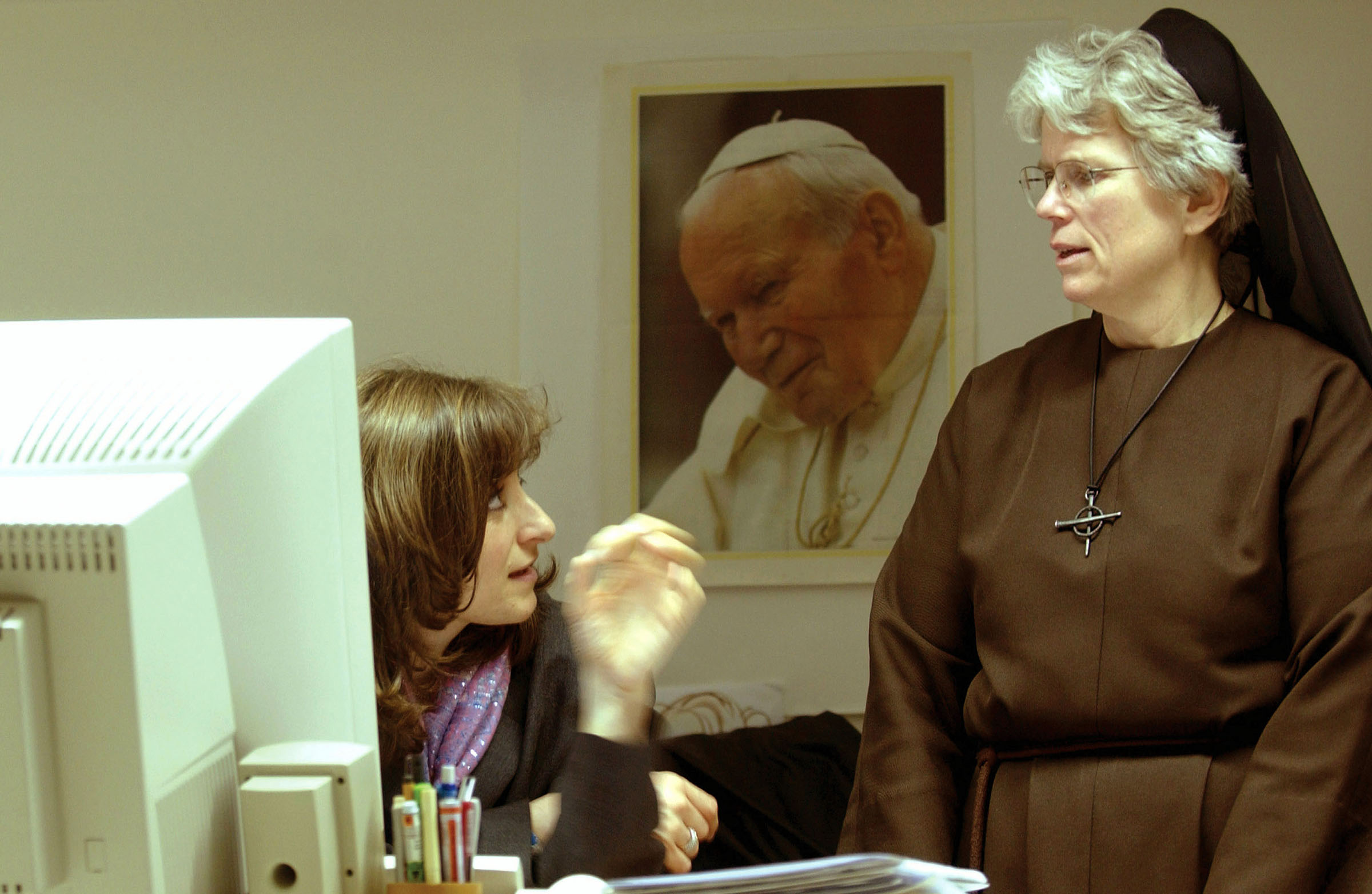
TOP IMAGE: Sister Judith Zoebelein in Vatican City, May 7, 2004; Photo by Franco Origlia/Getty Images
