Sign up for the daily CJR newsletter.
Twice each month, Covering Climate Now speaks with different journalists about their experiences on the climate beat and their ideas for pushing our craft forward. This week, we spoke with Lagipoiva Cherelle Jackson, a Samoan native and longtime journalist covering climate and environmental issues in the Pacific Islands. Jackson is the recipient of a Covering Climate Now Journalism Award for her work on “An Impossible Choice,” a podcast series from The Guardian about the harrowing decision Pacific Islanders face amid climate change to leave their homes or remain in harm’s way. The conversation, between Jackson and CCNow deputy director Andrew McCormick, has been edited for length and clarity. Follow Jackson on Twitter.
Tell us about your background as a journalist.
I’m from the island of Savaiʻi, which is an outer island in Samoa, and I always found when I listened to the news that there wasn’t much coverage of the issues affecting my island. The news was always about the urban areas. So, from a young age, I always felt that was a missing piece. When I grew up and moved to town for high school, I learned more about journalism. Then, at nineteen, I joined the Samoa Observer, which is the only daily newspaper in Samoa, based in the capital, Apia.
My mom was an Indigenous conservation leader, and she instilled in me the importance of nature in our culture and community. Separately, when I was about eight years old, my island was hit by a category 4 cyclone. That was an early wake-up moment for me, to see death before my eyes. So when I moved to Apia, I came with that perspective of really valuing the environment and started specializing in environmental reporting.
After a few years with the Samoa Observer, I freelanced a bit and was a stringer for the Associated Press, AFP, and a few others. When I was twenty-five, I became the youngest editor in Samoa, working for a newspaper called Newsline Samoa, which was a smaller publication with three editions a week. There, I really learned to feel the pulse of the nation and could feel the demand for the kinds of stories that I was interested in.
For context, can you describe the climate situation in the Pacific Islands?
Climate change is the new norm in the Pacific. In the first ten years of my life, I experienced three cyclones. In the first one year of my daughter’s life, she experienced fifteen. In all of the Pacific Islands nations, we’re seeing more extreme weather events, with greater severity. Every November in Samoa now, we prepare for cyclones and landslides and flooding, all of which have become normal parts of our lives. When it floods, the whole town area can be underwater, by about a meter in some places. If I’m driving downtown for a meeting, for example, I know that I might not make it, that I could be delayed for hours while we wait for the waters to subside.
When we talk about climate change in the Pacific, a lot of the media focus is on visual damage from storms. But there are many aftereffects of severe weather as well: the destruction of fisheries, for example, and impacts on seasonal crops in farming communities. A cyclone can hit, and a community can clean up afterward, but we can’t replace lost food resources. For a farmer, lost crops can mean no money for their children’s school fees, for healthcare, and so much more.
You wrote recently on Twitter, “Spent over twenty years in journalism avoiding first-person narratives only to be firmly thrust into it by the climate story.” Can you unpack what you meant by that?
As a journalist, I never wanted to use the word “I” in my stories. I’m used to being the one with the microphone, holding it to the farmers, the chiefs, the women, and the children, to observe how society in the Pacific is experiencing climate change. But I am part of that society—I have also lived through these climate disasters.
Recently, when I started working for The Guardian—through many conversations with editors there, especially in working on the series “An Impossible Choice”—I came to realize that my personal story is of value and can help relay parts of the climate story in a way that my colleagues in the UK or Australia cannot. There was a point in the scriptwriting for the podcast where I kept taking the “I” out. My colleagues saw that and were like, “You know, we actually really need your story in here.”
Given that you’d covered the environment and climate in the Pacific Islands for so long, when you were working on “An Impossible Choice,” which is quite ambitious in scope, did you learn anything new or did anything surprise you?
A lot of my coverage has been local, in Samoa or in the Pacific generally, reporting for people who already know our circumstances because they live here. This was the first big project where I approached the story for an international audience, where I had to adjust my lens as a reporter.
So what I liked about doing “An Impossible Choice” was delving deeper than I normally had into the existential threat, really having that conversation with people who will be forced at some point to leave their islands. I got the impression that not many people have been asked directly about this, and I found myself really appreciating how we were mindfully navigating those conversations. We did that by using local field reporters, so that they could ask questions in local languages.
I also came to realize that, in ways, we’ve come to take for granted the impacts climate change has had on our people. As we laid it all out in the podcast, I was like, “Wow, that’s some really severe stuff. We’ve normalized some shit that we should never have normalized.” For instance, there was a point during Cyclone Evan, in 2012, when a good friend of mine seriously thought she had to pick which of her kids to save, because the floods were coming in and they had to quickly climb on top of the roof. I had known that story for years. We all know many stories like that. I know people who died. So to be able to tell these stories and to hear the shock in the voices of my Western colleagues was really eye-opening.
The Pacific Islands are often covered in the international press as a ground zero of climate change’s impacts. Are there stereotypes in this coverage that you find wrong or unhelpful?
Oh yeah, so many. The first thing is the use of the word “tiny.” I always find that when international media covers climate change in the Pacific, they use the word “tiny” to describe our countries. It’s so disempowering. These are whole nations. My entire life was on that island! “Drowning” is another one of those words. Islands are being submerged, yes, due to sea level rise. But when you use the word “drowning,” you basically make an entire region helpless, when in fact Pacific people are very resilient. When a cyclone or another extreme weather event hits, they get up straight after and they start rebuilding. They don’t wait for the government, they don’t wait for anybody. I wish I could see more of that resilient nature in the international press.
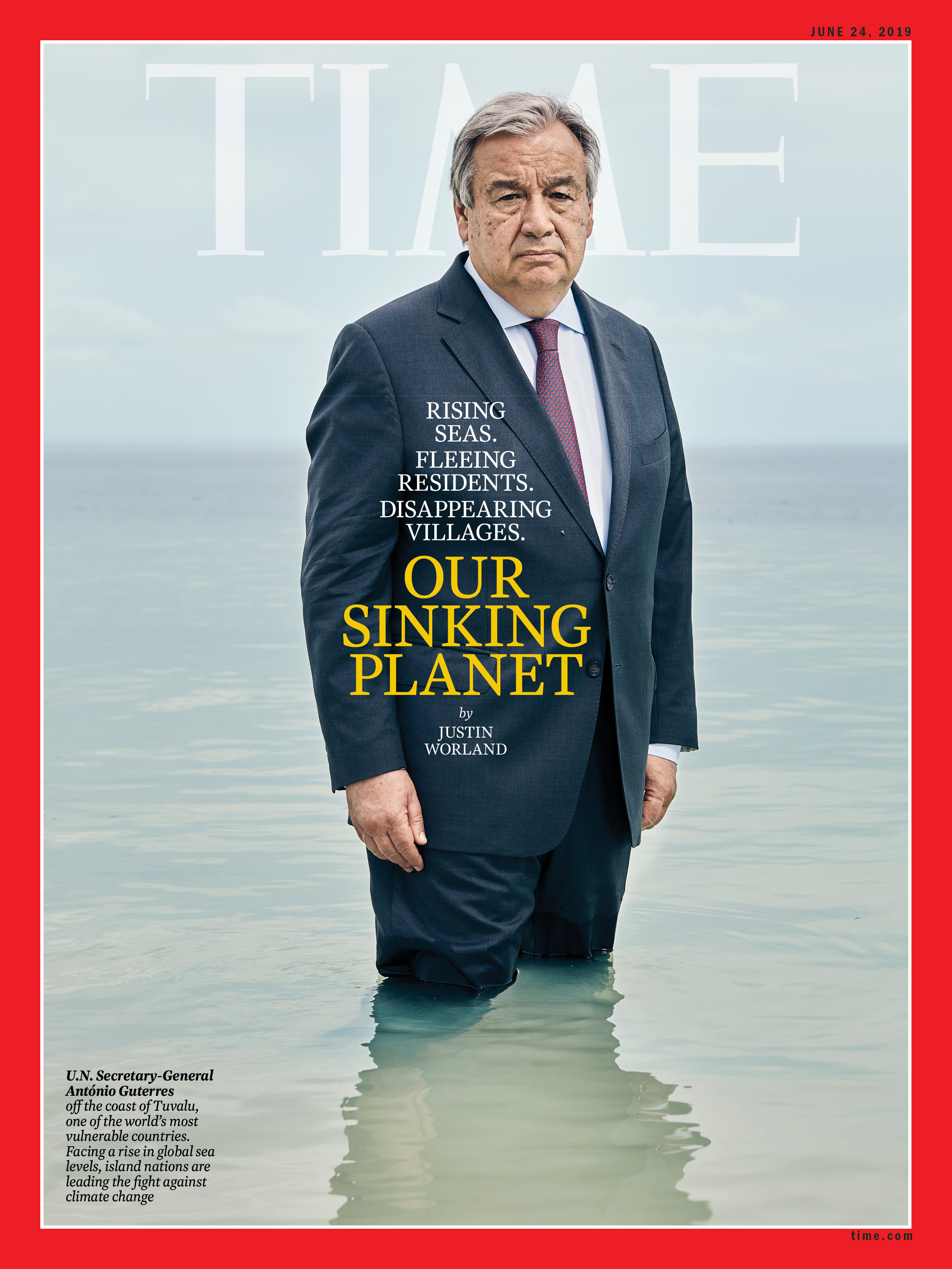
I also feel that a lot of international coverage focuses on perceptions from the West and the Global North. A good example is a Time magazine cover from several years ago. The UN secretary-general António Guterres had flown to Tuvalu with a big delegation, and a Time photographer was there with him. And the cover photo that Time went with was Guterres standing in a very expensive suit, knee-deep in the ocean. This was probably the only Time photographer to have visited Tuvalu in the last hundred years, and the image they chose was a European man in a suit. I understand the framing and what was intended, but it’s the villagers watching that photo shoot—just meters away—who are actually going through the hardships. Those are the people who during king tides are having to lift up their children, lift up their fridges, carry their pigs, so they don’t drown. I felt that that was the best demonstration of how international media depicts the climate crisis in the Pacific.
Pacific Islanders are also at the forefront of many climate solutions. Are there lessons you’ve learned that you would pass on to journalists covering solutions elsewhere?
My tip is to follow the money. A lot of climate solutions in the Pacific are funded through the UN, for example, and if you follow the financing trail you can get to the core of why the powers that be focused on a particular solution—and usually you’ll find that the justification isn’t rooted in the realities and needs of the place where the solution is being implemented.
So I encourage journalists to focus on the bigger picture when it comes to climate solutions. Was the local community consulted? Do solutions factor in local knowledge? Do they take into account social and environmental safeguards? In many cases, we find that not all of those things have been considered. Often, it’s a one-size-fits-all template from a project that was done in Bangladesh fifteen years ago, and someone said, “Oh, let’s do that in Samoa.” Sustainability is also important. If you’re going to do a climate project—say it’s a bridge—can the community afford to sustain that bridge once the developers are gone?
That said, there has been a surge of interest in traditional knowledge of climate change, and in the Pacific it’s those local solutions that really work. On islands that don’t really have the capacity to bring in extensive climate-financing projects, villagers just come up with their own solutions. On some islands, they’ve developed a way to plant taro in floating tires and tubes. In some coastal communities, villagers have enforced “marine protected areas” themselves. Communities have solutions, and our ancestors have passed down amazing knowledge that we’ve adapted over the years to survive. That’s a story more journalists should be telling.
“Loss and damage”—the idea that the wealthy countries primarily responsible for climate change should pay smaller, developing countries for the harm it’s causing—is an issue of great importance to Pacific Islands countries. What does “loss and damage” mean to you, and how would you like to see journalists in those wealthy countries approach the issue?
It’s really obvious in the Pacific what has been lost and damaged as a result of the climate crisis and as a result of the actions of others. It’s everything from physical assets and infrastructure to livelihoods to ancestral rights to the land we live on. Many people in island nations will need to relocate, and that’s the ultimate loss, right? They will lose access to their homeland and everything they’ve known. The Pacific Islands are owed compensation for what has been lost over time and what they continue to sacrifice as a result of the greenhouse gas emissions of other nations.
As journalists, I think we haven’t delved deep enough into covering loss and damage as a responsibility of countries like the US and Australia. I often see loss and damage covered as a diplomatic issue, as a “work stream” in the UN Framework Convention on Climate Change process. The coverage doesn’t really link to what’s actually being lost. It’s a political issue, yes. But journalists should also remember that there’s a human face to loss and damage.
Has America ever needed a media defender more than now? Help us by joining CJR today.