

Sign up for the daily CJR newsletter.
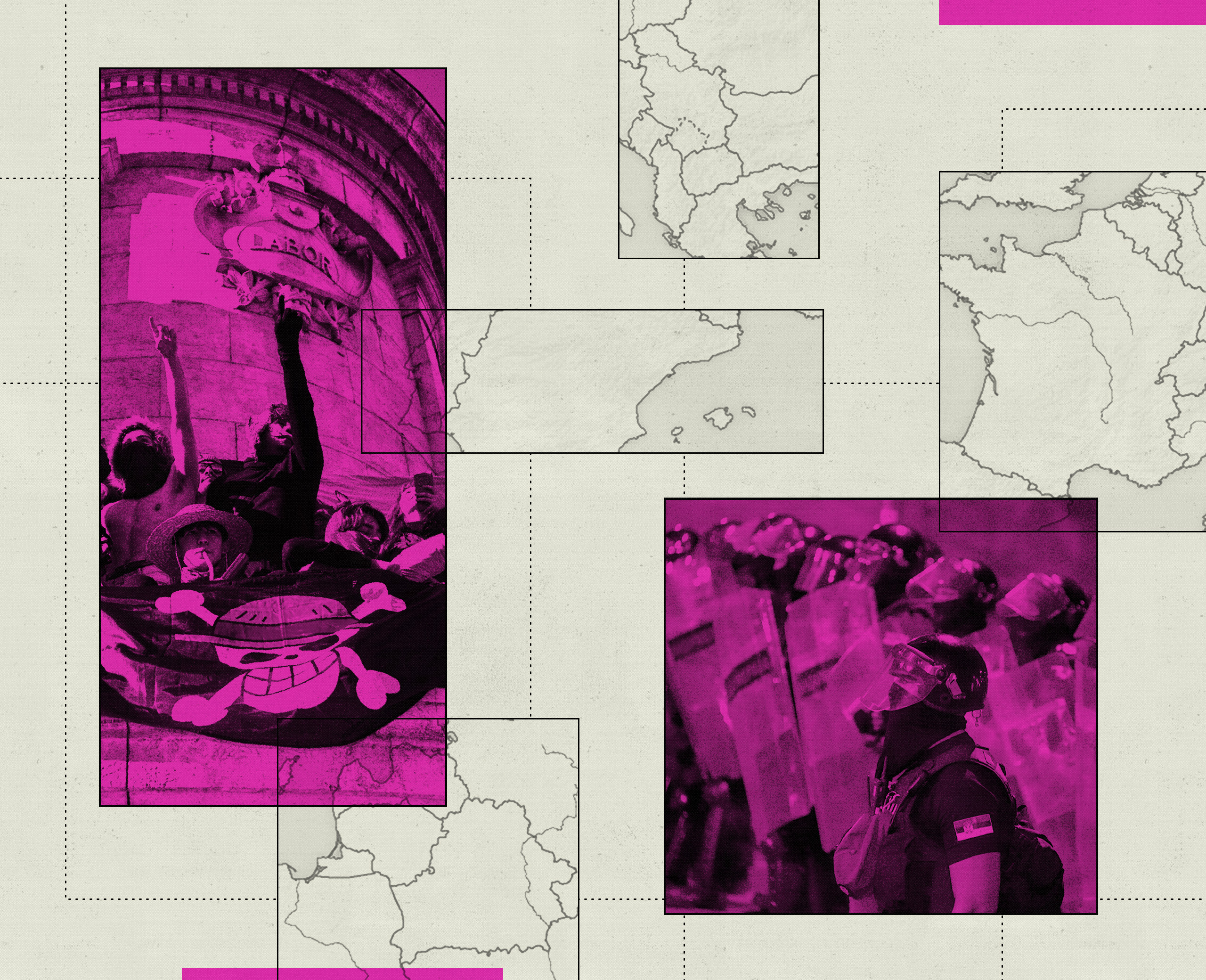
This fall, images of protests in Paris came to represent what seemed like a Europe-wide, youth-led wave of unrest. As French student blockades grew into a nationwide movement, anti-government protests cropped up in Italy, Belgium, Portugal, and Germany. In Serbia, following the collapse of a railway station’s facade in Novi Sad, a two-year-long student-led protest movement precipitated the ouster of Aleksandar Vučić, the country’s autocratic leader, after fourteen years. And in Albania, the government’s support for Jared Kushner’s planned luxury resort in a nature preserve sparked Gen Z’s so-called Flamingo Revolution, leading to violent clashes between protesters and police.
When covering these events, international outlets tend to describe them as a single protest movement spanning across borders and to focus on demonstrations getting out of hand. Julius Fintelmann, the cofounder and editor in chief of the European Correspondent, a four-year-old newsroom with reporters across the continent, begs to differ. “It’s a bit silly to call this a European Autumn like the Arab Spring,” he told me. “It’s not a pan-European protest, because they’re not coordinated together.” Fintelmann, who is twenty-four and based in Brussels, takes a different approach: “Through our pan-European lens, we can identify the problems, but the solutions hide in the different local, regional, and national settings. If we find them, others can learn from them.”
The Correspondent’s mission has been identifying those nuances. It started in 2022, as a daily newsletter and social media project that Fintelmann and his cofounders, Carla Allenbach and Philippe Kramer, ran on a voluntary basis while pursuing their undergraduate degrees in different European cities. Over the next three years, hundreds of people volunteered as contributors, many of them recruited via LinkedIn and the founders’ personal networks. In 2025, the Correspondent received 2.1 million euros (about 2.36 million dollars) from a European Commission digital media grant program, allowing the venture to scale up from a sprawling volunteer project to a fully developed news organization.
There is an office in Brussels, but the team—several editors and support staff—is scattered around the continent. Rather than sending reporters to parachute in to stories, the Correspondent relies on at least a hundred contributors based in each of Europe’s countries. These journalists produce daily and weekly newsletters that reach ninety thousand subscribers, as well as Web articles, social media (the Instagram page boasts a hundred and eighty-four thousand followers), and, soon, a monthly, pocket-size print product. Their work appears in English, then gets translated to six additional European languages.
“We’ve anchored our editorial strategy in our readers,” Fintelmann said. “We tell them how things that happen across Europe impact their own lives.” For instance, when a tragic rail accident killed nearly seventy people in Spain at the end of October, the newsroom’s data team looked into how railway safety compared with other modes of transportation across Europe. As energy prices soared, a reporter collected lessons from seven European cities on how to quit gas heat.
The audience is not exclusively young—Fintelmann told me that, according to a survey, about 60 percent of the Correspondent’s readers were over the age of forty-five—but most of the editorial team, and especially the local correspondents, are from the same generation whose disenchantment is driving the protests. Nevena Vračar, a thirty-year-old Serbian journalist, was working in Amsterdam two years ago when she met a Correspondent editor who told her that they were looking to hire a reporter for Serbia. Vračar joined the team, and two months later, the disaster in Novi Sad kick-started the student protest movement. “All of this really resonates with me,” she told me. “I think if you understand the disappointments that our generation is going through on a personal level, then you can really translate the spirit of the movement.”
The Correspondent has attracted senior journalists, too: Claire Alex Brown spent a decade and a half covering international news for France 24 before joining as a newsletter editor. “There are so many different styles, different takes, different ways of writing,” she told me, of the reporters she works with. “And these journalists are all very young. They’re extremely concerned with what’s going on right now in the world. And their perspective is very interesting compared to the big news machines.”
The Correspondent’s grant works like startup seed funding, and runs out in 2027. Fintelmann and his colleagues are now seeking other sources of revenue. The newsletter is free; the Correspondent accepts recurring and one-time microdonations, which helped them raise a hundred and eighty thousand euros (about two hundred thousand dollars); soon, they will open a merch shop. The upcoming print magazine, which will cost twelve euros (about fourteen dollars) per issue, is a part of the growth strategy: “People want to pay for journalism—they just need to have something that they feel is valuable,” Fintelmann told me.
All the while, the Correspondent has been publishing three or four stories a day. “People are already seeing things on breaking news outlets, so we always try to find a more unique angle, something that the audience might not immediately expect,” Deniz Eker, an editor for the democracy and human rights desk, told me. “We had someone go to the Kushner resort sites in Albania and frame it as an environmental story. In the French protests, we talked about the disproportionate use of tear gas as a symbol of the movement. When we covered the Turkish protests last year, we wrote about the meme culture around the movement, and how the use of satire can help reach apolitical people. The lack of formal constraints in how we present the news helps us be more curious.”
Has America ever needed a media defender more than now? Help us by joining CJR today.