Sign up for the daily CJR newsletter.
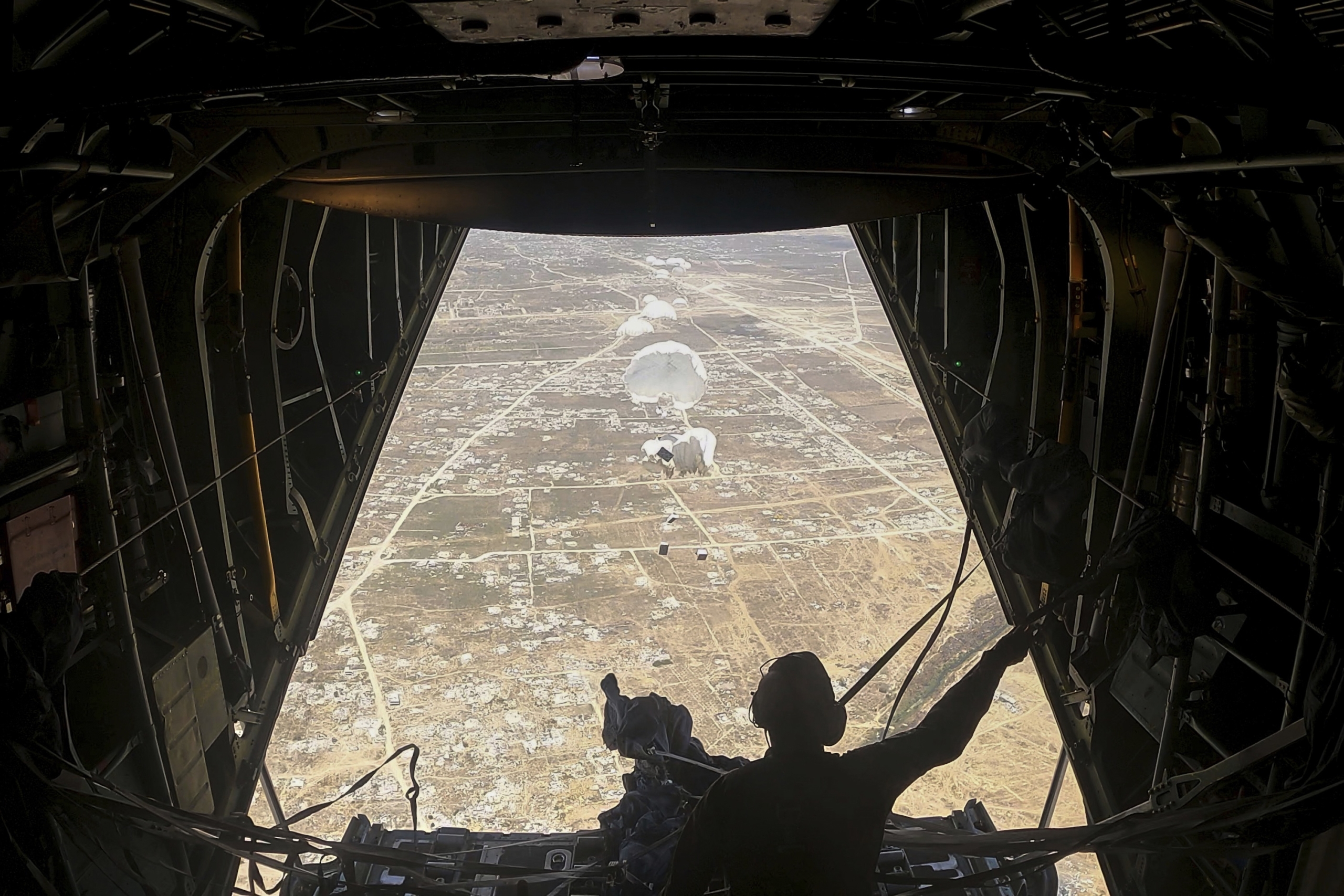
Diego Ibarra Sánchez only had about a minute to capture the photos of the besieged landscape below. It was Thursday, July 31, and he was aboard a Jordanian military aircraft that was air-dropping aid into Gaza, when the plane’s rear cargo door briefly opened to dispense pallets of food for the enclave’s starving population. In that moment, Ibarra, a Spanish freelancer on assignment for the New York Times, relied on his instincts. “I’m not feeling, I’m just acting. I’m just focusing on my work,” he said.
The photos Ibarra took were among a handful of similarly stark images and videos published over the past week by various news outlets that laid bare what two years of bombardment and urban conflict have done to the enclave of two million people. Entire neighborhoods appear reduced to rubble, their former structures virtually indistinguishable from the dirt of the surrounding landscape. In one photograph, taken by the Washington Post’s Heidi Levine, smoke rises from several areas of dense urban terrain; hardly a single building appears unscathed. “I’m trying to portray the consequences of war,” Ibarra said. “Without pictures, there is no memory.”
For almost the entirety of the Israeli war in Gaza, since the Hamas terrorist attacks of October 7, 2023, international media has not been granted access to the region, to witness firsthand the effects of the war. (Select reporters have been permitted to embed with Israeli military units, with strict limits on what they can see and show.) That’s left Palestinian reporters in Gaza to share what they can—much of it intense and deeply personal—but there has been relatively little that captured the full scope of the tragedy, from above.
“It was just a hellscape,” said Emma Murphy, the international editor for the British news channel ITV News, who flew on one of the aid planes. “It looked otherworldly. And yet it wasn’t otherworldly; it was a very short flight from safety.” Murphy captured footage of the landscape below using her iPhone. When she landed, she was asked by Jordanian officials not to publish any footage she’d taken out the window—conveying, apparently, the wishes of the Israeli government. “We felt it was a very questionable request from the Israelis not to film the damage below—we felt that there was an absolute obligation upon us to show what Gaza looked like,” she said, of ITV’s decision to publish the footage anyway. “I suspect Israel doesn’t want the world’s media to see what’s going on in there because they know that there will be very serious questions.”
Other reporters received similar instructions. Ibarra, who is based in Lebanon, said the Jordanians on the plane told him that the Israelis might re-block the flow of aid into Gaza if he took photographs of the ground below out of the windows—but seemed less concerned about photographs of the aid going out the rear bay. (One journalist told CJR that it appeared important to the Israelis that “the focus was purely on the humanitarian nature of the aid drops”—rather than what the aid was being dropped into.) Jeremy Bowen, the BBC’s international editor, said in his report from an aid plane that he was able to look out the windows but not film from them. He described the scenes instead: “I can tell you that communities in the north of Gaza…are flat. There’s nothing left of them.” Bowen told CJR: “The way it worked out for us was fine. I think for the Israelis it was a PR disaster.” (Israel’s Government Press Office and military did not respond to requests for comment on these apparent media restrictions.)
Mary Angela Bock, a professor at the University of Texas at Austin who researches photojournalism, says there’s a long history of photographs breaking through in the public consciousness, particularly when it comes to international conflicts and disasters. Bock cited the famous “Napalm Girl” photograph, from the Vietnam War, and the 2015 photograph of Aylan Kurdi, the Syrian three-year-old who died while trying to migrate to Greece. “We tend to take in visual information much more quickly,” Bock said. “We respond more emotionally to images.”
Aerial photographs of war zones in particular can have a marked effect on the public, according to Caren Kaplan, professor emerita at the University of California and the author of Aerial Aftermaths: Wartime from Above (2017). During World War II, aerial photos of the destruction of London caused by Germany’s blitz campaign contributed to an increased willingness among Americans to enter the conflict, she said. Later on, photos showing the impact of the atomic bombs in Japan helped inspire the antinuclear movement. Kaplan said the recent photos of Gaza reminded her of photos from World War I showing cratered land in Europe. “I do have a somewhat cynical view of war imagery actually changing public opinion,” she said. “But every once in a while it does, and I think that this is an image that could possibly do that.”
At least 186 journalists and media workers have been killed since the war began, according to the Committee to Protect Journalists, making it the deadliest conflict on record for reporters. The vast majority of those killed have been Palestinians; those who remain are now among those starving in Gaza. “We filmed it from above, and I believe that matters to support our colleagues in Gaza and the work that they’re doing,” Murphy said.
Has America ever needed a media defender more than now? Help us by joining CJR today.