Sign up for the daily CJR newsletter.
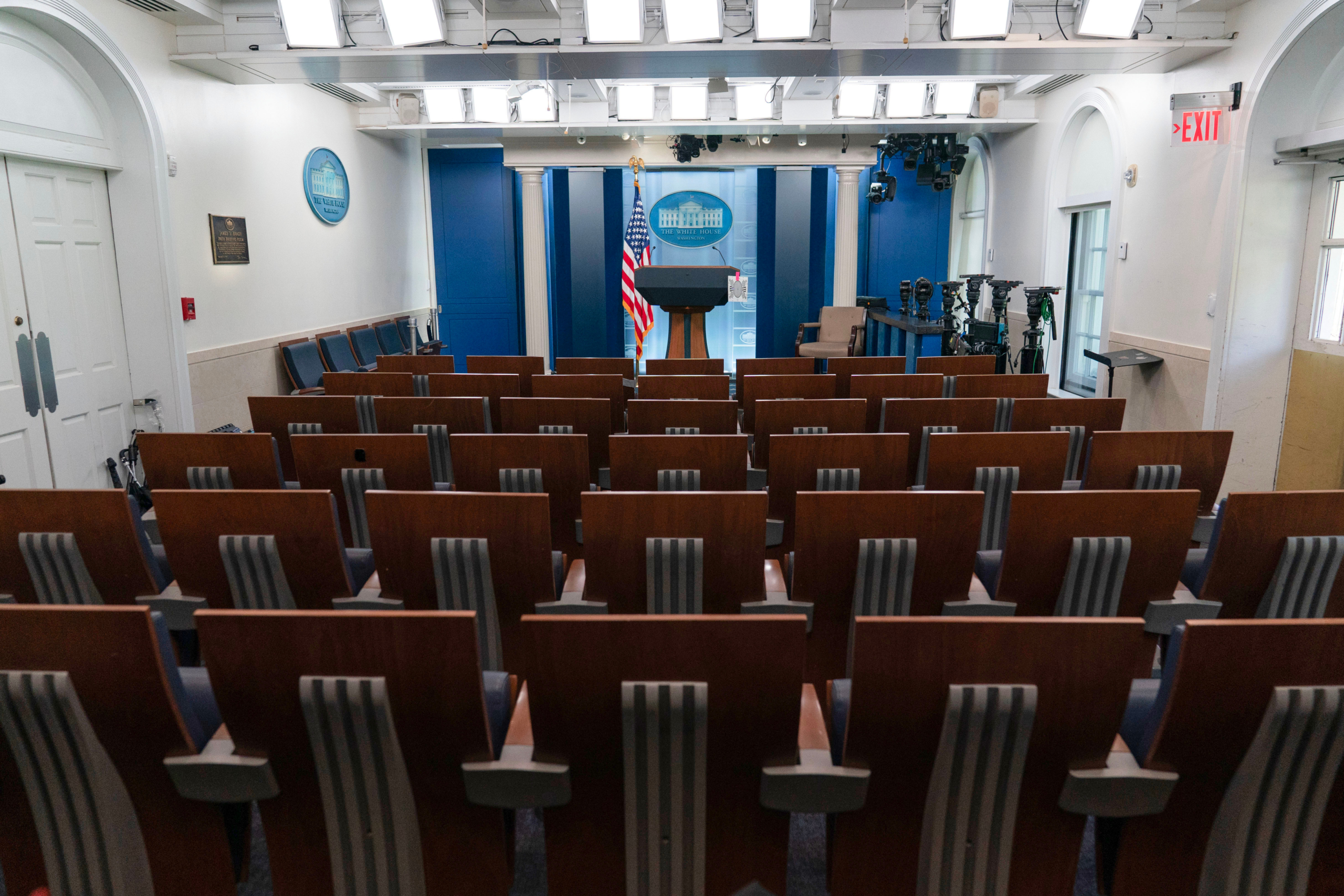
Guards have stopped reporters at the door, but there is a new clip show set to “Video Killed the Radio Star,” starting, naturally, with Jesse Pinkman, the ne’er-do-well survivor of Breaking Bad, and with appearances by the Seinfeld gang, the Friends friends, and the Office workers. You guessed it: we’re on the official White House dot gov website, and it’s the Monday after Donald Trump has banned CNN, MS Now, and Politico from the grounds. “Watch the Trump Administration’s biggest moments all in one place,” the blurb on the YouTube link reads. “Top videos, major remarks, and must-see highlights streaming 24/7 and updated in real time. Stay informed and stay up to date!” Kids, you’re watching Trump TV.
Trump TV made its trollingly timed debut in the aftershocks of Trump’s dubious pronouncement, which also came with threats against the New York Times and Washington Post. Homespun media was a given, though it was at first unclear what the ban would mean for the White House press pool: CNN—one of five networks in a rotation, sharing reporting and footage with NBC, ABC, CBS, and Fox News—was set to cover the president this week. “The public has a vital interest in receiving accurate, independent information about its government,” they said in a joint statement. “No administration should restrict a news organization because it objects to its reporting.” On Monday, they collectively suspended coverage. No one could hear what Trump was saying at a ribbon-cutting ceremony (got a boom mic?)—not even viewers of C-SPAN. Later that day, though, Trump appeared audibly, in New York. “It’s interesting because they said they were going to boycott me, but they never boycott me, so I wasn’t very worried about that,” he said, standing beside Zohran Mamdani, the mayor. He flicked out a hand: “Look at all that press.”
The Times and the Post put out statements in solidarity with the booted outlets; they and others vowed not to publish or disseminate White House pool photographs until midnight on Monday. Jacqui Heinrich, the Fox reporter who serves as president of the White House Correspondents’ Association, declared: “It is about the right of the American people to receive a full and independent account of the activities, policies, and decisions of whoever occupies the nation’s highest office.” Meanwhile, CNN, MS Now, Politico, and the spurned reporters filed suit in the United States District Court for the District of Columbia, against Trump and Steven Cheung, the communications director; Susie Wiles, the chief of staff; and Sean M. Curran, the director of the Secret Service, arguing that “this ban could not be a more direct assault on the First Amendment nor a more blatant violation of our most fundamental constitutional principles.” The filing says, too, that the action “should be immediately restrained” and that reporters should be allowed back on the White House grounds. Judge Timothy Kelly, whom Trump appointed in 2017, has asked that Trump’s lawyers respond by Tuesday and scheduled a filing for Wednesday. (In 2018, when Trump revoked the press pass of Jim Acosta, who was then a White House reporter for CNN, Kelly ordered the White House to give back his credentials; in the end, Acosta’s status was fully restored.)
One of this weekend’s turned-away journalists, MS Now’s Akayla Gardner, published a piece detailing her experience. “As I reported from across the street after being denied entry to the White House, I heard the US military color guard preparing for Chinese president Xi Jinping’s visit next week,” she wrote. “What message does this send to the world? What is the message to the leader of an authoritarian country with virtually no press freedom, where the media is controlled by the state?” Loads of legal scholars have weighed in, attesting, as Bruce D. Brown, the president of the Reporters Committee for Freedom of the Press, put it, to the “flatly unconstitutional” nature of the ban, which is “textbook viewpoint discrimination.” Even Trump, when asked whether he thought the ban would survive a court challenge, didn’t seem optimistic: “Well, we’ll see,” he replied. “I think it’s good to point it out”—that he dislikes news coverage he’s getting—“whether it survives or doesn’t.”
Trump TV is not showing all this democracy-ending doom and gloom on its three-million-ish-subscriber feed. It is, rather, “The Essentials Station,” as the channel bills itself. (We are not getting a presidential version of The Truman Show, following along with all of the Diet Coke–chugging and drone-launching.) First on the program: Trump’s July 3 address at Mount Rushmore, followed by Trump’s 2025 inauguration and other highlight reel footage that is not what Trump deems “fake news.” Trump TV presents no serious threat to legitimate reporting, though it broadcasts the reality Trump wants to inhabit, the borders of which he is testing by way of the ban.
Like many of his media projects—including his pay-for–Truth Social gambit, which on Monday got a bad review (“obvious risk of corruption”) from a group of former federal prosecutors—it seems intentionally provocative. It’s notable, though, how the provocation of recent days has summoned the White House press corps in a rare form: “How far will that solidarity go?” Gardner wondered. “Last year, after the White House barred reporters from the Associated Press from covering certain events, there were no organized boycotts from fellow journalists for crackdowns on press access. Will this time be different?” Maybe so; there are promising signs. What’s clear is that the press cannot afford to cede territory to obvious propaganda. Last night on Trump TV, I saw an image of a military artillery unit set up on a beach, possibly in California, with a chyron: “Text ‘VP’ to 45470 for updates from the White House.” The only sound was filtered air, like broadcast static.
Has America ever needed a media defender more than now? Help us by joining CJR today.