Sign up for the daily CJR newsletter.
At first glance, Ground News looks like any other news aggregator. The site displays a menu of trending news topics: Israel-Gaza, artificial intelligence, Donald Trump. In the feed below is a list of headlines. On the afternoon of Wednesday, September 3, 2025, the headline at the top of that list is “Florida becomes first state to end all vaccine mandates for schools.” But there’s no news source attached to it. Instead, there is a blue, white, and red graph showing something Ground News calls “bias distribution,” and a handful of AI-generated bullet points.
To find the sources for this headline, readers must click on it and then scroll down to a feed that lists news stories from outlets classified as “left,” “right,” or “center.” The Florida headline lists sixty-nine source articles, 55 percent of which are outlets in the center, such as CNBC, 37 percent left-leaning outlets like the AP, and 5 percent right-leaning, like the New York Post. Readers then have the option to click through to read the full articles. The site also assigns each outlet a “factuality rating” for how accurate and trustworthy it is as a source, though that feature is paywalled.
The tagline of Ground News is “See every side of every news story.” It aggregates articles from more than forty thousand free and subscription outlets, then uses AI to publish a daily average of about thirty thousand summaries of news events from these articles. The idea is that by presenting a story as a synthesis of articles from outlets across the political spectrum, readers will be able to bypass the bias inherent in any one publication and see with clear, unmuddled eyes the information on the other side. “When a news event happens, it passes through the prism of our media landscape and shatters into competing narratives,” Harleen Kaur, a former aerospace engineer who is now cofounder and CEO of Ground News, wrote in an email. She added: “After working in areas as complex as space exploration and jet engines, it struck me as unimaginable that we don’t have a simple way to assess the facts about what’s happening around us here on Earth.”
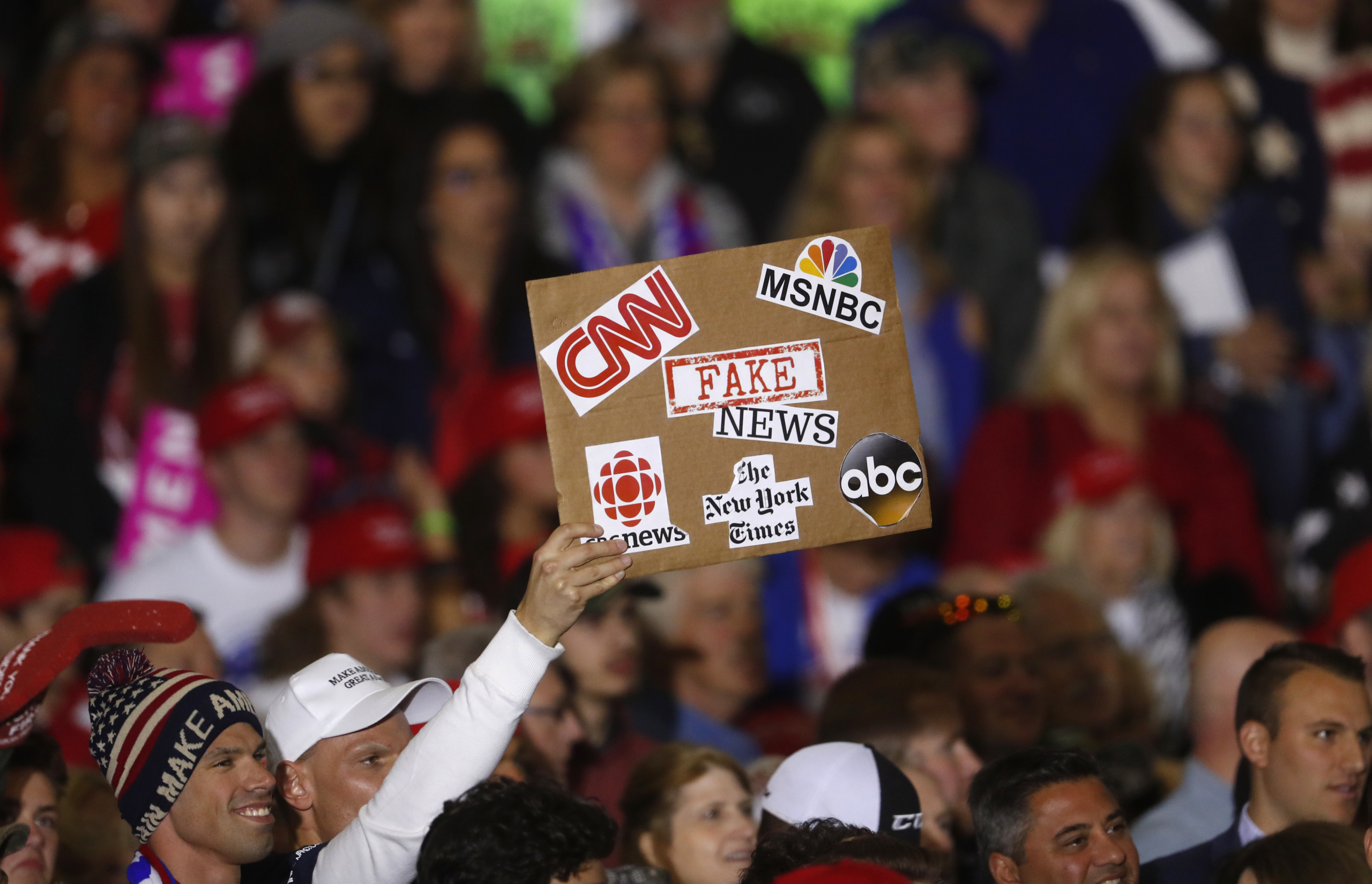
There is no doubt that the modern media ecosystem is confusing, sharply polarized, and full of misinformation—all conditions that have eroded the public’s trust in news institutions. More than half of Americans say they prefer news with “no particular point of view,” according to a study published in the International Journal of Communication. Trust in national news organizations started dipping in the mid-eighties and went downhill from there; by the late 2010s, the majority of people surveyed said that the news media was “often inaccurate.” This belief endures today. Distrust of news media is particularly pronounced among Republicans, only 53 percent of whom say they have at least some trust in mainstream news, compared with 81 percent of Democrats.
Kaur’s solution seems to have appeal. Ground News declined to share subscriber numbers with CJR, but according to the traffic tracker Similarweb, the site had just under eight million visits during the month of July. The Ground News app has millions of downloads across digital stores. This spring, it reached the number one spot on the App Store’s free news app list.
Kevin Tang, the founder of a startup and a regular reader, uses Ground News to browse headlines and read the linked articles. “It makes it pretty clear what the partisan lines on a particular issue are going to be,” Tang said.
Ground News is far from the first startup to play the news aggregation game. It’s not even the first aggregator that promises to counteract media bias. AllSides, which launched in 2012, likewise publishes summaries of news stories that are divided into left, center, and right. Alice Griesemer Sheehan, the COO and CFO, told CJR that AllSides’ content is written by human staff, and that the company is not yet profitable.
AllSides is one of three companies that Ground News relies on to determine its bias ratings. Sheehan tells CJR that Ground News has been using AllSides’ ratings without “formal permission” and without providing compensation. The other two ratings companies used by Ground News are Media Bias/Fact Check and Ad Fontes Media. Dave Van Zandt, founder of the former, told CJR that Media Bias/Fact Check does not have an agreement with Ground News. Vanessa Otero, CEO of Ad Fontes Media, said that Ground News pays for its ratings. Ground News declined to comment, writing, “We don’t disclose ongoing business relationships and arrangements.” Media Bias/Fact Check and Ad Fontes are also the source of Ground News’s factuality scores.
Media Bias/Fact Check, Ad Fontes, and AllSides measure media bias differently. Media Bias/Fact Check scores outlets on a scale from very liberal to very conservative and uses human fact-checkers to determine its factuality ratings. Ad Fontes started off using three human analysts—hailing from left, right, and center—to rate articles. It then trained an AI model based on those reviews. AllSides uses a combination of human reviewers and blind surveys of news consumers.
Is it possible that Ground News’s approach can help overcome political polarization? A 2024 study by Curtis Bram, an assistant professor of political science at the University of Texas at Dallas, reviewed Ground News’s “Blindspot” coverage, a feed of stories that the site describes as “disproportionately covered by one side of the political spectrum.” The study surveyed more than twelve hundred subscribers before and after they had read four stories. “Three of the four stories did not change people’s minds on these issues,” Bram wrote. But one piece, about the Biden administration limiting the entry of Cuban refugees, increased Republican subscribers’ support for more open refugee policies. “Overall, these findings demonstrate that highlighting news stories covered from across the partisan divide can, in certain contexts, reduce polarization,” the study concluded. That is in part because it exposes people to information they might not otherwise see.
Ground News told CJR that the company does not collect demographic information from its readers. It did provide a screenshot of a reader survey it conducted on political orientation that showed 304 readers evenly distributed across the spectrum. Its marketing strategy relies heavily on partnerships with YouTubers who span political beliefs.
In a recent promotion, left-wing commentator Adam Conover described Ground News as a way to “make sure you’re getting the real truth.” Another partner, the far-right commentator PaxTube, known for posting anti-LGBTQ and anti-Semitic content on X, said in a video, “Ground News is fixing what’s broken in the news landscape.”
Reached for comment on that particular partnership, Ground News replied: “Ground News’ sponsorship of a creator is never an endorsement of their personal views. Our goal with partnerships is to reach audiences across the political spectrum, including those in tightly siloed communities, so they can access a broader range of perspectives.”
Are Ground News subscribers really in it for the facts? “When people say they want unbiased news, they mean ‘I want news I don’t recognize as biased,’ which means ‘I want news consistent with my own biases,’” says Kathleen Hall Jamieson, founder of FactCheck.org and codirector of the National Annenberg Election Survey at the University of Pennsylvania.
Ultimately, Ground News leaves media literacy up to individual readers. Because the site paywalls factuality ratings, the vast majority of readers encounter news stories solely through the lens of how much coverage is skewing left or right. But truth is not a measure of how far a story strays from other coverage; it’s a measure of how near it comes to reality.
Some readers seem to find value in a site that maps out the media industry and makes news digestible. Improving the quality of news, though, requires hiring and training a workforce of journalists according to nonideological principles. Ground News’s system of aggregating already published content and tagging on bias ratings is not a better way to do this. It’s just cheaper.
Has America ever needed a media defender more than now? Help us by joining CJR today.