Sign up for the daily CJR newsletter.
In recent weeks, a picture of TikTok’s future in the United States has come into some clarity. A consortium of American investors—including Oracle’s Larry Ellison, a close ally of Donald Trump; Susquehanna International’s Jeff Yass, who has donated tens of millions to conservative causes; and Silver Lake, a private equity firm whose affiliates have donated to both Republicans and Democrats—will own about 80 percent of the company. Over the weekend, Trump said that Rupert Murdoch and his son Lachlan would also “probably be in the group.” Trump is soon expected to approve the framework of the deal through an executive order. (China will also need to sign off, and the arrangement will need regulatory approval.) We’ve come a long way from TikTok getting banned in the US—and Trump’s White House, whose account has more than 1.4 million followers, has become a real-time laboratory for how the government can leverage the platform.
Last month, Tow Center researchers wrote about how the White House has been transforming its communications from a traditional government press office to a direct-to-consumer media operation, producing articles that are top-ranked on Google News and running its own news aggregator to promote favorable coverage. Since late August, when the White House created its TikTok account, we have been collecting data on its follower and engagement metrics. (“President Trump’s message dominated TikTok during his presidential campaign, and we’re excited to build upon those successes and communicate in a way no other administration has before,” Karoline Leavitt, the press secretary, said then.) The data paints a picture of a communications team increasingly emboldened to test the boundaries between entertainment and public information.
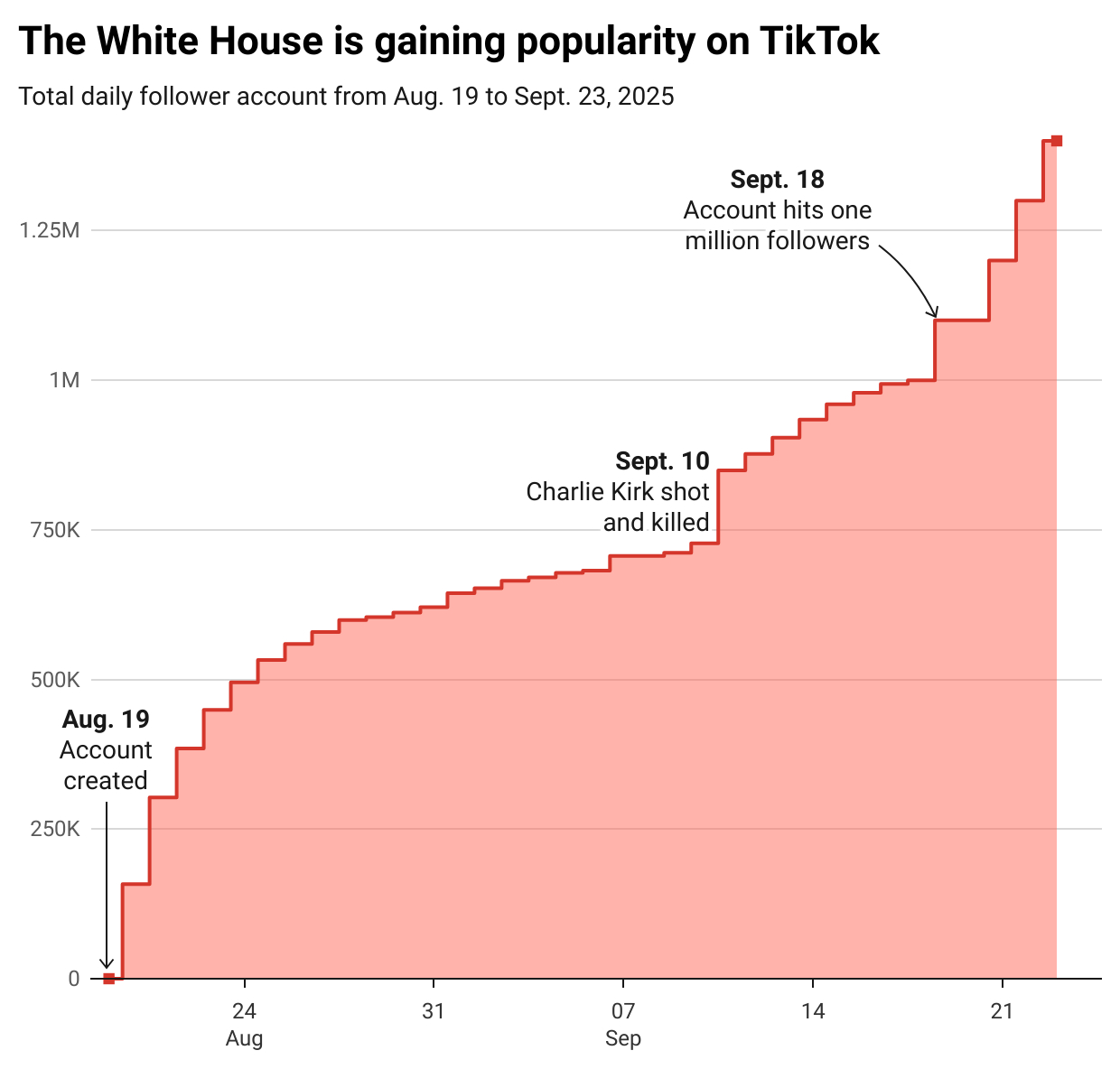
Our data shows that, after its launch, the White House account saw stagnant follower growth. But internal strategy iterations are visible in engagement patterns, as the team learns what works and what flops. If some posts, such as the “Press Sec’s MAGA Minute”—a short preview of what’s on the schedule for the president each week—resemble government communications of days past, the WhiteHouse TikTok also features increasingly aggressive memes. One video shows Tom Homan, the “border czar,” with lasers coming out of his eyes; another, originally shared by the Department of Homeland Security, has a montage of arrests set to the “Gotta Catch ’Em All” Pokémon theme song, with photos of immigrants on Pokémon-style cards and descriptions of their alleged criminal offenses. The latter had accrued 6.4 million views as of Tuesday evening—making it one of the most-watched videos on the White House account. Other high performers: September 11 commemorative posts, military- and crime-focused content, and religion-themed videos. The top videos, at nine and eight million views, were both from Charlie Kirk’s memorial service. (Traditional policy categories lagged significantly: economic content and foreign policy posts, for instance, were viewed much less.)
According to the Washington Post—which interviewed several people, including an anonymous TikTok official—the establishment of the White House account “kindled months of internal uncertainty over strategy, resources, and tone,” including questions of “how aggressive the videos should be.” The Post reported that TikTok told the White House that the app would likely ban some of the material the administration had posted to other platforms, including “jokingly edited videos showing undocumented immigrants being deported.” Posts on Trump’s TikTok, the Post observed, have often been more toned down than what’s found on X. The Pokémon-theme immigration video seems to mark a change in the tenor of Trump’s TikTok presence.
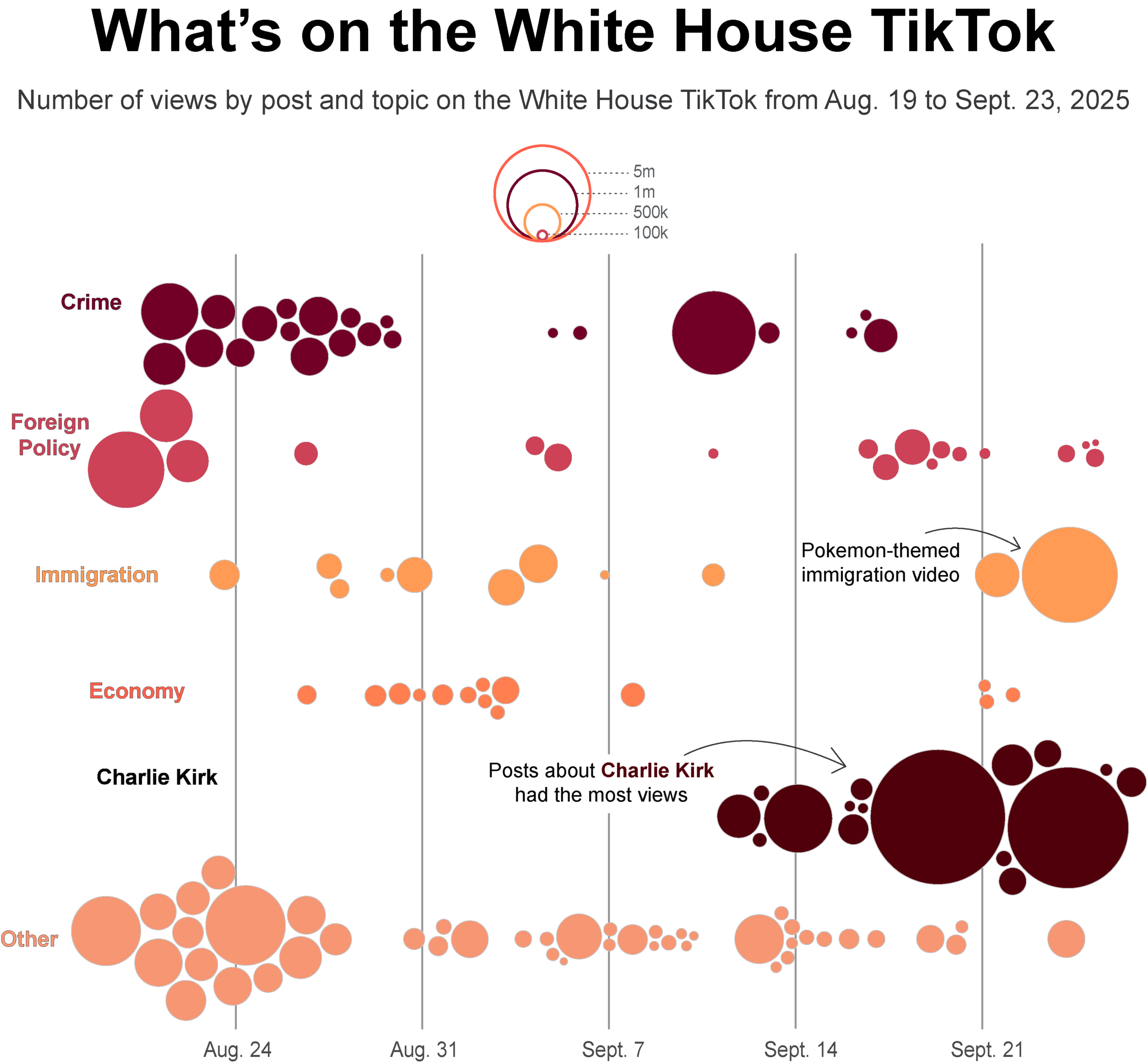
But logging on to TikTok doesn’t always work in the administration’s favor. One persistent thorn in the side of the administration is the presence of criticism from commenters: thanks to a 2019 ruling about Trump’s Twitter account, the president, the White House, and other government officials cannot block people on social media while in office, and the Post’s analysis found that the top comment on ninety-seven of the one hundred and one videos posted since Trump’s TikTok launched had been negative or critical of him. A popular move has been to comment, regardless of the content of any given post, asking the Trump administration to release the Epstein files; another involves posting memes with a distorted version of JD Vance’s face.
It is not yet known the extent to which the deal around TikTok’s ownership will change the platform’s algorithm or content policies to favor the Trump administration. Many of the details are still up in the air. On Saturday, Leavitt said on Fox News that non-government-associated Americans would hold six of seven controlling board seats. The deal structure is set to involve new investors alongside ByteDance, the Chinese-based company that owns the algorithm, which will have at most a 20 percent stake. (It’s worth noting, though, that even as the White House claims to be a hundred percent confident in the deal, Liu Pengyu, a spokesman for the Chinese embassy in Washington, said there has been only “a basic framework consensus.”)
Still, the extensive involvement of Trump’s allies in this deal may give him powerful levers to apply pressure on the board to make decisions and influence the app’s content ecosystem in ways that would be beneficial to the administration. According to the Post, a senior White House official told reporters on Monday that the US government will not be able to install its own representative to the board—but the official also said that the board will consist of investors who “are patriotic and love America.” This entire ordeal forces a reckoning: Can democracy—filtered through editorial judgment and fact-checking—coexist with direct, entertainment-optimized political communication?
Has America ever needed a media defender more than now? Help us by joining CJR today.