Sign up for the daily CJR newsletter.
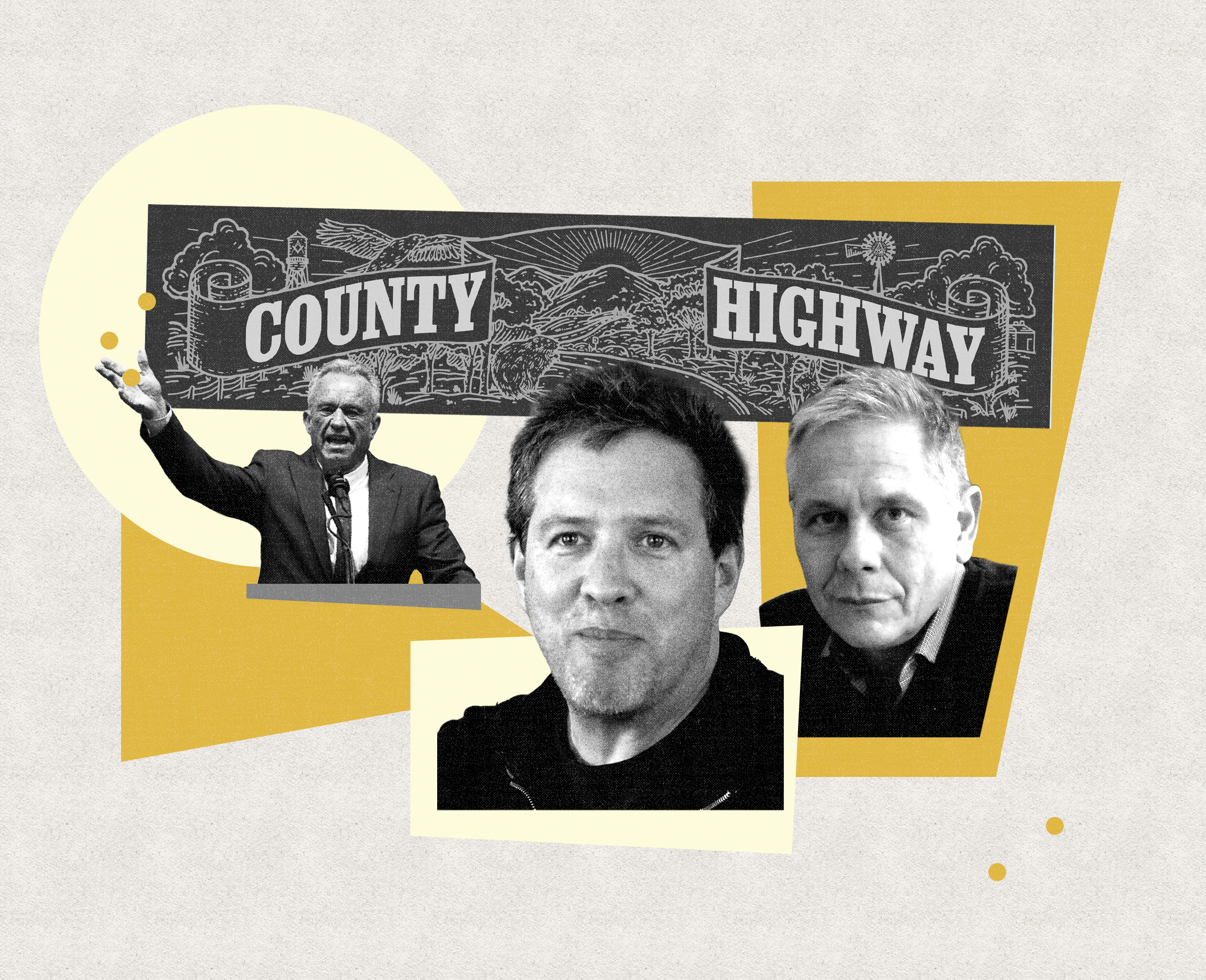
The first issue of County Highway, dated July–August 2023, features an interview between David Samuels, the editor, and Robert F. Kennedy Jr., identified variously as “Bobby,” “the last true Kennedy,” “the first environmental activist with a legitimate shot at winning a major-party nomination for President,” and “a master falconer.” Samuels had written about RFK Jr. before, noting that he had first seen him the day he knocked on the door of his house in 1976, when RFK Jr. was working on the campaign of a friend running for the New Jersey Legislature. In County Highway, Samuels remarked that RFK Jr. is “the co-author of the 94-page manual of multiple-choice questions and answers that applicants must study in order to pass the New York State apprentice falconry exam” and relayed that when they first spoke, Kennedy had wanted to “convince him to write a book about falconry.” That hasn’t come to pass, but RFK Jr. has since gone on to write for County Highway, contributing a four-thousand-word remembrance of his mother, Ethel—who, with his father, he writes, “shared a conservative nineteenth-century sensibility that children should be toughened by constant exposure to the elements and physical challenge.”
RFK Jr. is at home in County Highway, a twenty-page broadsheet that hired Pentagram, the design firm, to comb through nineteenth-century newspapers in search of fonts, and which Samuels described to me as an aesthetic object as much as a portal for information. (“We love RFK Jr.,” County Highway posted on X late last year. “We think that he will help make our children healthier and our air and water cleaner.”) The paper is produced six times a year by Samuels and his cofounder, Walter Kirn, supported by a staff of editors and contributors, along with Donald Rosenfeld, their publisher, who used to run Merchant Ivory Productions, the movie company, during the era of Howards End (1993) and The Remains of the Day (1994). Rosenfeld raised County Highway’s initial funding, though it is now self-sustaining, even turning a small profit. Some fifteen thousand people subscribe; seven to eight thousand more copies are sold via a “network of stockists” that Samuels described as “general stores, record stores, feed stores.” There is also an online presence, largely behind a paywall—though the RFK Jr. content is freely available. “Congrats to County Highway,” RFK Jr. posted on X on its first anniversary. “Finally an article that let me speak about my passion, falconry, rather than another paper trying to hunt me down.” He called the paper an inspiration “for all those who are sick of scrolling,” and added, “Please subscribe to County Highway today!” (Kennedy did not respond to my requests for comment.)
Other writers for County Highway, which calls itself “America’s only newspaper,” have included Ian Frazier, Joshua Cohen, Jonah Raskin, and Heather Heying (a cohost, with her husband, Bret Weinstein, of the DarkHorse podcast, whose website describes them as “infamous spreaders of ‘Covid disinformation’”; they have also interviewed RFK Jr.). The pieces, which range from dispatches and jeremiads to longer-form essays, cover America: its past, its present corners, its music, and its political textures, in a manner generally unsupported by other outlets. The idea here, per County Highway’s self-description, is quality writing revolting against contemporary orthodoxies of style and content. Duncan Moench, who in addition to contributing to County Highway is Tablet’s “social critic at large,” called the paper a “punk Harper’s for Middle America.” He’d been waiting for years to find a home in a publication like this, he said, and has a book, on producerism, coming out via County Highway’s new publishing imprint, Hard Cider Press. Rosenfeld, meanwhile, emphasized the paper’s interest in regionally rooted stories, its attention to “vanishing” things, and a devotion to long-form. Samuels, he said, is the paper’s “auteur.”
Reading County Highway, it is easy to see an abiding concentration on the artisanal, the natural, the rural. These fixations on a particular understanding of health have propelled much about the publication, including its plan to be print. In the old days, Samuels told me, reading involved having “a private encounter with a text behind which stood the shadowy figure of the author, and you were valued as a human because you were given the luxury of making up your own mind. You weren’t being screamed at and being herded around. You were taking a warm bath.” That is, “the print experience is a healthy experience,” he explained. “It reaffirms personhood, and rationality, and humanity. The digital experience, especially on phones, is the opposite. You can’t even see more than a paragraph at a time. You don’t even remember what came three paragraphs ago. There’s no demand for coherence. We know this because we have plenty of studies of how people read online. They don’t read, they sort. That’s different. That’s something that mice can do.”
Samuels told me that he is “thrilled” about RFK Jr.’s contributions to County Highway. “That said, we’re not a political outlet, and I feel entirely free to disagree with him with the next thing he says in public.” Rosenfeld concurred that the paper was not political. “Politics has let us down,” he told me. “We’ve elected these people, and they don’t probably represent us.” As for what the paper is about, “our stance is: to get to the bottom of what is creative and brilliant in America, and to keep going and keep mining it and finding that treasure and bringing it out. We’re getting so lost in this other conversation about politics, and it’s honestly deadening.”
Sometimes, people will look at County Highway, Samuels told me, and “say, ‘You must be some kind of MAGA red-state thing because you’re saying America is good.’ No, ma’am. I grew up in a liberal Democratic family, and I was always told America was good. I don’t know when that became the province of the right.” So too do right-wingers read the publication and drop off, he told me, at the first mention of a “Ryobi power dildo” at a Hells Angels convention. Still, in his ten-thousand-word dispatch from a Taylor Swift concert in Seattle, Samuels, a Swift fan, does overtly explore the political, characterizing American women over forty as “the most uniquely miserable group of women on earth, having been hopelessly fucked over”; unmarried women under thirty-five as “brides of the state”; and N95 masks as a “box-checking trick.” He also describes Swift’s “boobs” as “normal-sized but unlikely to launch ships.”
Rosenfeld told me that he always looks forward to the paper when it arrives at his door. County Highway “tricks you,” he told me. “You think you got a newspaper, and it’s something else.”
Has America ever needed a media defender more than now? Help us by joining CJR today.