Sign up for the daily CJR newsletter.
Like many young women, Alex Clark grew up watching movies about girls who worked at fashion magazines. Early on, she knew that’s what she wanted to do, too. She read every book she could find about working in the industry, and wrote a fashion column for her high school paper. In college, she minored in fashion merchandising. Now thirty-two and the host of Culture Apothecary, a conservative wellness podcast, she’s glad she didn’t go down the mainstream media path.
Take Teen Vogue, Clark said, calling from Scottsdale, Arizona: It “became a Marxist rag.” She continued, “What an absolute disaster that has become.” (Teen Vogue was shut down in November.)
Clark’s first jobs in media included a role as a traffic reporter at WDJX in Louisville and cohost of a morning show at 100.9 WNOW (now WHHH) in Indianapolis. She said she didn’t feel she could be “openly conservative.” So, in 2019, she left radio to host the Turning Point USA–produced podcast POPlitics. The following year she started The Spillover, which she rebranded in 2024 as Culture Apothecary, and shifted focus to wellness because she thought that health topics would resonate with more voters ahead of the election.
Clark’s show is popular: It ranks among the top ten health podcasts on Spotify. It is one of the most visible cultural products in a fast-growing wave of women’s media that tackle topics like wellness, pop culture, and fashion from a right-wing perspective, presenting a glossy version of conservatism that reads as both aspirational and accessible.
When I asked Clark which other women’s magazines she follows, she said, “Evie is crushing it.” Evie, founded in 2019, is a magazine that Brittany Hugoboom, its editor in chief, describes as “classier than Cosmo, sexier than Refinery29, and smarter than Bustle.” Recent articles include an essay on why Taylor Swift is dreaming of the “trad wife” life and a listicle on the dangers of birth control. Evie also publishes Cosmopolitan-style sex tips that are mostly aimed at married couples.
The Conservateur, another conservative women’s magazine, was founded in 2020 by Isabelle Redfield and Jayme Franklin, both of whom worked in Trump’s White House during his first administration. (Redfield was an intern; Franklin was director of correspondence after working as coalitions coordinator during the campaign.) The Conservateur is openly political, covering topics such as Vice President JD Vance’s relationship with his wife, Usha, and California’s Proposition 50, a contentious amendment that passed last year. At the same time, the magazine carves out a uniquely Trumpian feminine aesthetic. “The soft click of heels echoing through the corridors of the West Wing, the confident cut of tailored blazers, and the gleam of stringed pearls,” Bethany Miller writes in a piece that ran next to an image of the White House engulfed in a cloud of pink glitter. “These are the sights and sounds of the newly appointed Trump administration.”
“The Conservateur fit a niche that did not exist,” Emma Foley, a content manager at the National Review and a contributor to The Conservateur, told me. “Vogue was—and is—left-leaning. It seeks feminism, whether that’s traditional feminism or this more progressive, radical ideology that just doesn’t jibe with how traditional, conservative, and religious women think. And so there was an empty space in the market.”
The followings of Evie and The Conservateur are still relatively small compared with mainstream fashion magazines like Vogue. On Instagram, Evie and The Conservateur both have over two hundred thousand followers. But their audiences are engaged. “POV the streets are clean and the border is secure,” read the text over one recent image on The Conservateur’s account, published alongside a caption: “It’s not a fantasy, it’s just Trump’s America.” Below it, users flooded the comments section with American flags and prayer hands, flames and smiling crying faces. “Yassss,” one user wrote.
On television and online video platforms, people like Candace Owens—who recently created her own lifestyle venture, Club Candace—and Brett Cooper, the Gen Z Fox News contributor, try to appeal to a similar audience. Meanwhile, smaller independent initiatives like Evie Solheim’s Substack The Girl’s Guide, which features interviews with conservative writers that explore “the intersection of culture and politics,” have also started to crop up.
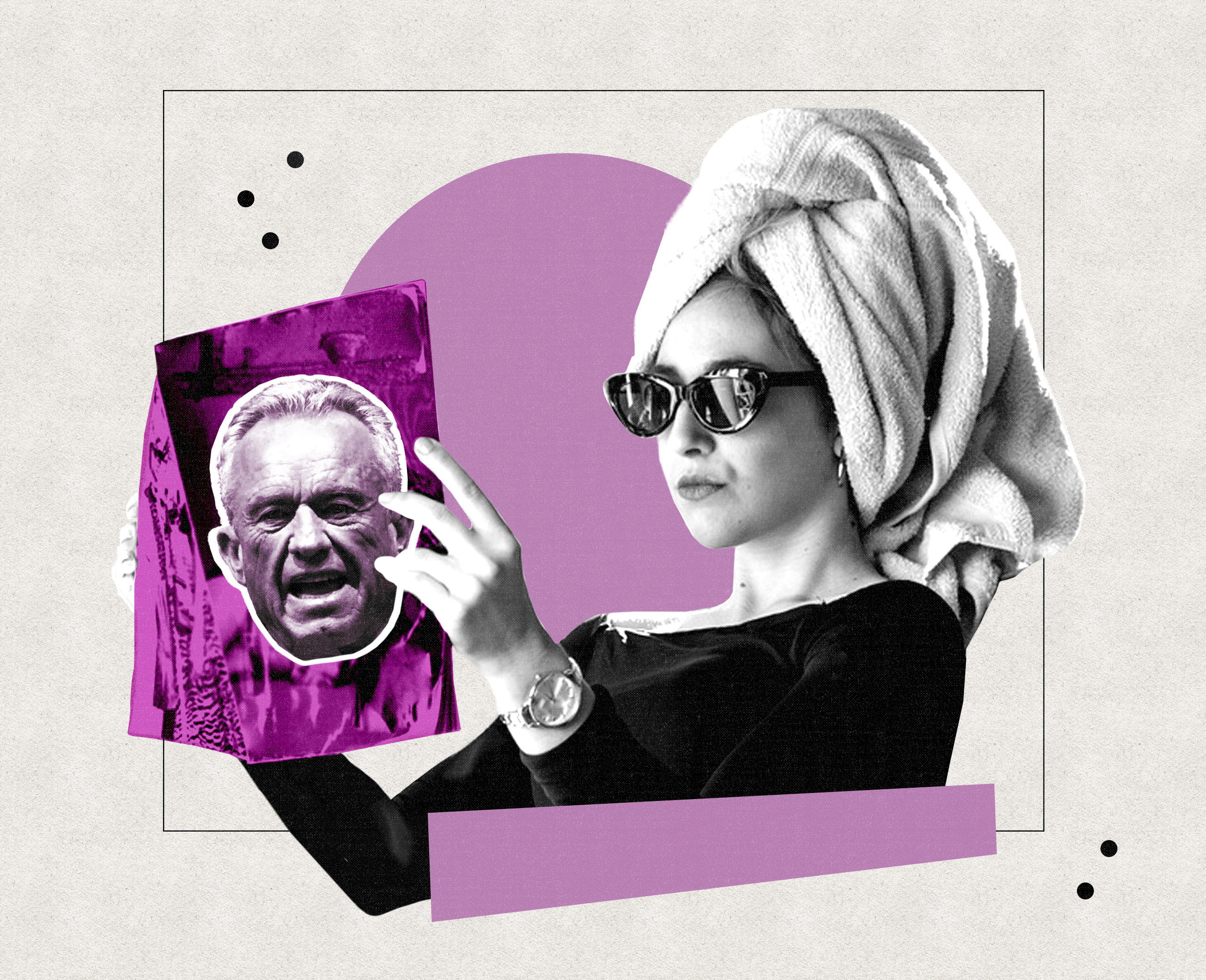
While American women overall favored Kamala Harris in the last election, Trump made gains with the group. Support for the Republican ticket increased by 6 percent from 2020 to 2025, according to the Center for American Women and Politics. “I totally attribute that to MAHA,” Clark said, referring to Robert F. Kennedy Jr.’s antiestablishment Make America Healthy Again movement. “I have had thousands of DMs of women saying ‘I never would have voted for Trump if it wasn’t for the MAHA movement and him joining forces with Bobby Kennedy.’ I’ve had women come up to me at events and say, ‘I never would have imagined coming to a conservative event until the MAHA movement.’” Clark believes Kennedy has been “sent by God.”
“Many people on the right are becoming more interested in health and wellness, because we’re tying it to the continuation of the strong American family,” said Andrea Mew, the managing editor of IW Features, the storytelling arm of the conservative nonprofit Independent Women. Mew is also a contributing writer at Evie.
Katie Gaddini, a visiting scholar at Stanford University and associate professor at the Social Research Institute at University College London, sees parallels between the “exaggerated femininity” and “hard-bitten toughness” of the women behind these media ventures and the likes of Ann Coulter and Laura Ingraham, conservative pundits who rose to prominence in the 1980s and 1990s and “made conservatism cool and hidden and attractive and sexy” in unprecedented ways. Christian women voters in particular, Gaddini said, see in these personalities “a type of MAGA that they can get behind, which maybe they didn’t feel was as appealing with just Trump himself.” These publications are pulling women who are already conservative further to the right, Gaddini said.
“These platforms speak to women who want to be grounded in faith or family and still be leaders and creators,” said Isabel Bogner, a reader based in Miles City, Montana, who is currently building a platform that highlights women in leadership and politics. Bogner, who is originally from Mexico and is married to a Republican member of the Montana State Senate, describes herself as a “Latina living as a political wife” on Instagram. She believes there’s a growing audience of women who want content that’s “thoughtful, feminine, and values-driven.”
In 2024, Foley, who profiled White House press secretary Karoline Leavitt that year for The Conservateur, attended a party cohosted by the publication and the New York Young Republican Club. Spirits were high, she said. There was a three-hour open bar. “These women, they’re hungry for this kind of stuff, no matter where they work,” Foley said, “whether that’s in fashion or at Fox.”
Has America ever needed a media defender more than now? Help us by joining CJR today.