Sign up for the daily CJR newsletter.
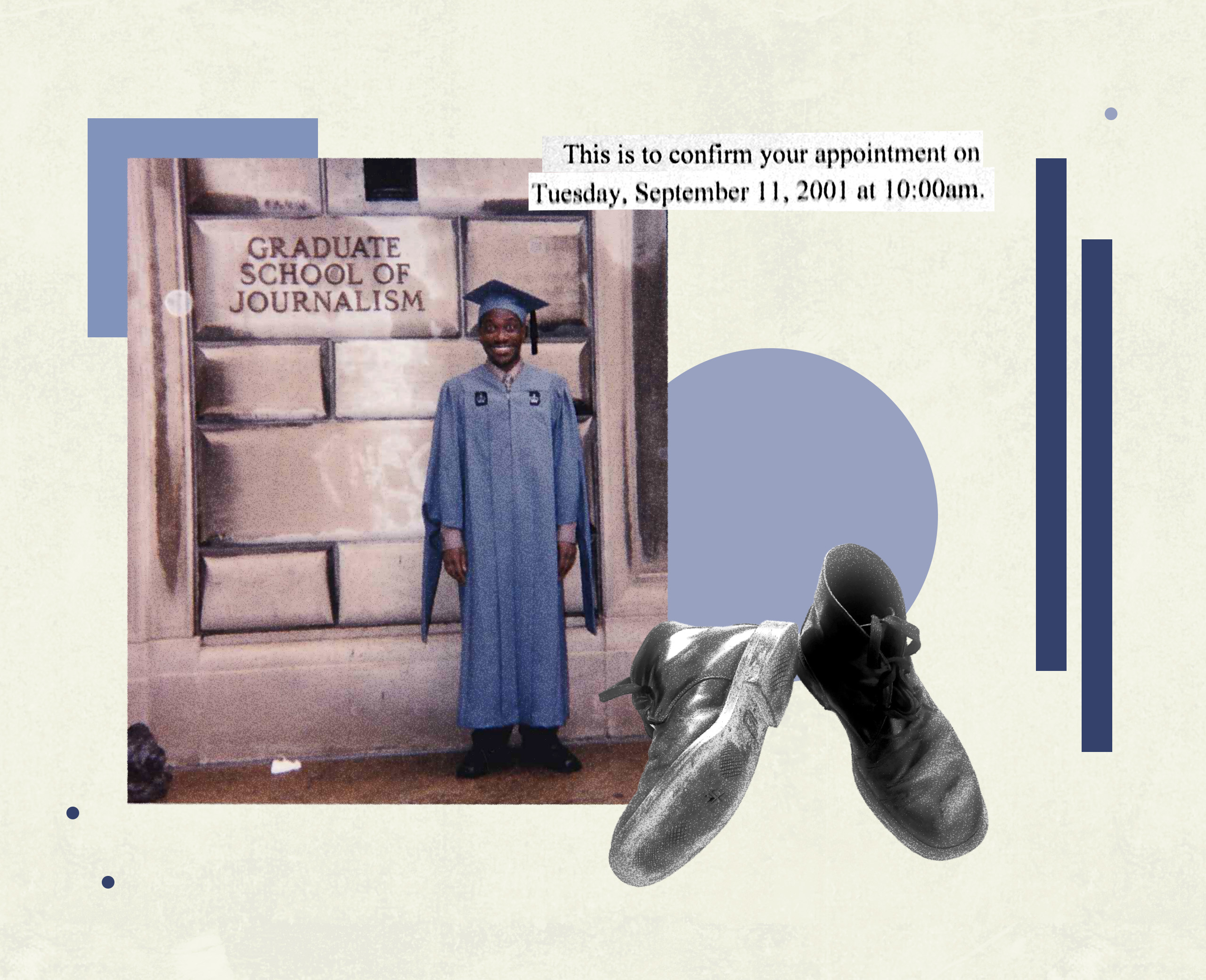
On the morning of September 11, 2001, I laced up my black chukka boots, stepped from my apartment in Upper Manhattan, and headed out for a job interview. Twenty-five years later, I cannot bring myself to throw those boots out. I keep them stored in a plastic bag, their soles dusted with the ash of the collapsed twin towers.
The 9/11 terrorist attacks killed nearly three thousand people in New York City, Arlington, Virginia, and Somerset County, Pennsylvania, and affected countless more. Everyone with a conscious memory of that day can say where they were, what they felt, how they coped. For me, given its confluence with a job prospect, the memory will forever be associated with my career trajectory and the evolution of the journalism profession over the ensuing quarter century.
My destination that day was an office building on Madison Avenue in Midtown where I hoped to land an entry-level reporter job. The letter of invitation (which I have also kept), dated September 7, reads, “This is to confirm your appointment on Tuesday, September 11, 2001, at 10am. Please allow up to three hours for your visit.” It did not play out as planned. The south tower fell at 9:59, the north tower at 10:28. My interview was cut short. But instead of returning home, I proceeded on foot to Ground Zero. “Reporters are expected to write between six and ten stories per week, most of which should be self-generated,” the letter said. In my jumbled thoughts that day, I imagined this could be my first.
I belong to the last cohort of Columbia Journalism School graduates of the twentieth century, the Class of 1999. My classmates and I entered an industry at a point of considerable churn, with the advent of digital, heightened conglomeration, and the 2000 presidential election. The 9/11 attacks added their own far-reaching fractures.
Before I left home that morning, I had already heard that a plane hit the World Trade Center. The details were hazy. At every stop on the subway line along my journey, the conductor announced the train would be taken out of service at a station increasingly higher from the Financial District, at the southern tip of Manhattan. The faces surrounding me mirrored my foreboding. When I reached the office, the receptionist’s first words were, “A plane crashed into the Pentagon.”
Shown to a windowless conference room, I sat in solitude awaiting the deputy editor. He came in with the news that one tower had crumbled. The staff watched it live in horror in the adjacent newsroom. We made an attempt at the interview, but were too preoccupied. He suggested we move straight to an editorial test and left to get it. After what felt like an eternity, he returned looking even more stunned than before: neither tower was still standing. We agreed to reschedule everything. On my flip phone, I called a close friend from J-school, who was a reporter for a local paper headquartered a few blocks away. Together, we headed toward the devastation.
Every surface was covered in pale-gray, cakey powder—buildings, trees, lampposts, street signs, and, of course, the ground we walked on.
Last year, we exchanged text messages about the scene. “Do you remember when we came across those people, still in their business attire, crammed onto the back of a sort of flatbed truck, and others on the ground, hammering sheets of wood to beams?” I wrote. “When I asked them what they were doing, they said they were making stretchers to take down to what later that day was dubbed ‘Ground Zero’? This was right in front of City Hall.”
“Yes. I remember that!” he replied. “And Tower 7 collapsed when we were around City Hall.”
“How did we know that?” I asked.
“There was a weird rumbling noise when we were near City Hall, and you looked at me and said, ‘This isn’t over yet.’ We may not have known what the rumble was until later.”
The original 7 World Trade Center building collapsed at around 5:20pm. My friend and I made our way back north. By the time we reached Canal Street, around 7pm, the barricades that would remain in place for months were already going up, prohibiting unauthorized entry to Lower Manhattan. Not knowing what to do with ourselves, I steered us to my favorite magazine store, on Broadway at Broome, thinking it would be open for business. It was not. I realized later that I was postponing sorrow with the delusion of normalcy. Its closure was also symbolic: an augury of the accelerating decline of glossy-magazine sales and the increasing constriction of the print world.
It had formerly been the case that recent J-school graduates left the city to practice in smaller regional and local markets and gradually work their way back to New York, if that was their desire. We in the class of ’99 entered the workforce at the tail end of the dot-com boom, attracting a number of us to “Silicon Alley.” Months prior to 9/11, I had left a job at a financial-journalism website whose offices were in the Trinity Building, at the mouth of Wall Street, a ten-minute walk from the World Trade Center. What if I hadn’t quit that job to go to another dot-com in Silicon Alley (from which I got pink-slipped when the Web 1.0 bubble burst)? What if I had been there on the morning of September 11 instead of pounding the pavement to get a new job? (My former coworkers all survived.)
The rescheduling of the interview never happened. The company, like many across the media landscape, put hiring on hold. Instead, I landed a position as communications director of a nongovernmental organization promoting environmental justice. (The organization was one of the first to raise concerns about the health and environmental impacts of the attacks.) Later, I had stints at the New York Observer and Condé Nast. My post-9/11 experiences in the job market sparked questions about the media workforce: What material, social, and especially technological conditions configured the pipelines for workers into and across these industries? Seven years out of J-school, a full-ride scholarship took me back to university to examine the emerging, digital forms of media aspiration for my doctorate.
I have been a tenured professor of media studies for more than a decade now. Every fall, in one of the survey courses I teach, I include a module on how the press discourse surrounding 9/11 has changed over time. As the years multiply, my students’ connection to the events wanes. For some fifteen years after the attacks, I had students despairing, recounting personal loss. Since then, it’s been staid contemplation.
Read More: What one student reporter saw on 9/11. By Nicholas Spangler
Has America ever needed a media defender more than now? Help us by joining CJR today.