Sign up for the daily CJR newsletter.

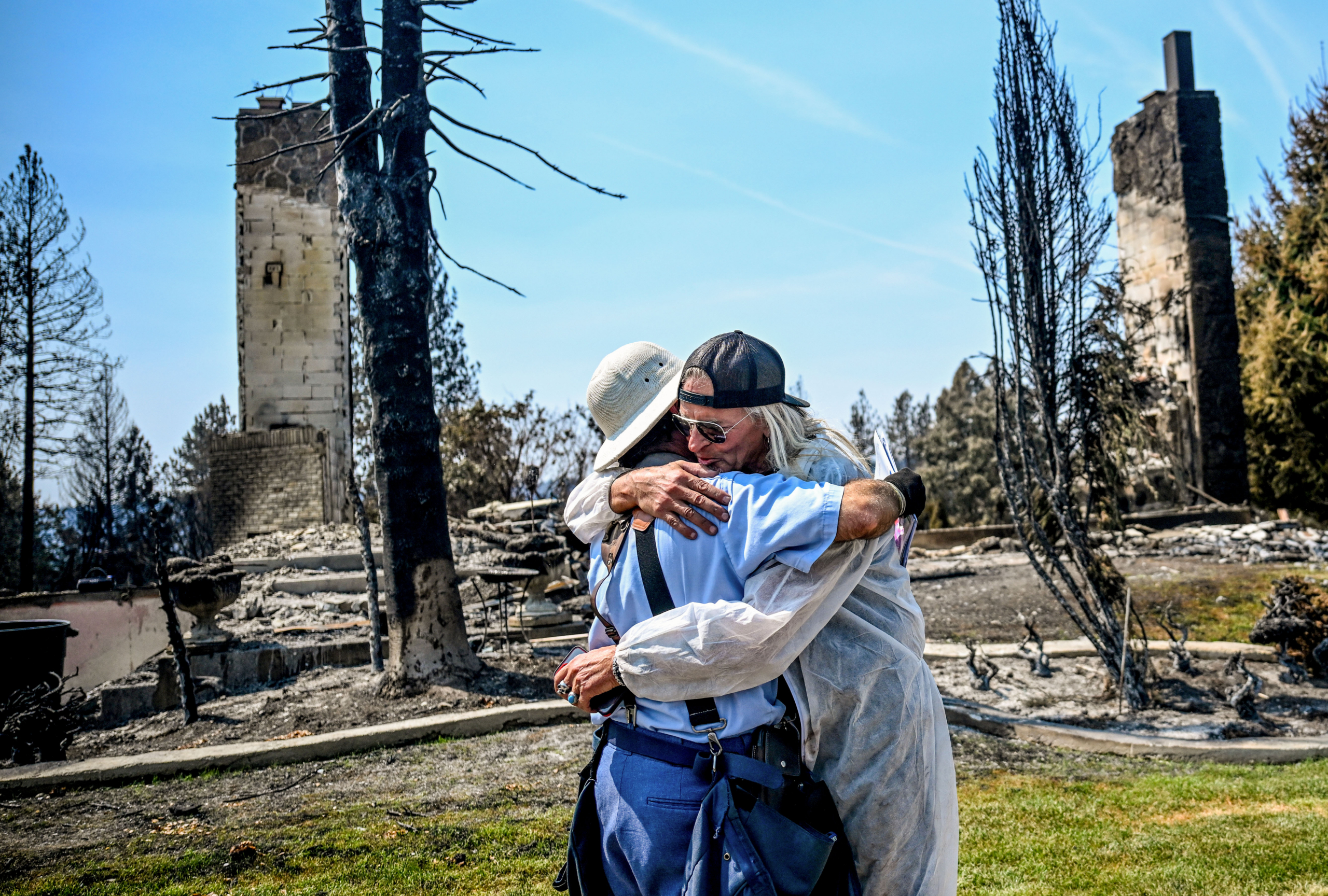
Alexandra Duggan, a wildfire reporter for the Spokane, Washington, Spokesman-Review, wasn’t supposed to work last Saturday. But something felt off. Fire season in the Pacific Northwest was already raging, and officials had been warning for days that high heat and strong winds could prove dangerous. Duggan checked her scanner. A fire was burning. By noon, she was on the ground, the first Spokesman-Review reporter to arrive at what would become Spokane’s most catastrophic fire in more than a century.
Since the blazes erupted, on August 1, Duggan and all her colleagues at the Spokesman-Review have tirelessly covered the three wildfires that have come to be known as the Spokane Complex fires, working through their own exhaustion and shock. The scale of the destruction is staggering. The fires have scorched nearly ten thousand acres of land. Almost nine hundred homes, businesses, and buildings have been damaged or destroyed. “It just looks like a wasteland. There’s no way to describe it other than horrible and apocalyptic,” Duggan told me. “You can see as many photos as you want, but standing there, you just feel overtaken by the emptiness of what used to be a really happy neighborhood with kids running around. And that was just gone in seconds.”
This week, Thomas Clouse, another reporter at the Spokesman-Review, profiled the fire crew who saved his home, which was in the evacuation zone. One firefighter described the work as “trying to manage the aftermath of a nuclear bomb.” It was so hot, Clouse writes, that it “melted the safety goggles on their faces.” Another fireman became so dehydrated that the acting lieutenant had to administer fluids intravenously. The fireman, Clouse writes, “re-engaged the battle with the IV hanging off his arm.”
Lindsey Treffry, the editor overseeing the newsroom, grew up in Spokane and has been with the Spokesman-Review for thirteen years. She estimates that the paper, which was founded in 1883, has published more than a hundred and twenty-five stories on the wildfires. Last Tuesday, it published eighteen in a single day. She told me that the newsroom is just beginning to grapple with the devastation it has documented. “There’s at least a little separation from some of the horrors that they witnessed, but I think it’s going to be a while before that can be fully processed,” she said. “It reminds me of grief, like losing a loved one. Sometimes it doesn’t hit you hard until later.”
And the work is far from over. It’s still early in the fire season, and the story will extend beyond the flames into the long and complicated aftermath of any disaster: the mental health toll, insurance claims, lost property values, housing shortages, and other consequences. “When all of the national media packs up and leaves, it’s going to be us that’s still here,” Duggan said. “We still have to face this in our community. We don’t get the option to just leave. We have to continue to show up.”

Last week, USA Today Co. announced it had partnered with Palantir, the surveillance company. On an earnings call, Mike Reed, the chairman and CEO, said that the purpose of the deal was to “strengthen how we collect, connect, and activate audience data to drive more effective and faster monetization across our platform.” In part, the move is intended to help USA Today address the decline of search traffic as audiences increasingly turn to AI. As Reed put it: “We recognize that we have to create and format content for humans and for machines.”
As you might expect, journalists at USA Today’s more than two hundred local publications did not welcome the news. On Monday, the majority of unions representing more than eight hundred USA Today Co. employees called on the company to end the partnership, writing in an open letter: “We have significant ethical issues with Palantir, whose artificial intelligence software has been used to advance widespread surveillance and power immigration crackdowns. Not only does partnering with Palantir, a major player in the news we cover, create an inherent conflict of interest, but it fails the journalists who have been assaulted and falsely arrested while covering immigration enforcement actions and protests.”
In addition to the reasons outlined in the letter, Palantir is controversial in journalism circles because its cofounder and chairman is Peter Thiel, a billionaire best known as the man who bankrolled the demise of Gawker. (I wrote more about Thiel in a recent column.) “Peter Thiel is a guy who’s openly talking about democracy and freedom not being compatible. That goes directly against what our own corporate values say,” Mike Davis, an investigative reporter at the Asbury Park Press and a vice chair for the NewsGuild of New York, told me.
USA Today Co., which has roughly seventy-five hundred employees in the US, is the nation’s largest network of local newsrooms. Davis told me that he and his colleagues are concerned that the deal will undermine the trust they have built with their (human) audiences. “Everybody recognizes that if we’re going to become sustainable in any real way, where we can actually build and grow, you’re going to have to figure out ways to monetize your audience,” Davis said. “But the problem here is that at its core, it’s going to make our jobs harder in that there are some readers, there are some subscribers, and there are certainly many activists and people in public life that will hold it against us.”
In an email, USA Today Co. provided me with a statement from Amy Garrard, its vice president of labor relations: “We respect that employees have a range of perspectives. Our agreement with Palantir is a business decision focused on strengthening how we connect and better serve audiences, advertisers, and subscribers. Our data remains protected under our existing privacy commitments, contractual safeguards, and applicable laws. As always, our journalism remains fully independent.” The company did not respond to my request for additional information about the deal.
The challenges facing USA Today (and all newsrooms) are real, but the choice of Palantir as a partner is harder to understand. Davis told me that USA Today Co. leadership has yet to directly address the concerns raised by the letter. “It’s hard to believe,” he said, “that if you really want to monetize your audience and do all the things that a journalism company should be doing, that this was the only option.”
In 1996, Almeer Nance, who was then sixteen, was coerced into helping a man rob a Radio Shack. When that man, Robert Manning, killed a store employee during the robbery, both Nance and Manning were arrested and charged with felony murder. Although Manning confessed to the killing and admitted that he’d forced Nance to participate, both were ultimately convicted and sentenced to life in prison.
In an in-depth investigation for MLK50, Rebecca Cadenhead examines how Tennessee’s felony-murder law disproportionately affects Black children like Nance. The law allows prosecutors to charge people with murder even when they did not kill anyone themselves. “Prosecutors can convict you of felony murder if you participate in a felony and someone dies in the process—regardless of the role you played in the crime,” Cadenhead writes.
Of the hundred and four children convicted of felony murder in Tennessee between 1995 and 2019, almost 90 percent were Black, even though Black children make up just 17 percent of the juvenile population. Cadenhead also found that the average defendant was sixteen at the time of the offense, but some cases involved kids as young as twelve.
Cadenhead is the first person to assemble a comprehensive picture of how Tennessee’s felony murder law affects Black children; the state does not maintain data on such convictions. For her analysis, she built on an attorney’s list of all first-degree-murder convictions from 1977 to 2017, added data from an advocacy organization for 2018 and 2019, and reviewed publicly available records for all cases involving children.
Despite Cadenhead’s thorough research, there are likely far more cases in which children were pressured into plea bargains. “Prosecutors often want to avoid expending resources on a trial,” Preston Shipp, a former Tennessee state prosecutor, told her. Yet those decisions are often influenced by a stark racial disparity. “I have to admit that prosecutors, police, judges just look at Black people differently,” Shipp said. “When white prosecutors evaluate a young white person who has committed a felony, they’ll say, ‘We don’t want to ruin this white kid’s life,’” he told Cadenhead. “Whereas with a young Black kid, they’ll say, ‘He’s already a criminal.’ They already see him as some sort of a hardened criminal.”
If you have a suggestion for this column, please send it to laurelsanddarts@cjr.org. We can’t acknowledge all submissions, but we will mention you if we use your idea. For more on Laurels and Darts, please click here. To receive this and other CJR newsletters in your inbox, please click here.
Has America ever needed a media defender more than now? Help us by joining CJR today.