Sign up for the daily CJR newsletter.

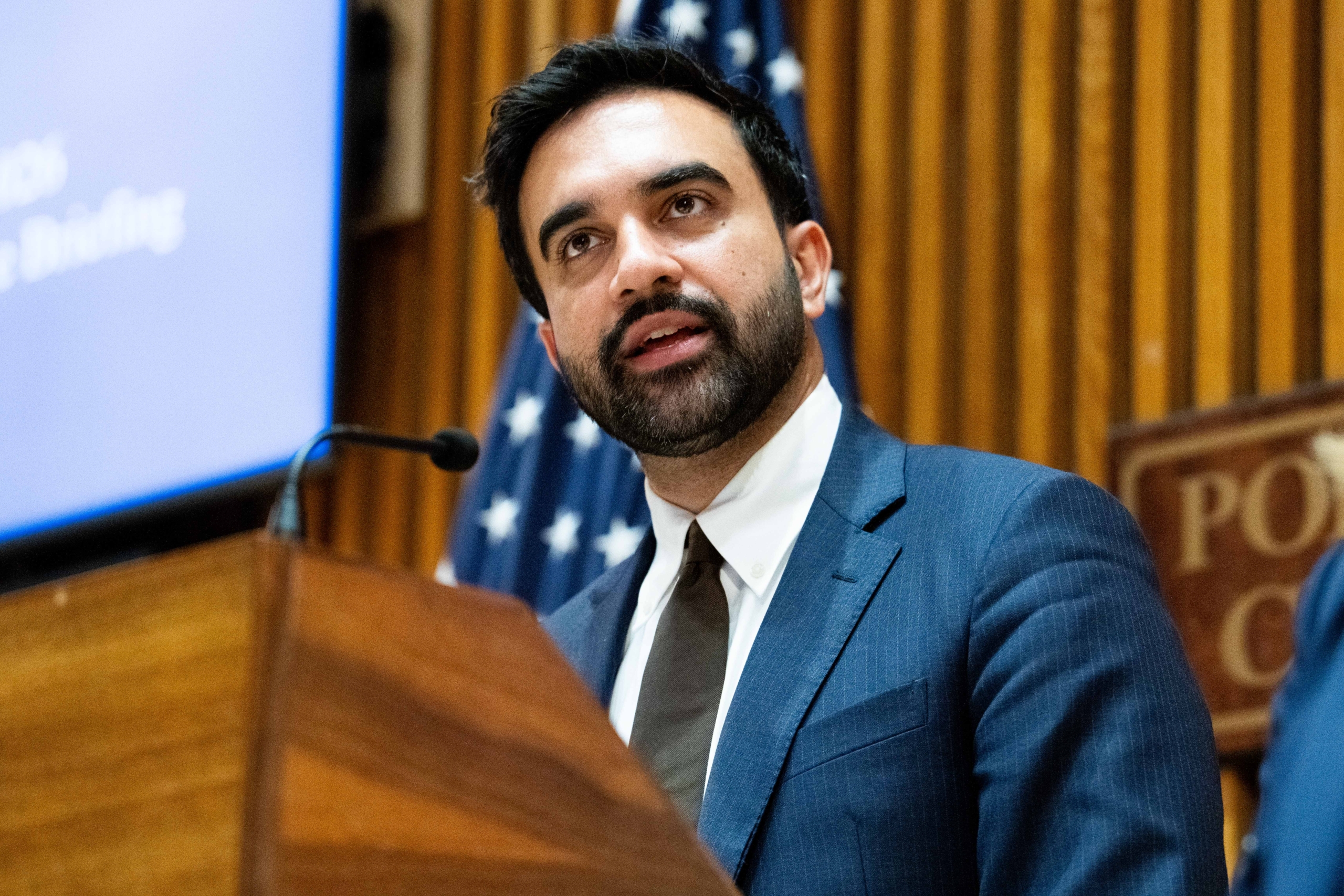
On Monday, the Wall Street Journal published an opinion piece by Matthew Hennessey arguing that Zohran Mamdani, the mayor of New York, has enabled or signaled tolerance for anti-Semitism, despite his repeated condemnations of anti-Semitic hate. It was—unfortunately, predictably—laden with a casual Islamophobia that I, as a Middle Eastern American, have come to expect. Hennessey calls Mamdani a “zealot” and describes him as “a rabble-rouser in a kaffiyeh.”
But what was most shocking was the appalling image that accompanied the essay: a photograph of a man holding an obviously doctored cut-out of Mamdani’s head with a green Hamas headband emblazoned with meaningless markings meant to imitate Arabic script. It’s difficult to imagine that the Journal would be comfortable publishing such overtly racist tropes about almost any other minority group.
Anna Bahr, Mamdani’s director of communications, responded to the picture on X, writing that she spoke with Paul Gigot, the Journal’s editorial page editor, about “the incredibly Islamophobic image printed alongside this opinion piece. His take: ‘I don’t see it as racist.’” Therein seems to lie the problem. (I reached out to both Gigot and a spokesperson for the Journal, but neither responded.)
In his column, Hennessey extensively quotes from a viral New York Post cover story from the weekend that claimed “thousands of 9/11 families” wanted Mamdani banned from the twenty-fifth-anniversary memorial ceremony at Ground Zero and suggested that the mayor is an “apologist for Islamic terror.” Funny thing about that piece, though: it’s bullshit.
The Post story is about a petition started on Change.org by Giovanni Galante, whose wife died on September 11. But, as Judd Legum pointed out on his Substack, Popular Information, the article “directly contradicts its cover.” The piece says that the petition “collected over 1,100 signatures in a little over a week, including from at least 300 victims’ families.” When Legum tried to verify that much smaller figure with Galante, he “acknowledged that there was no actual list of family members who had signed the petition” and that “the 300 figure that organizers shared with the New York Post was an estimate based on how they believe the petition spread.”
After Legum published his post, the Post story was quietly updated, without any correction or editor’s note. It now says the petition has “collected more than 42,000 signatures so far” and “Galante estimated that between 3,000 and 7,500 of the signers are relatives of victims.”
I suppose it’s progress that the updated version no longer presents an unverified estimate as fact. But simply citing a source’s new and convenient made-up figures doesn’t resolve the underlying problem. If only there were someone—perhaps a journalist—whose job was to investigate claims before publishing them. I asked a spokesperson for the Post whether it stands by its story and whether it is standard editorial practice to update an article without acknowledging the changes. I received no response.
I don’t usually bother to dart opinion pages or the Post’s often unhinged coverage of Mamdani. But it increasingly feels as though bigotry aimed at Middle Eastern Americans remains one of the last forms of prejudice this country still tolerates. If we do not confront it, it will only grow.
In 1997, Edward Said wrote, in a new introduction to his book Covering Islam: How the Media and the Experts Determine How We See the Rest of the World: “It is not difficult to imagine that a Muslim might be made uncomfortable by the relentless insistence—even if it is put in terms of a debate—that her or his faith, culture, and people are seen as a source of threat, and that she or he has been deterministically associated with terrorism, violence, and ‘fundamentalism.’” I wish those words didn’t still resonate today.

“Even on freak days when the sky pissed rain, the farms of Patrick Esch and Ed Dean Jagers remained bone-dry.” So begins Chris Bennett’s yarn about an elaborate scheme run by a group of farmers who faked a drought to collect millions in federal crop insurance.
Bennett covers all things agriculture for AgWeb, an online arm of Farm Journal, an agricultural trade magazine. Founded in 1877, the Journal began as an eight-page monthly. “It started out as a field magazine, where everything in there was supposed to be something the farmer could use right directly in their forty acres, or four hundred acres, and then it evolved from there,” Bennett told me.
How did the farmers, “via a perverted alchemy,” turn “rain into gold,” as Bennett writes? They “plugged, tipped, covered, and destroyed” the rain gauges in Colorado and Kansas that federal agencies rely on to record rainfall. “The actual weather people of the United States—the National Weather Service and all of them—were simply getting false recordings because these farmers had gone, with a hammer, with a shotgun, with different kinds of silicone caulk, and messed up the rain gauges so it didn’t record properly,” Bennett said. Crop insurance is based on rainfall, not crop performance, so when the recordings came back dry, the farmers collected millions of dollars.
“The details of this case were wild,” Peter McNeilly, the US attorney for the District of Colorado, told Bennett. “Wherever there’s a lot of government money being given out, people are going to be opportunistic to get it. This case was a whole cast of characters with creativity that surprised even career prosecutors.”
Bennett first came across the story five years ago and filed it away. Last month, he finally had a chance to return to it. “This reads like a Coen brothers film. There’s layers and layers to the cake, and every layer rotted out,” he said. “Agriculture is filled with crime, because you’ve got two million farmers, so just by human nature.”
He sees himself less as a journalist than as an advocate for farmers, one who measures every story against a simple standard: Will farmers care? “Is my friend Billy, who farms right across the field from me, is he gonna read this? That’s it. There’s the bar right there,” he told me. “I absolutely love, love, love what I do. I’m a redneck. So a redneck covering rednecks or people that have redneck association, it’s a natural fit.”
Guillermina Solano-Chala was living her dream. In 1999, desperate to support her two teenage sons and five-year-old daughter, she traveled from Mexico to Tennessee in search of work as a cook. She spent nearly three decades in Chattanooga, working in kitchens and waiting tables before opening her own restaurant in 2017, a beloved local spot. Then, in January of this year, she suddenly lost everything: after a traffic stop for a faulty headlight, she was deported.
In a poignant piece for the Chattanooga Times Free Press, Ignacio Perez looks at what comes after deportation through the story of Solano-Chala, known to her customers as “Miss G.” Perez follows her in the months after she was forced to leave Chattanooga, weaving the two defining journeys of her life: the treacherous one that brought her to the United States and the heartbreaking one that sent her back to Mexico.
Also published with the report was a letter from Alison Gerber, the editor of the paper, affirming the imperative “to document the ongoing story of our community for our neighbors and leave a narrative that future historians will consult.”
When we spoke on Wednesday, Gerber told me, “A lot of the immigration coverage in the United States is about protests, or it’s about people being arrested, or—like on the national level—it’s about the political debate over these policies. But I haven’t seen a lot of coverage about how the individuals who are arrested and deported are impacted.”
Over seven months, Perez followed Solano-Chala’s family in the United States and spent a week in Mexico with her. “It was a dream project where I got to properly document how something at a large political scale can impact an individual,” he told me. “Getting to be very immersed in that story and to spend a lot of time with her in Mexico was very unique and felt very special.”
Now, back in Mexico, Solano-Chala is starting over at fifty-nine years old. She operates a makeshift taco stand and has entered an entrepreneurship program in hopes of building a business again. She is approaching her next steps pragmatically. “I knew one day it was going to happen, just not that it was going to so soon,” Solano-Chala told Perez, of being deported from the US. “With my pockets empty, I still have my hands and feet.”
Hat tip to Sunday Long Reads for highlighting the AgWeb story. If you have a suggestion for this column, please send it to laurelsanddarts@cjr.org. We can’t acknowledge all submissions, but we will mention you if we use your idea. For more on Laurels and Darts, please click here. To receive this and other CJR newsletters in your inbox, please click here.
Has America ever needed a media defender more than now? Help us by joining CJR today.