Sign up for the daily CJR newsletter.
The day after the Pentagon press corps left the corridors of the Defense Department rather than sign on to restrictive new reporting rules, things got weird across the Potomac.
On October 16, S.V. Dáte, HuffPost’s senior White House correspondent, asked White House press secretary Karoline Leavitt who had suggested the Hungarian capital, Budapest, as a venue for a meeting between President Trump and Russian president Vladimir Putin to discuss the war in Ukraine. She texted back: “Your mom did.”
Dáte previously worked for the AP, the Palm Beach Post, NPR, and National Journal, and has written several books, including one about Donald Trump’s autocratic tendencies in his first term. “Is this funny to you?” he texted back in an exchange Leavitt later posted on X.
“It’s funny to me that you actually consider yourself a journal [sic],” Leavitt replied. “You are a far left hack who nobody takes seriously, including your colleagues in the media, they just don’t tell you that to your face. Stop texting me your disingenuous, biased, and bullshit questions.”
On Monday, Dáte asked the Pentagon about the red, white, and blue striped tie Defense Secretary Pete Hegseth wore to a White House meeting with Ukrainian president Volodymyr Zelensky. When Dáte pointed out that the Russian state news agency TASS had praised the tie because its pattern matched the Russian flag, chief Pentagon spokesman Sean Parnell replied: “Your mom bought it for him—and it’s a patriotic American tie, moron.”
Dáte said the personal insults are not his main concern. He is far more worried about the press losing sight of what actually matters as the Trump administration overwhelms reporters with what Dáte calls “nonsense.” Our conversation has been edited for length and clarity.
ILN: How did press relations in the White House deteriorate to the level of mom jokes?
SVD: They had already deteriorated in the first term. The final press secretary of Trump’s first term, Kayleigh McEnany, started the trend of not even making a real attempt to answer questions accurately, but just basically to repeat what Trump had said or attack the reporters personally. The new administration started at that level and has just gone from there.
How do you feel about the personal nature of the insults you’ve faced?
This was the first time I’ve seen something quite that juvenile coming from the White House. I mean, that’s an insult that elementary-school kids say to each other.
They’ve made personal attacks before in their responses. And it’s not just been Karoline, it’s been others in the press office, including very junior members in their twenties who have not been in government very long, who really don’t know the facts of what they’re talking about.
You tend to use strong language in your stories, such as referring to Vladimir Putin as Trump’s “benefactor” and a “murderous dictator.” What are the benefits and drawbacks of using this kind of language?
I guess the drawback is I’m less likely to get my questions answered. The benefit is that my audience is frequently reminded of the facts.
The Pentagon press corps collectively left rather than sign on to rules that said basic requests for information to DoD employees would not be considered protected speech under the First Amendment. How do members of the White House press corps see their future?
I was pleased and grateful that the Pentagon Press Association did what it did and took collective action. Pretty much every single real news outlet refused [to sign], including mine. It’s fine. We don’t need to be here. We can still do our reporting.
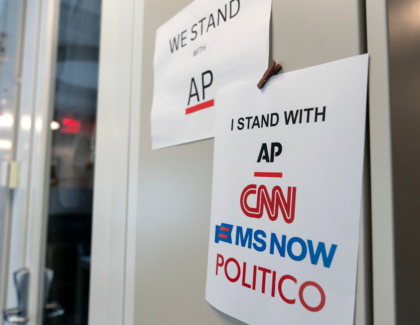
I wish that the White House press corps had taken that kind of collective action back when Trump first punished AP for refusing to go along with the renaming of the Gulf of Mexico to the Gulf of America. And then the judge said, “Well, you’re not allowed to treat AP any differently than other wire services. That’s viewpoint discrimination.”
But the White House, instead of saying, “Okay, we’ve lost, we’ll let AP back into the rotation,” they said, “Fine, we won’t give the wires any access like they’ve had for decades and decades.” So now we have this absurd situation where the wire services are [shut out]. Think about that. When the president goes overseas on a foreign trip, he has done so with no wire service aboard. It’s bad for journalism. It’s bad for America. It’s bad for the world.
Do you think collective press action could have made a difference given the administration’s heavy emphasis on social media?
I think we’d be in a very different place right now because Donald Trump, more than anything, wants media attention. He can’t go a day without it. So I think that would have been an effective tactic, and I wish we’d done it.
I was outweighed when I suggested that if they can do this to the AP, they can do this to anyone. I mean, Donald Trump could very well kick out all the press from the White House. He’s tearing the place down without asking. Why would it be a big deal for him to kick us out?
The problem is that the White House Correspondents’ Association is made up of different constituencies with different goals. There are some reporters who file two or three things out of the White House every day. That’s not my job. But they feel they need to have access to Karoline Leavitt and to [White House communications director] Steven Cheung.
I think the White House Correspondents’ Association is in a much weaker position than the Pentagon Press Association. For example, TV demands fresh footage of Donald Trump every day. Coincidentally, Donald Trump wants fresh footage of himself on TV every day, so that’s very symbiotic. Same thing with the photographers. So that gives Trump a lot of leverage.
The Trump-Putin summit in Budapest, which set off your exchange with Karoline Leavitt, ended up collapsing. How do you cover this boy-who-cried-wolf kind of governance?
I go about it by not covering it. It would be a bad use of my time to try to run down all the things Trump says.
The American media is not made for this moment. It was not designed for this. We’ve never had an autocratic threat before. And we’ve never had a serial liar like Donald Trump before.
For example, he’s made up a story about how his own treasury didn’t know where money was coming in from until he told them to “check the tariff shelf.” There’s no tariff shelf. Tariffs are collected by United States Customs as they have been for two hundred and thirty years. And they’re accounted for immediately. Yet instead of pointing out the obvious, we’ll gloss over that and grab onto the new announcement.
The problem is that the media is designed for news, and whatever is different that day is, by definition, news, so everyone jumps on it.
Trump is very good at this. He’s been doing it for fifty years. He had to manipulate the New York City media in his twenties, and he did it all the time. But this is different. This is not about whether he sold an apartment in his building to Prince Charles or not. This is serious stuff. And we, unfortunately, collectively have not figured out a way to convey the seriousness of it to our audience.
The current government shutdown will soon be the longest in history, yet solving it hardly seems to be at the top of the White House press corps’s agenda.
That’s because Donald Trump doesn’t care about it. The last shutdown we had was also under Donald Trump. But in that one, he was demanding money for a border wall, and Congress wouldn’t give it to him.
Now there’s nothing that Donald Trump cares about in the budget. And he’s got other things to do. He wants to tear down the [East Wing of the] White House, put up this ballroom, meet with Putin somewhere. He’s got all kinds of things on his agenda beyond restoring funding to the United States government.
So would you say his strategy is working?
To say that it’s working implies that there’s a plan. I don’t think there’s a plan with Donald Trump. He likes the sound of his own voice. He likes making people listen to him, and that’s what this is about.
Do you see any solutions to deliver meaningful reporting from the White House despite all the noise?
The most important thing that’s happening right now is the president’s move toward autocracy. And when you say it like that, people roll their eyes: “Oh, you’ve got to be kidding. We’re not an autocracy. We have three branches of government. He can’t be a dictator.”
But I think that’s the moment we are in right now. He is deploying the military in American cities. That’s against the law. And he’s hoping that the courts will defer to his decision that “I, as the chief executive, am allowed to make determinations and no one else can question them.” If that happens, there’s nothing to stop him from saying, “Look, I was cheated out of a term, and so I’m just going to run for another term.”
The danger here is we can become more like Hungary, we can become more like Turkey, and we won’t appreciate that it’s happening until it’s too late to turn it around. That’s the number one story. And I don’t know how to get my colleagues to share that worry.
Has America ever needed a media defender more than now? Help us by joining CJR today.