Sign up for the daily CJR newsletter.
Today the Economic Hardship Reporting Project (EHRP), an organization that seeks to give a voice to “writers and photographers from underrepresented quarters” and supports serious coverage of inequality, published a piece of research delving into how media outlets cover the working class. The project was led by Elena Krumova, a sociologist and assistant director of Columbia University’s Quantitative Methods in the Social Sciences program, and was shared exclusively with CJR.
Using digitized historical records of newspapers, Krumova and her team “collected all articles for the period 1980–2024 in which the expression ‘working class’ is mentioned at least once” for the following outlets: the New York Times, Pittsburgh Post-Gazette, Philadelphia Inquirer, Dayton Daily News, Minnesota Star Tribune, and Chicago Daily Herald. With that database, of thirty-five thousand articles, the researchers then used text-mining techniques to analyze the coverage in terms of variables such as article topic, regional focus, and level of abstraction. Krumova and her team concluded that the working class appears in media coverage as something “to be analyzed, appealed to, or explained,” especially during elections, but that the realities of their lives remain underexamined. “In other words, the working class is talked about more, but described less,” Krumova writes.
Recently, I talked with Krumova about the research and what it means for journalists during the midterms—as the working class has become something to cover “in a political context,” she says, but “not in any kind of other context.” Our conversation has been edited for clarity and length.
What were the core questions you wanted to explore with this project?
What I noticed when I started looking into this is that there are two contradictory findings. First, a book by Christopher Martin documents how reporters on the labor beat have been cut. There is a complete reorientation—in the national media specifically—toward professional, middle-class readers. On the other hand, Robyn Muncy’s research documents how, in the New York Times, there has been increased attention to class from the end of the seventies and the beginning of the Reagan era—after class was rarely mentioned in the fifties and sixties, as there was a view that talking about class was somehow un-American or aligned to Marxist views. So my first question was: How can we reconcile these two findings?
How do you then translate that into an analysis?
It’s now possible to collect a big corpus of newspaper articles and perform natural-language-processing analysis on it. There are a lot of digitized articles on databases like LexisNexis. I had a team of research assistants, and the first task was to count how many articles mention “working class.” Next, we had to make decisions, clean the data, get rid of some kinds of article—classifieds, obituaries, and duplicates. Then we used a transformer model called BERT to classify articles that mention “working class” by their topic.
What did you find?
We confirmed Muncy’s observation that, for the Times, there is indeed an increased attention to “working class” as a category. But that does not hold for regional papers. We looked at five regional papers, in areas that were traditional industrial cities: Minneapolis, Chicago, Pittsburgh, Philadelphia, and Dayton. For those papers there is really not an increase in attention to the working class, except during election years. But that is not sustained. With the Times, that attention is sustained. It starts in 2015, with the Trump campaign, because he explicitly mentions factory workers and the working class.
What do you think is going on there?
I found this surprising. I thought regional papers might continue to pay attention to the working class a little bit more, at least in the aughts, during the loss of manufacturing jobs and so on. It may be a matter of funding, or power relations on the ground. As for the Times, what I see is that they have tried to become much more of a national rather than a Northeastern paper. What we saw in the analysis for Times articles mentioning the “working class” is a decline in actual Northeastern or Midwest locations being specified, and the rise of a kind of unspecified location—which speaks to a drive to become a truly national paper.
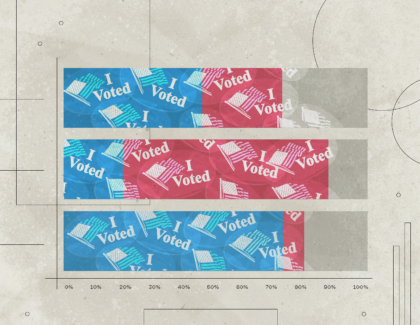
What stood out to me from your study is that a majority of the mentions of the “working class” after 2015—70 to 80 percent for regional papers, and about 60 percent for the Times—were pegged to politics or election coverage topics. Did this, for you, suggest that the papers in the study largely saw the working class as a category to be wheeled out before an election, but forgotten in between?
Yes, it means that “working class” as a category has become something to talk about, to discuss, in a political context, not in any kind of other context. Specifically, how they vote. Or it could be in terms of who is campaigning where. It could be in terms of election results. It could be in terms of the background of politicians who talk about their origins. But “working class” has become a signifier for an ill-defined, even mythical category.
What do you think we lose when the working class are primarily viewed through this prism of horse-race politics in media coverage?
What is lost is attention to real, important issues affecting people on the ground, especially locally. When there is union organizing and strikes happening on the ground, for instance, and there are no reporters following it closely, the coverage that does emerge can feel surprising or out of context. And a Reuters Institute study found that, between 2015 and 2024, people without a college education are disengaging from reading the news at a higher rate than those with a college education.
What are you hoping this research will encourage editors and reporters to think about when they cover the realities of working-class life beyond the midterms?
I hope that this would encourage them to rethink their editorial strategies. To hire people on the ground locally to report on working-class lives. More editorial attention to local issues that are not yet defined nationally. I hope this contributes to a world where we’re not just polarized and screaming at each other, but it brings up new issues, new points of view, and new ideas.
News organizations should also look into increasing the recruitment, training, and promotion of journalists with working-class backgrounds, just as was done for increasing the representation for women and minorities—such as recruitment outside the college track and training that doesn’t depend entirely on universities but happens on the job itself.
Has America ever needed a media defender more than now? Help us by joining CJR today.