


Sign up for the daily CJR newsletter.
Last month, when the Ohio gubernatorial campaign of Vivek Ramaswamy, a Republican, released an ad featuring the estranged mother of his Democratic challenger, Amy Acton, now the governor-elect, two websites styled as local news outlets covered the story from opposite political perspectives. The Buckeye Bulletin paid to boost the video on Facebook, while TiffinOhio.net ran stories on the Republican backlash, including a call from Governor Mike DeWine to pull the ad.
The Los Angeles Times later connected Buckeye Bulletin to the Lincoln Media Foundation, a nonprofit affiliated with the Lincoln Club, which the Times described as “the oldest and largest conservative donor organization in California.” TiffinOhio is one of six sites run by NorthStar Civic Media, whose registered address is a Chicago apartment. An analysis from the Tow Center for Digital Journalism found that, between early August and Election Day, Democratic groups spent more than a million dollars on Facebook ads promoting TiffinOhio stories.
TiffinOhio and Buckeye Bulletin are two of more than sixty websites that look like Ohio local news outlets but are run by partisan networks, according to our review of business records, domain registrations, and Meta ad data. Many of the sites are examples of what researchers call pink slime: partisan content disguised as local journalism. Ahead of the midterms, these sites were used to reach voters in Ohio’s races for governor and the United States Senate, including through paid advertisements on social media. But their reach extends further, according to NewsGuard, which found that leading AI chatbots cited pink-slime sites nearly half the time when asked about midterm candidates and issues.
TiffinOhio consists mostly of stories republished from established newsrooms. Its original articles are largely critical of Republicans—including Ramaswamy, Jon Husted, a Republican senator, Derek Merrin, a former state representative, and Gary Click, a current state representative—and credited either to the publisher, Dylan Poe, or to four staff reporters whose identities Tow Center researchers could not independently verify. Poe worked for the 2018 Senate campaign of Sherrod Brown, the 2012 presidential campaign of Barack Obama, and the Ohio Democratic Party, according to a 2020 Marion Star report. In response to emailed questions, Poe said that while his “background in political work is a matter of public record,” NorthStar, which he founded under a different name in 2024, “proudly operates a network of freely accessible news websites. We stand behind our reporting and believe our work should be evaluated on its factual accuracy, sourcing, and public-interest value.”
The NorthStar network shares several traits of pink slime: generic local names, nearly identical content across sites, a pre-election expansion, staff reporters who could not be identified, undisclosed funding, and heavy promotion by political groups. Poe denied that TiffinOhio is pink slime, saying the site has “proudly served Tiffin, Seneca County, and other Northwest Ohio communities for over ten years.” He pointed instead to sites like Buckeye Bulletin and Ohio Pulse as “actual ‘pink slime’ websites.”
Among the Ohio partisan sites Tow Center researchers reviewed, most of those that ran ads paid to promote themselves. TiffinOhio was the exception. The site spent about thirteen hundred dollars on Facebook ads between August 4 and November 2. During the same period, outside groups spent far more promoting its stories.
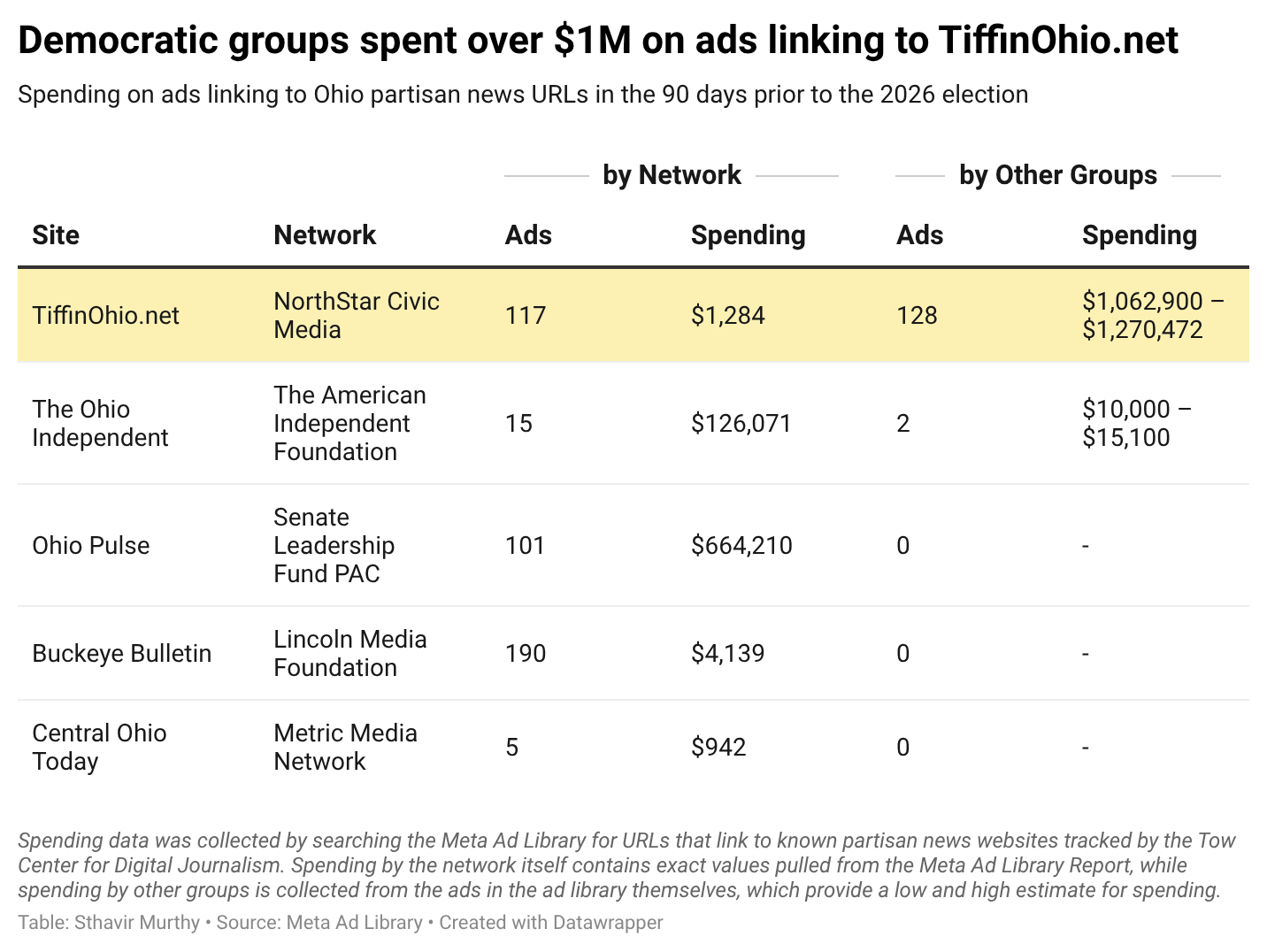
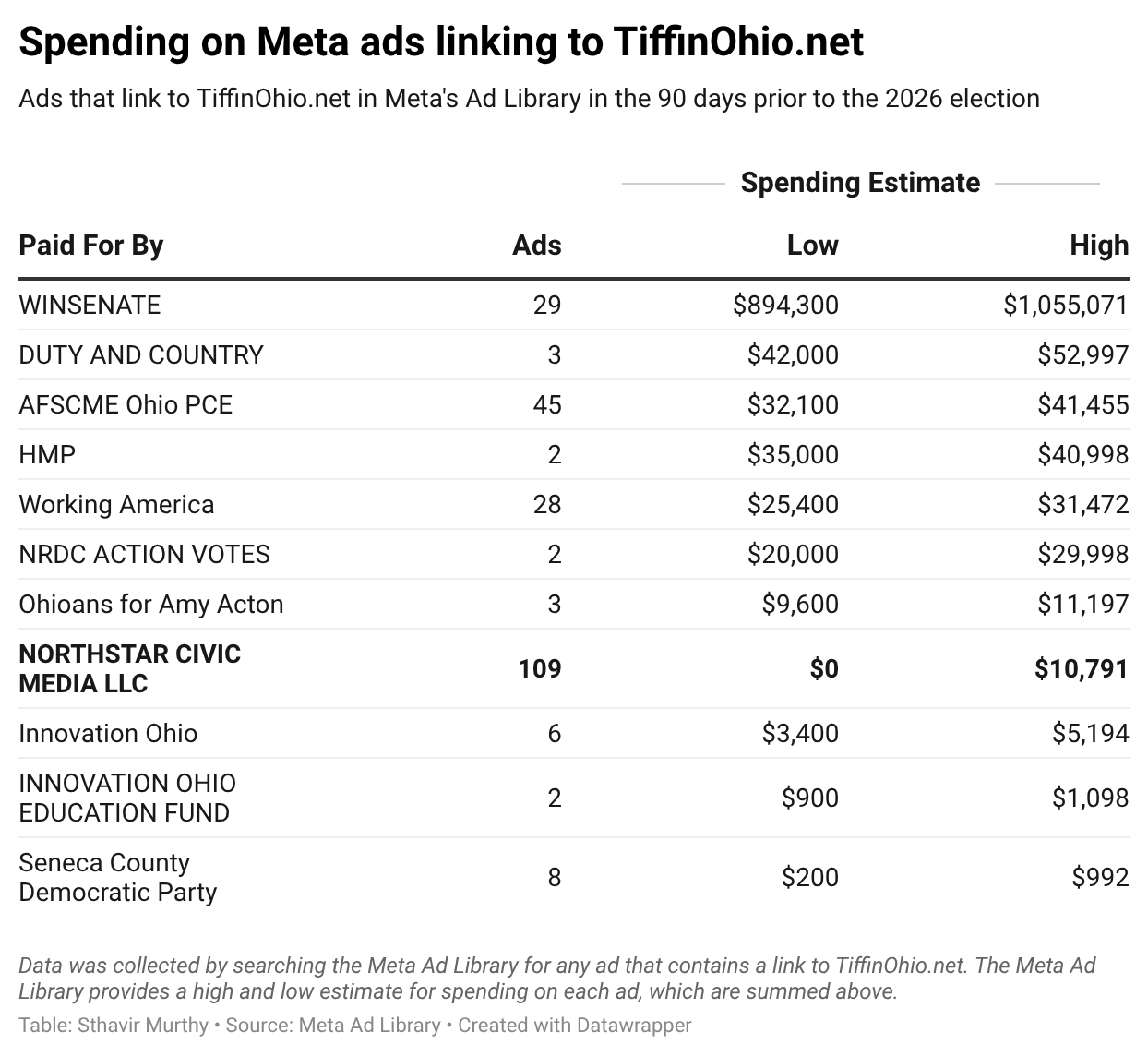
Nearly all of that outside money came from Democratic-aligned groups and campaigns, including Acton’s campaign for governor, the American Federation of State, County, and Municipal Employees’ (AFSCME) Ohio political fund, the House Majority PAC, and WinSenate, a super-PAC funded almost entirely by the Democratic Senate Majority PAC, according to FactCheck.org. WinSenate alone spent between eight hundred and ninety-four thousand and 1.06 million dollars, much of it on ads promoting a TiffinOhio story that connected Husted to House Bill 6, a 2019 law that added fees to Ohioans’ electric bills to bail out nuclear and coal plants. Federal prosecutors later found that the nuclear plants’ operator had secured passage of the bill with more than sixty million dollars in bribes. (Husted has not been charged in connection with the scheme, and has denied involvement.)
TiffinOhio states on its website that it accepts no money from political parties, committees, candidates, or campaigns. Instead, it says, it is funded by readers, “limited earned revenue” and “mission-aligned partners,” which it describes as “organizations that share our commitment to democracy and local journalism.” It does not state who those partners are, or how much they contribute, and Poe declined to identify them.
A review of campaign finance and union records found no direct payments to Poe, NorthStar Civic Media, Tiffin Publishing, or any of its websites. In his email to the Tow Center, Poe said “third parties are free to share or promote” NorthStar’s work, and that “advertising expenditures by outside organizations should not be conflated with funding received by NorthStar Civic Media.” Beyond paid ads, NorthStar’s stories have been cited in Wikipedia entries. Since August, one editor has added six NorthStar articles, most of them critical of Ramaswamy, to entries on Ramaswamy and Ohio’s 2026 gubernatorial and House races. Two of those references, from the Cleveland Monitor, another NorthStar publication, were added four days before Election Day. (Poe said no one “involved with” NorthStar added the citations.)
As of November 10, of the seventy-five authors listed on TiffinOhio—the only NorthStar site with an author page—five, including Poe, were identified as staffers. Around a quarter of the site’s articles are attributed to these authors; unlike Poe, the other four staff reporters had no photos on the author page. The Tow Center could not find LinkedIn profiles, bylines at other publications, or public records to verify their journalism careers. When asked about the site’s reporters, Poe said they are “real people,” and that “the absence of publicly available photographs or professional profiles should not be interpreted as evidence that these individuals do not exist.” He did not answer a question from Tow Center researchers about whether any of their work is produced with AI tools. The other seventy names on the author page referred to reporters or commentators for other outlets such as Signal Ohio and the nonprofit Ohio Capital Journal (OCJ) and its parent, States Newsroom, whose work is republished on TiffinOhio and its sister sites.
In response to questions from Tow Center researchers, Lara Weber, the communications director for States Newsroom, wrote in an email that “None of us at OCJ or States Newsroom were aware of the ‘writers and contributors’ list they have posted, and no one from OCJ or States Newsroom agreed to it.” After the Tow Center’s inquiry, Weber said States Newsroom asked Poe to remove its journalists from the author lists on all of NorthStar’s sites, “as we have no partnership or other arrangement that would allow that.” She said Poe confirmed that NorthStar would do so. TiffinOhio initially removed just the names of authors from States Newsroom and OCJ from the author page; by November 11, the page was taken down. (Poe said TiffinOhio’s content management system had “automatically added the authors to our author archive,” and that NorthStar had “never claimed a partnership or arrangement with States Newsroom beyond their standard republishing permissions.” Signal Ohio did not respond to Tow’s request for comment.)
David DeWitt, the OCJ’s editor in chief, was among those listed on TiffinOhio’s author page. He said he had seen TiffinOhio’s articles but “was not aware of their author list” before the Tow Center contacted him, and that he has had no arrangement with the site beyond the OCJ’s standard republishing guidelines, which allow other outlets to republish its stories with credit. DeWitt’s only contact with NorthStar, he said, was an email he sent notifying the site that the OCJ had updated an article that TiffinOhio had republished.
Six of the authors who were listed on the TiffinOhio author page earlier this month are reporters for the Ohio Independent and its parent network, the American Independent Foundation, a Democratic Party–aligned 501(c)(4), some of whose publications have been classified as pink slime. Unlike 501(c)(3) nonprofits, its classification allows for political advocacy. TiffinOhio has republished twenty-one articles from the Ohio Independent and three from the American Independent.
Along with TiffinOhio and the Cleveland Monitor, NorthStar Civic Media owns Seneca Live and the Toledo Ledger, Columbus Wire, and Cincy Current. TiffinOhio has about sixty-seven thousand Facebook followers; Seneca Live has about forty-eight hundred. The other four sites don’t appear to have Facebook pages. Almost all the same headlines and articles run across the sites, but Seneca Live is the only site with a disclaimer: “Fifty headlines syndicated from TiffinOhio.net. Full stories are published at TiffinOhio.net.”
The Fostoria Free Press, an Ohio outlet whose articles carry the byline “FFP Ai Bot,” appears to be the only site that has published substantial information about NorthStar’s connection to TiffinOhio. On its website, NorthStar says its mission is “empowering local journalism in the Great Lakes region” by offering “timely news” alongside “progressive analysis.” Editions in Michigan, Pennsylvania, and Wisconsin are “coming soon,” according to NorthStar, and Indiana, Illinois, and Minnesota are “on the roadmap.”
According to the Tow Center’s review, Poe started TiffinOhio.net in 2016 and formed Tiffin Publishing LLC in 2020. In October of 2023, he announced that the site was closing because the pandemic had “led to decreased advertising revenue.” He dissolved the company three months later, but the site was soon publishing again. In October of 2024, Poe formed a new company in Chicago, DJP Holdings LLC; in March of 2025, it was renamed NorthStar Civic Media. Poe is listed as its only manager, and signed every filing reviewed for this report. On August 21, 2026, roughly ten weeks before the midterms, domains for the Cleveland, Columbus, and Toledo sites were registered. The Cincinnati domain was registered two days later. The expansion occurred shortly before Northwest Ohio’s largest newspaper, The Blade, in Toledo, announced its possible closure. (In September, the paper’s owner, Block Communications, said The Blade would shut down on December 31 unless a buyer was found, citing years of financial losses.)
The 2020 Marion Star report that identified Poe’s previous political work cites his LinkedIn profile, which is no longer online. It also includes a quote from Melissa Ackison, who was then a Republican state senate candidate: “We also have the help of Dylan Poe, who writes the Tiffin paper,” she says, according to an edited audio recording released by her primary opponent. “He’s helped me. He’s written op-eds for me.” The recording continues: “He has said, ‘We know a Republican’s going to hold this district. At least with you, we’ll get a seat at the table.’” Tiffin Publishing said at the time that it did not coordinate with any campaign. Ackison said her opponent’s allegation was “full of lies,” but did not directly address the claims about Poe.
Since the Tow Center’s first published research into pink-slime networks in 2019, partisan groups have increasingly used local news-like sites as campaign vehicles. Other partisan networks targeting Ohio have been documented before by the Tow Center and other researchers. Metric Media, a conservative network tied to Brian Timpone, a former broadcast news reporter with a history of establishing publishing companies that use “proprietary technology to transform public records into news,” publishes at least fifty-two Ohio-branded sites. Senate Leadership Fund, a Republican super-PAC that NewsGuard found targeting Michigan voters last month, also funds Ohio Pulse, which spent more than five hundred thousand dollars on Meta ads between early August and Election Day.
Sthavir Murthy contributed research.
Has America ever needed a media defender more than now? Help us by joining CJR today.