


Sign up for the daily CJR newsletter.
If you wanted a snapshot of the tangled relationship between AI companies and the journalism industry, October provided. At the beginning of the month, the OpenAI Foundation distributed fifty million dollars to a hundred and sixty-three nonprofits in the United States, including twenty-nine journalistic organizations, among them the American Journalism Project, the Indigenous Journalists Association, and Trusting News, which helps newsrooms build trust with their audiences. A week later, USA Today Co. sued OpenAI in the Southern District of New York for copyright infringement, seeking more than two hundred and fifty million dollars in damages; around the same time, a coalition of Canadian news organizations sued Anthropic, which had so far managed to avoid getting caught up in the web of journalism deals and disputes. Mid-month, Google expanded its AI pilot licensing program, which pays for content to “develop new AI features,” signing deals with more than four hundred publications worldwide. And more than forty journalistic organizations from the United States, Canada, Europe, Latin America, and Asia joined the SPUR coalition, which aims to establish shared technical standards and responsible licensing frameworks for how generative AI applications use journalism.
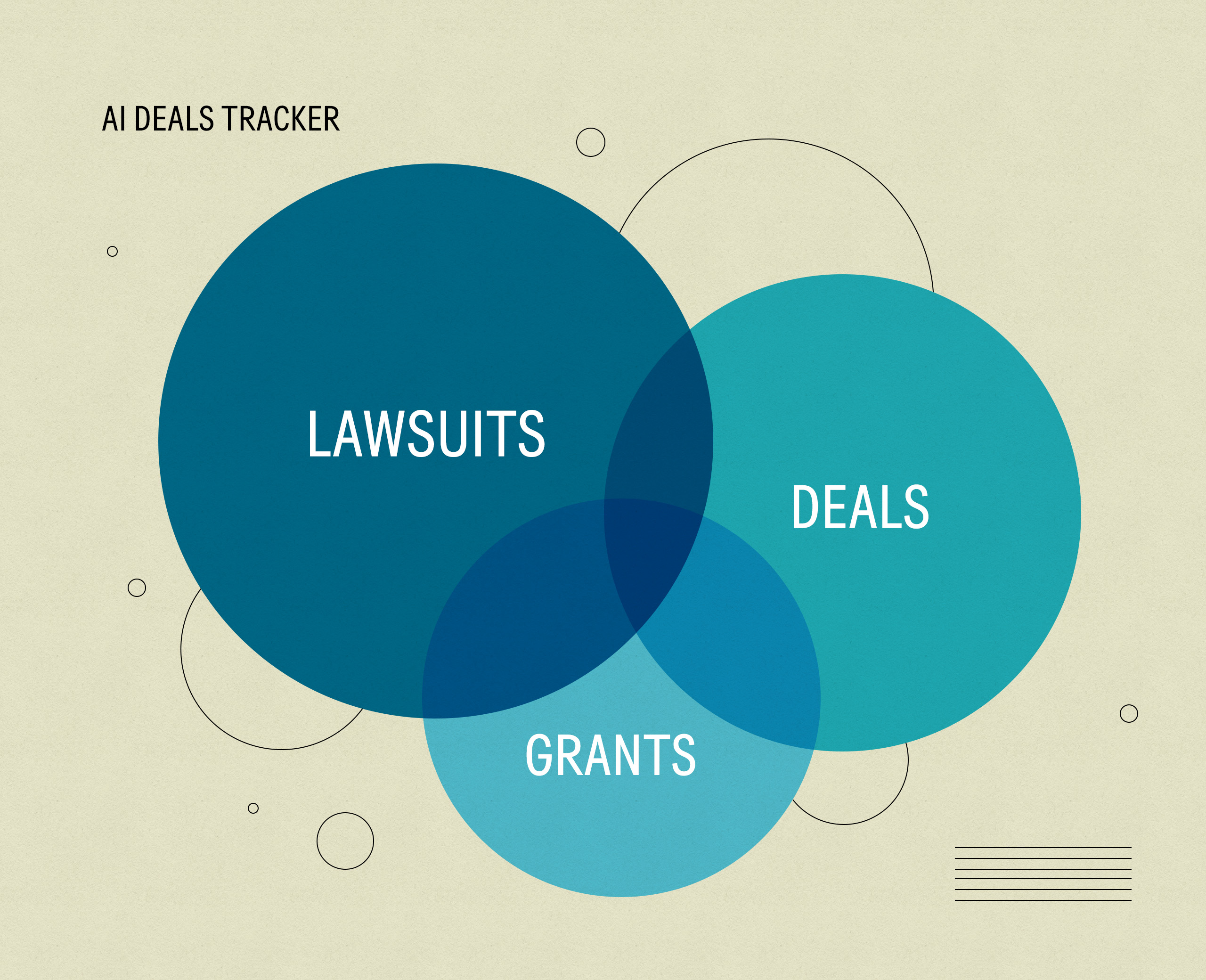
Publishers’ relationships with AI companies are often complex: a publisher can sue one platform while entering a licensing agreement with another and taking grant money from a third. There are even instances in which a publisher sues the same platform that previously gave it money. The head-spinning pace of content licensing agreements, data access disputes, lawsuits, and corporate funding for newsroom AI experimentation is what prompted the Tow Center for Digital Journalism to build the AI Deals and Disputes tracker last year. We recently added data visualization features, including network graphs and Venn diagrams, to help show how each of these developments fits into the larger dance between journalistic entities and AI companies.
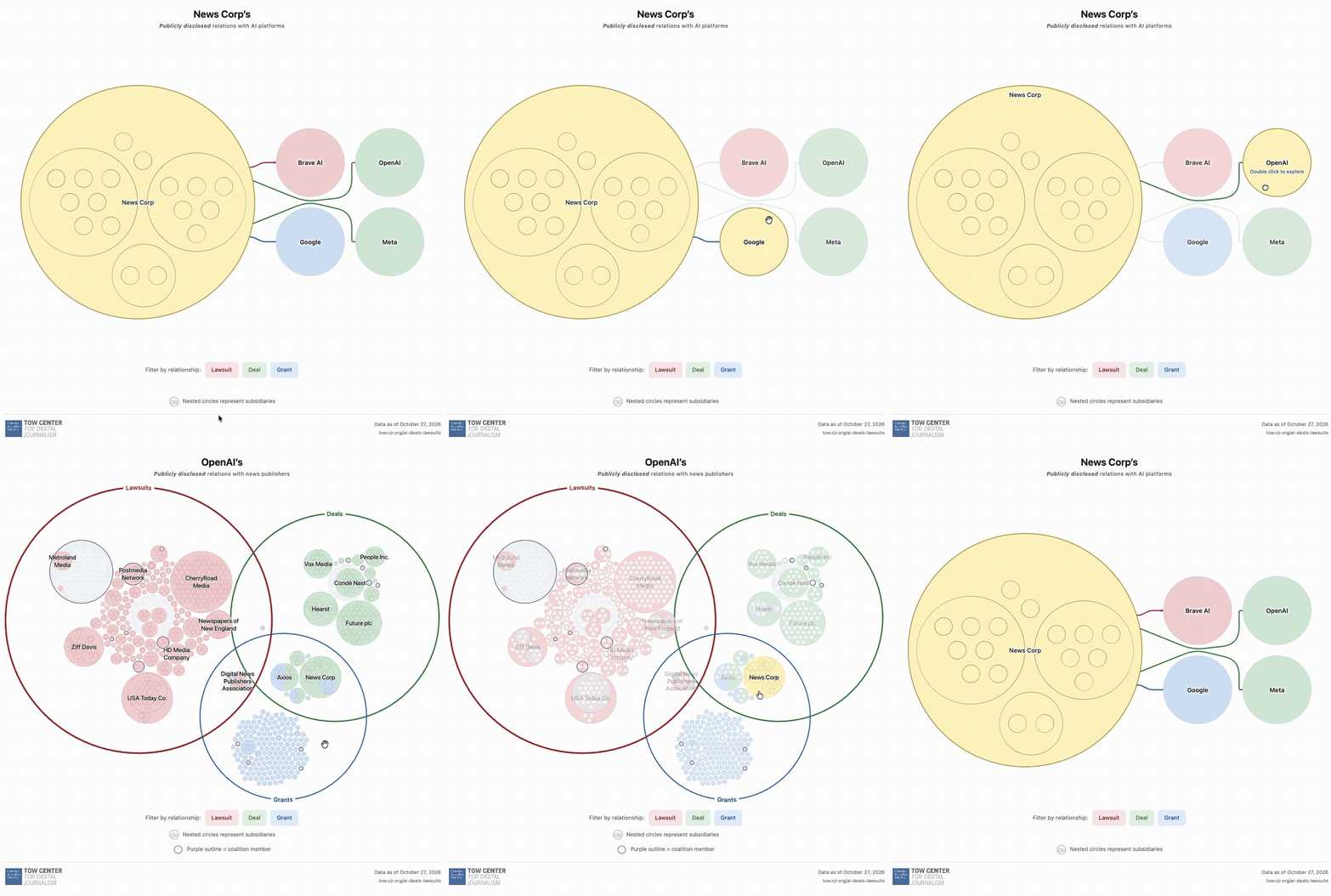
You might get the impression from some recent reporting that more media companies are rushing to sign deals with AI companies than pursuing litigation. But when it comes to news publishers, the data is not so straightforward. Directly comparing deal and lawsuit counts can be misleading, because a deal is typically between one publisher and one AI company, whereas a lawsuit can involve many publishers and many AI companies. Litigation is ruinously expensive and resource-intensive and often takes years, putting it out of reach for most newsrooms. A deal, however, comes with a check attached. Finally, neither AI companies nor publishers fully disclose the terms of their agreements. Many announcements explicitly name just a few organizations out of dozens or even hundreds involved, and often only parent companies are named, without specifying which of their subsidiaries are affected. Our dataset includes only the parties named in official documentation, such as press releases and court documents. Every figure in the tracker is therefore a floor, not a ceiling: it represents the minimum number of publishers affected, not a complete accounting.
The clearest pattern to emerge from our data relates to where the biggest AI companies are spending money, and where they aren’t. African publishers, for instance, barely register in the tracker. The few that do appear—such as Nigeria’s Punch, South Africa’s Daily Maverick, Egypt’s Al-Masry Al-Youm, and the Kenyan-based Nation Media Group—have received support from the AI Launchpad Program, developed by FT Strategies and the Google News Initiative with the goal of identifying and testing “the impact of AI across editorial and commercial use cases.” Africa is the only continent, according to public documents, in which no publishers have been parties to deals with or lawsuits against the major AI companies. As Joshua Olufemi wrote last year in a Nigerian outlet, The Cable, “most African countries lack detailed copyright or neighbouring rights laws that could compel AI companies to negotiate with media houses. Without such legal frameworks, African publishers have no leverage to demand compensation or fair usage practices.” As a result, he continued, African media outlets “miss both potential revenue and the opportunity to influence how AI systems perceive and represent the continent.”
In some countries, such as Australia, the primary form of engagement with major AI companies has been content agreements. In Canada, meanwhile, most interactions—aside from a single partnership, between OpenAI and Village Media—have taken the form of copyright lawsuits.
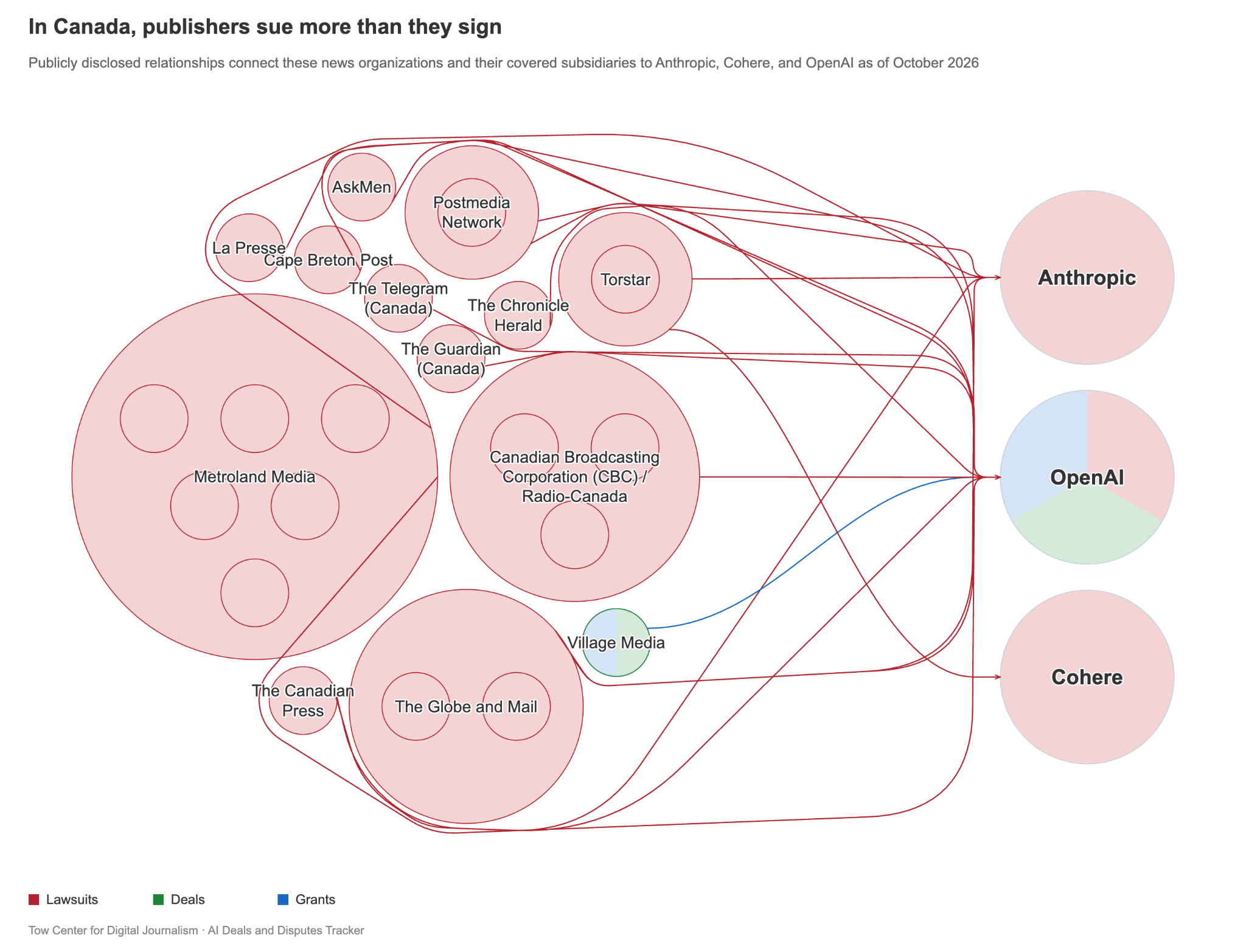
While US publishers appear to be the primary subjects of AI companies’ journalism-related licensing agreements, they have also been the most adversarial, filing eighteen copyright-related lawsuits against major AI companies to date. Based on the tracker, it appears that more US news titles are involved in litigation than in partnerships with major AI companies, but various data voids make it difficult to draw this conclusion definitively.
Another limitation of quantifying these sorts of interactions is that, because we don’t know the total number of publishers in each region, we can’t know what share of a country’s press is interacting with AI companies. Without that denominator, there is too little data to draw confident conclusions about where the industry is heading, either globally or locally. For example, while Canadian publishers have been involved in multiple suits, Danish media filed only one lawsuit, against OpenAI; but because that suit was filed by the Danish Press Publications’ Collective Management Organization, which represents nearly all of Denmark’s media outlets, it could have sweeping consequences for the country’s media ecosystem.
It’s also worth noting that, apart from one-off direct deals, other types of transactions are taking place between news publishers and AI companies. A growing set of arrangements, such as pay-per-use and pay-per-access models, are being mediated by both third-party startups and big tech companies. But as Courtney Radsch and Karina Montoya warn in their analysis of the AI content licensing market, without regulation, these marketplaces risk re-creating dynamics that empower platforms at publishers’ expense. That asymmetry is part of why we have very limited insight into how these transactions play out in practice.
All in all, it is hard to say with confidence whether any single approach to dealing with AI companies has emerged as dominant; the relationships between publishers and AI companies are still being improvised. What we can say is that most publishers around the world are not party to deals, engaged in lawsuits, or recipients of AI company grants—yet they are affected by the design and data access decisions these companies make.
We will keep updating the tracker as these relationships evolve. If you are aware of any developments in this space that we’ve missed, please reach out to us.
Has America ever needed a media defender more than now? Help us by joining CJR today.