Sign up for the daily CJR newsletter.
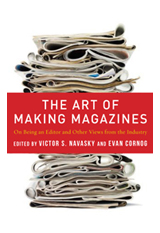
Last month, Columbia Journalism Review Books and Columbia University Press released The Art of Making Magazines: On Being an Editor and Other Views from the Industry, an anthology of insights and reminiscences from top magazine editors. The book is based on talks given to students as part of the Delacorte Lecture Series at the Columbia University Graduate School of Journalism. The following is excerpted from chapter five, “Fact-Checking at The New Yorker,” which is itself taken from a lecture delivered by New Yorker fact-checking director Peter Canby on February 28, 2002.
 Preventing errors from appearing in the magazine is not a simple process. For openers, you need to know that in addition to the basic reporting pieces, we also check “The Talk of the Town,” the critics, fiction, poetry, cartoons, art, captions, the table of contents, certain of the several-paragraph-long essays in the “Goings On” section. We also fact-check the contributors page, the cover wrap, the letters column, all the press releases, and a good deal of the recently mounted Web site.
To start checking a nonfiction piece, you begin by consulting the writer about how the piece was put together and using the writer’s sources as well as our own departmental sources. We then essentially take the piece apart and put it back together again. You make sure that the names and dates are right, but then if it is a John McPhee piece, you make sure that the USGS report that he read, he read correctly; or if it is a John le Carré piece, when he says his con man father ran for Parliament in 1950, you make sure that it wasn’t 1949 or 1951.
Or if we describe the basis on which the FDA approved or disapproved the medical tests that ImClone used for Erbitux, then you need to find out what the complexities of that whole situation were. And of course, this kind of thing has consequences, because if you get it wrong, it matters. We also work on complicated pieces such as the ones we’ve been running this fall about the Pentagon’s top-secret team that is trained to snatch nukes away from belligerent countries, or the piece about the Predator drone that had a clear shot at Mullah Omar, for better or for worse, and didn’t take the shot because the CENTCOM attorneys were not clear on the legality of that operation.
But the unfortunate thing is that when The New Yorker is wrong on these allegations, which we are from time to time, the cry goes out not for the writer or for the editor but for the fact-checker. In the department, we refer to that as the Shoot-the-Fact-Checker Syndrome, which is one of our occupational hazards.
Prior to the Tina Brown period, there were eight checkers. And particularly during the editorship of William Shawn, which was when I started—Shawn was the editor of The New Yorker from ’52 to ’87—stories progressed in an orderly, almost stately way toward publication. Writers would work on pieces for as long as they felt was useful and necessary, and that often meant years. Once the pieces were accepted, they were edited, copyedited, and fact-checked on a schedule that typically stretched out for weeks and sometimes for months.
This process could produce some really wonderful writing. The last piece I worked on before I left The New Yorker the first time around was something that I always think epitomizes a Shawn-era piece, although it was published by Shawn’s distinguished successor, Bob Gottlieb. But I think it was commissioned by Shawn. This piece was The New Yorker’s four-part excerpt of Neil Sheehan’s A Bright Shining Lie, which is a Vietnam book that went on to win not only a National Book Award but also a Pulitzer Prize.
Sheehan was one of the top Vietnam journalists. He was the reporter to whom Daniel Ellsberg gave the Pentagon Papers. The subject of A Bright Shining Lie was a man named John Paul Vann. Sheehan had met Vann in the early ’60s when he was a UPI reporter in Vietnam and Vann was a kind of maverick army officer who was very critical of the way that the world war was being conducted even then.
Not only a maverick but also a loose cannon—he talked readily to the press, and he was a source for a number of the early journalists. But Vann increasingly became a strident dissident voice within the military, which did not make the military happy. Eventually he alienated himself from the army command and left the army in disgrace. But due to a peculiar genius that this character had, he returned to Vietnam as a civilian and became the number three person in command of the Vietnam War after the ambassador and the commander-in-chief, which I think is completely unprecedented in American military history.
He was eventually killed. It was typical of him that even in this elevated position, he was involved in a battle and had to escape by helicopter. The helicopter got shot down, and he was killed. After his death he became an obsession for Sheehan, who had worked on the book about him, A Bright Shining Lie, for sixteen years.
Another checker and I spent two months working on The New Yorker excerpts of A Bright Shining Lie. It was made particularly difficult because Sheehan lived near Washington and he had his sources for this book in twenty-five army-surplus file cabinets lined up in a special room in his house. And these were not little Door Store file cabinets, these were heavy industrial file cabinets that stretched a good three or four feet back to the wall, and they weren’t filled up with fat reports but with single sheets of paper. This was sixteen years of work, and it was really out of the question for him to send this stuff to New York, so we went to Washington. Then life got more complicated because Sheehan is an insomniac and he didn’t get up till three in the afternoon every day. So we had to adjust our schedules to that.
One more thing I want to say about Neil Sheehan is that it was a particularly frustrating experience for us fact-checkers because Neil Sheehan never got anything wrong, and at the end of two months we would go, “Neil, give us a break, you know? Give us one little thing we can change.” If every writer were like this, the checking department would be a complete waste of time, but it is really to Neil Sheehan’s credit that he was like this.
I can’t leave the subject of the Shawn-era New Yorker without at least one more story that illustrates a completely different aspect of the old magazine, and this was its tendency to warehouse complicated fact pieces. There was an inventory sheet that went around every week, of fact pieces, and I think it was 100 pieces long. And considering that each of these pieces was worth $10,000 or $20,000 to the magazine, that was a lot of inventory.
One of these bottom dwellers had been in house for many years. It showed no signs of running, but I took a liking to it. It was called “A Scottish Childhood.” I can’t remember the name of the author, but it was a woman who had grown up in a drafty little castle in the Highlands of Scotland, and when her father died, her oldest brother inherited everything through primogeniture.
She was essentially, sort of in a gentle way, disinherited. She went to London. She wrote a memoir about growing up in this delightful and strange environment and she sold it. She sold it in The New Yorker as a work of fiction, but it was thinly fictionalized. By the time I latched onto this piece, it had become a fact piece and showed no signs of ever getting published.
But one day it kicked up on the schedule. So I was able to call the woman in London and say that the piece that you sold twenty years ago is going to press tomorrow or something. In the meantime she had gotten married. She’d had a child. The child had grown up and the child had gotten married and divorced—so long was this piece in house. And it was really a delightful piece, and though perhaps for her not worth the wait, she didn’t miss a beat when I called her.
So that was the old New Yorker. The biggest difference between David Remnick’s New Yorker today and the Shawn New Yorker is timeliness. During the Shawn years, book reviews ran months, even years out of sync with publication dates. Writers wrote about major issues without any concern for news pegs or what was going on in the outside world. That was the way people thought, and it was really the way the whole editorial staff was tuned.
All this changed when Tina Brown arrived. Whereas before, editorial schedules were predictable for weeks or a month in advance, under Tina we began getting 8,000-, 10,000-, 12,000-word pieces in on a Thursday that were to close the following Wednesday. But something else changed in a way that is more important. Prior to Tina, the magazine really had been writer-driven, and I think this is why they gave the writers so much liberty. They wanted the writers to develop their own, often eccentric, interests.
Under Tina, writing concepts began to originate in editors’ meetings, and assignments were given out to writers who were essentially told what to write. And a lot of what the editors wanted was designed to be timely and of the moment and tended to change from day to day. So the result was that we were working on pieces that were really much more controversial and much less well-formulated than anything we had dealt with previously, and often we would put teams of checkers to work on these pieces and checking and editing could go on all night.
When the new, remade The New Yorker of the last decade was gearing up and we started getting all these late-breaking stories, issues such as logic and fairness and balance—which previously had been the responsibility of the editors—began to fall on the checkers. This wasn’t by anybody’s design. It was because the editors were really busy putting these stories together and they wanted us to look at things from the outside and see how they were framed, and look at them from the inside and look at the logic and the way they were reported and the way quotes were used and many other such things.
That responsibility came to us not in the way of anybody saying suddenly, “You’re doing that.” It just became that when a problem arose, they would come to us and say, “Why didn’t you warn us?” And so it just became clear that there was this gap between editing and checking that had opened up under the pressure of later-breaking stories, and it just seemed logical that we should fill it. It made our job more challenging, and more fun.
Another change that took place in The New Yorker fact-checking during this same period came about in the mid-’90s as the result of the fallout from what was known as the Janet Malcolm case. Janet Malcolm is a New Yorker writer of great distinction. In 1983, she wrote a profile of a psychoanalyst named Jeffrey Masson, who subsequently sued her and the magazine for libel (it was an unfavorable story).
The court case didn’t resolve itself until 1994. The charge was that Janet Malcolm had compressed, rearranged, and even fabricated quotes. In 1993, The New Yorker was separated out of the judgment and in 1994, Malcolm was cleared of libel charges in the U.S. District Court in San Francisco. Prior to this resolution, when writers gave us their sources, they gave us books, magazine clips, news clips, and phone numbers, but they didn’t give us notes, and after the resolution of the case, we began to insist that writers turn in their notes to us as well.
And prior to the case, when people were quoted, we would call them up and we’d go over the information in the quote, but we would never go over the quote with them, for obvious reasons. You go over a quote with somebody, they don’t like the way they sound. Even if they said something, they are going to say, “Oh, that’s not what I meant.” Then there’s a problem. So that standard still holds. When we call people on the phone, which we do all the time, we never read them their quotes.
But after the Malcolm case was settled, we began to ask writers to include their notes, their tapes, and their transcripts with their source material, and this gave us a great deal more flexibility in how to approach stories. We continued to call sources, as I mentioned, but whenever there was a particularly controversial or sensitive issue or it was somebody that we couldn’t reach for whatever reason, we had the notes to fall back on. And the ideal for us—in fact, pretty much the norm—is both to use the notes and to call people, because notes can be wrong, just as with everything else.
And we always did the best we could to give people who were mentioned in a piece the chance to let us know if there was some wild-card reason not to publish the piece. It also allowed us the courtesy of telling people that they were about to appear in The New Yorker, so they wouldn’t be hit completely out of the blue. I feel strongly about this, because whether you’re delivering them good or bad news, the contact with these ultimately real people humanizes the process. I often think of the fact-checking process as setting off a series of controlled explosions, where it’s much better to have people go off before publication than afterward.
The use of writers’ notes raised another set of complicated issues. At the inception of this policy there was a lot of internal debate about how to go about it, and the suggestion was made that we require writers to use tape recorders. And this was rejected because of the general feeling that we didn’t want to put writers in a methodological straitjacket. But the result of that is that we got notes in all shapes and sizes, ranging from completely clear and legible and word-processed to the completely illegible.
Sometimes writers presented what were clearly second-generation notes. One long-term Shawn-era writer who didn’t like the change in procedures gave us for several stories a notebook filled with scrawls—you could picture her at home going, “Ha ha ha.” She got over that eventually.
Most of the complications surrounding the new policy revolved around the question of how we would use notes. When you actually report something, you’re sitting and talking with somebody. If you’re writing it by hand, it’s really not possible to write as quickly as somebody speaks to you. So you don’t actually write down what somebody says, you write down a distillation of what somebody says.
You might write keywords, key phrases, sentence fragments. You also know that when you’re writing down what somebody says to you, you have to work with a split mind, probably a three-part mind. You have to be focusing on writing what the person said a few minutes ago. You have to pay attention to what the person is saying in the present, which is different from what you are writing, and you also have to worry about what your next question is going to be.
Then when the interview is done, you put your notebook in your pocket, you put your pen away, you walk out to your car, you do whatever you do, and then the person stops you and says the most important thing of all. And you realize that their saying that at that moment has something to do with the fact that your pen is not in your hand and your notebook is put away, and you realize that if you pull out your notebook and pull out the pen it’s going to break the spell and you will wreck this moment of revelation.
So what do you do? You spin the conversation as long as you can get. You get as much as information as you can get, and you go back into your car or hotel room or your coffee shop and you write it down after the fact. And again, that’s not exactly what the person said to you, but it’s legitimate. This is the way reporting happens.
All of this means that working with someone’s notes is not a science. It requires judgment and discretion and a strong sense, which comes only with practice, of what is acceptable and what is not.
Ultimately we make mistakes. I wish we didn’t, but they are inevitable and constant. It does seem to be something of a national sport to write letters to The New Yorker and point out these mistakes. And often the mistake letters we receive explain that the letter’s writer has been reading The New Yorker for years and he’s never seen anything like this, that Shawn and Harold Ross must be turning in their graves, that the writer didn’t realize that as a cost-cutting measure The New Yorker had eliminated its fact-checking department, and did we know that there used to be fact-checkers in the old days?
These letters aren’t a great deal of fun for us, but we take some consolation in the idea that the indignation is perhaps a reflection of their high expectations and the degree to which we are generally successful in getting the magazine out there in a fairly sharp and timely fashion.
And the only reason that The New Yorker system works, however well it does, is because we’ve always had very good institutional support. All the editors have been big supporters of the checking process.
And with the help of all these people, fact-checking has become a big part of The New Yorker’s editing process, and our end of the bargain is to try to be intelligent and diplomatic. To try to make things work out. To try to not obstruct publication, but to get things as right as they can be, and as right as we can. This doesn’t always make us popular inside the magazine, but it seems to work.
Correction: Due to a transcription error, the word “world” was substituted for “war” in the eighth paragraph above. We regret the error and it has been fixed.
Has America ever needed a media defender more than now? Help us by joining CJR today.