Sign up for the daily CJR newsletter.
When Anne Hathaway’s Andy Sachs first walked into the offices of Runway magazine in 2006’s The Devil Wears Prada, journalism looked very different. Back then, the internet had yet to destroy the business model that allowed print magazines like Runway, a fictional Vogue stand-in, to capture cultural cachet and influence.
When Disney announced that Hathaway, Meryl Streep, and much of the original cast would return for The Devil Wears Prada 2, it seemed like a clear nostalgia play: chic fits, witty repartee, and withering looks from Streep’s Miranda Priestly, Runway’s icy editor in chief and the titular devil. It would be easy enough to ignore the real-life implosion of our industry and simply use fashion publishing as a playground for fun drama. Instead, the sequel takes us on a grim but oddly refreshing odyssey through the demise of journalism and the endless—perhaps fruitless—search for the one good billionaire who could save us all.
In the new film, things get real. Andy, now a star reporter at a prominent New York City newspaper, learns, via text message, that the paper’s owners—including a CEO who commands an eleven-million-dollar salary—intend to shut the whole thing down and lay off the entire staff. Soon after, the owner of Elias-Clarke, Runway’s parent company, offers Andy the job of editorial director. Runway is mired in a crisis of its own, the first of many: the magazine published a glowing profile of a fast-fashion company that, it turns out, used sweatshop labor, and now needs Andy to help salvage its reputation. Her return doesn’t exactly thrill Miranda. Still Runway’s editor in chief, she’s awaiting a long-promised promotion to head of global content for Elias-Clarke. (Her real-life counterpart, Anna Wintour, got a similar bump last year.)
Andy’s new role lets us in on the actual work of journalism, more so than in the first film. It’s not All the President’s Men, but there’s a sense of authenticity here. (Except for the absurdly big New York City apartment Andy can somehow afford on a journalist’s salary.) Andy is deep in Runway’s CMS, writing blog posts and reported features, stressing out trying to track down a source for a big profile, and using her position to help throw some work to former colleagues turned freelancers. Her stories are well-received by the few people who actually read them, but a weary Miranda criticizes her for her apparent inability to write anything Runway’s audience will click. The head of Elias-Clarke is largely sympathetic to the idea of restoring Runway to its former glory, but he, too, has concerns about traffic. For journalists, it’s a devastatingly familiar dilemma: Does good work matter if nobody’s reading it?
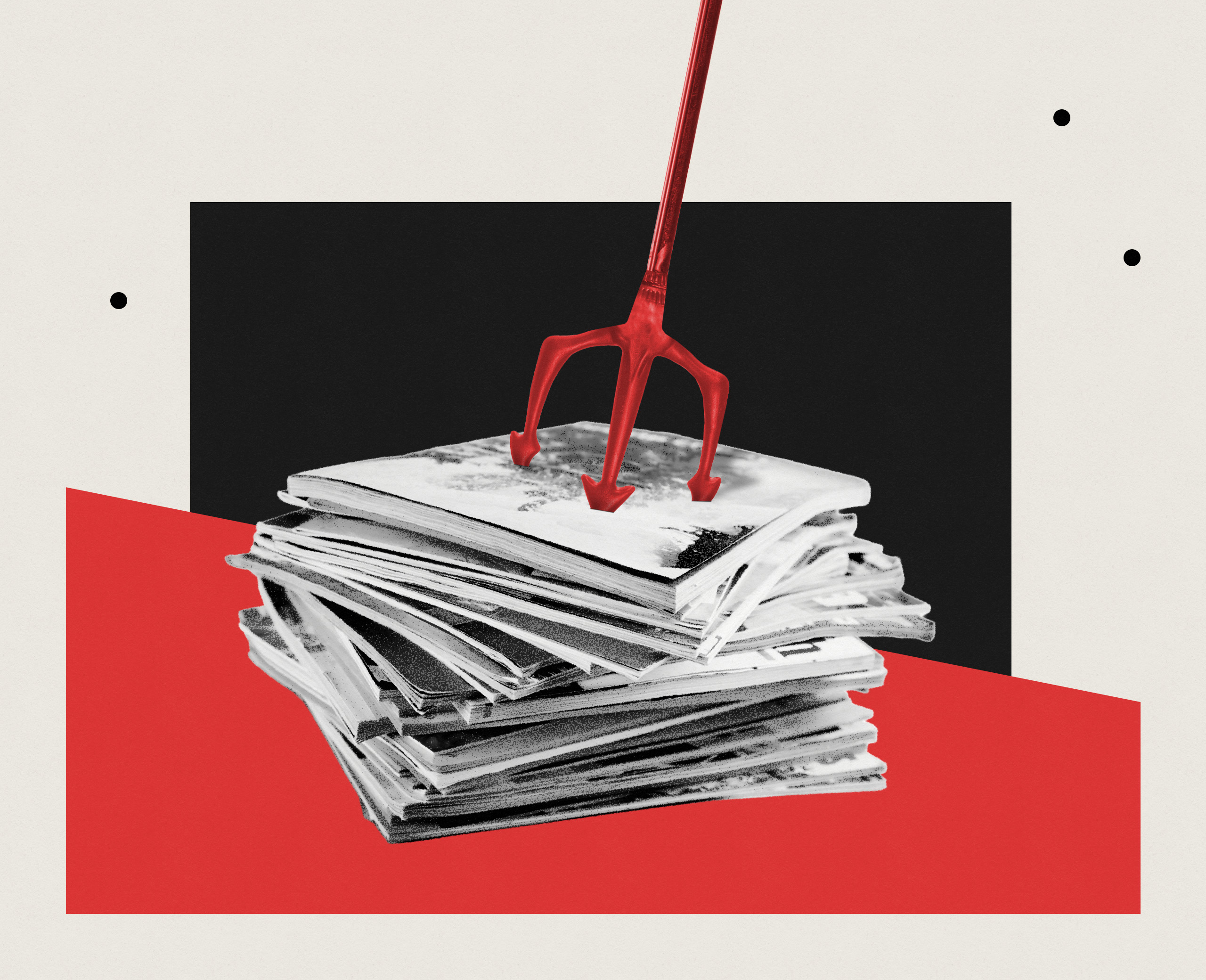
Soon, we start to see just how clearly the Runway of 2026 is no longer the Runway of 2006. A book so thin “you could floss with it,” Miranda quips, loaded with advertorials. Stanley Tucci’s Nigel Kipling, the magazine’s creative director, reminisces about a weeks-long photo shoot in Africa; now the best he can hope for is a few hours in a local studio.
Things gets worse when Elias-Clarke’s head honcho, a longtime ally to Miranda, suddenly dies, and is replaced by Jay, his nepo-baby son, played by B.J. Novak. Following the new- corporate-overlord playbook, Jay enlists a gaggle of odious Harvard Business School–namedropping consultants whose bro-y brio makes abundantly clear they haven’t the slightest clue what Runway does. They make plans to whittle the magazine down to the bone. Andy reaches out to Benji Barnes (Justin Theroux), a billionaire who happens to be dating Andy’s onetime Runway colleague Emily (Blunt). He agrees to buy Runway, saving it from cuts and mandates of corporate ownership.
Many journalists yearned for a benevolent business titan to swoop in and save their struggling publications. But we’ve all seen how this movie ends: Jeff Bezos and Patrick Soon-Shiong have failed to stabilize the Washington Post and the Los Angeles Times, respectively. Their Fourth Estate interests waned and they felt the need to put their thumb on the editorial scales. If real life is any guide, journalists can’t rely on billionaires to save journalism.
Briefly, it looks as if this will be the lesson of The Devil Wears Prada 2. Benji, it turns out, intends to buy Runway so he can oust Miranda and hand it over to his girlfriend to turn into a vanity mag, even imagining a future in which the fashion magazine will no longer need photos, human models, or clothes—they can do all that with AI. In our world, outlets such as McClatchy are looking to replace human journalists. An AI model has already appeared in an issue of Vogue, albeit in an advertisement. In any case, Benji’s talk doesn’t feel so far-fetched.
As a mainstream movie with blockbusting ambitions, The Devil Wears Prada 2 must end happily. Andy and Miranda realize the problem wasn’t trying to have a billionaire save Runway—it was that they needed the right billionaire. And so they join forces to persuade another billionaire (who happens to be Benji’s ex), played by Lucy Liu, to buy Elias-Clarke, promote Miranda to head of global content, and pledge to give Runway all the resources it needs to do whatever it wants. It’s a disappointing conclusion to what had otherwise been one of the most clear-eyed recent cinematic depictions of the modern journalism industry.
Perhaps there was a different way. During a montage of Andy making a flurry of phone calls, I wondered if she might be reaching out to her journalism contacts in an effort to turn Runway into an employee-owned publication. Of course, that, too, would have been a fantasy ending—the Defector of fashion is a nice idea, but it’s hardly the same thing as a Vogue. Perhaps there is value in a totemic legacy media brand; in this case, it can only continue to exist because of a fairy tale.
Has America ever needed a media defender more than now? Help us by joining CJR today.