Sign up for the daily CJR newsletter.

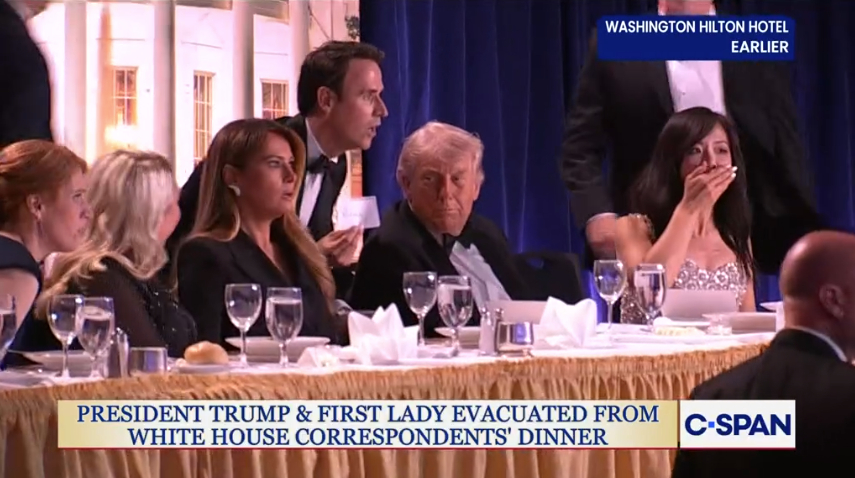
You’ve likely seen the video by now. At 8:34pm on Saturday night, the White House Correspondents’ Association (WHCA) dinner was getting underway. The US Marine Band had performed the national anthem. Salads had been served. Donald and Melania Trump were seated at the dais, between Karoline Leavitt, the press secretary, and Weijia Jiang, the president of the WHCA. Oz Pearlman, a mentalist and the night’s entertainment, was performing a trick for the group when there was a sudden commotion. The first lady reacted first, fear visible on her face. The camera quickly panned back as Secret Service agents rushed the stage. It was an alarming moment in an evening that would otherwise have been simply absurd, an almost perfect encapsulation of the whole affair.
The scene was captured by Mohaimen Aljasheme, a C-SPAN photographer and veteran war cameraman from Iraq. C-SPAN’s tagline is “democracy unfiltered,” and its cameras have rolled gavel-to-gavel through floor votes, committee hearings, and presidential addresses since 1979. As the longtime pool camera for the WHCA dinner, the network provided footage to all the news organizations covering the event, staying on the air through a chaotic and potentially dangerous situation. On C-SPAN’s platforms alone, the clip has been viewed more than fifty-seven million times.
Sam Feist, the CEO of C-SPAN, told me the camera operators were likely the first people in the room to know there was a gunman. The shooting was directly above their makeshift control room under a set of stairs, just outside the ballroom. “We’re doing our production, and that’s when we heard a very loud blast,” Bob Reilly, C-SPAN’s production manager on-site, told me. “It was like a cannon.” Randy Rohrbaugh, the director, recognized the sounds immediately. He called out over an open line to all four operators: “Gunshots, gunshots, gunshots.” They kept filming until the last possible moment. “When the ballroom was almost completely empty, the Secret Service told us we had to leave,” Reilly said.
C-SPAN’s steady coverage is why we have so many indelible images from the evening. “Our mission is to give audiences a sense of what it is like to be in a room with our policymakers and our political leaders. And undoubtedly, that’s what they did on Saturday night,” Feist said of his team. “They knew they had a responsibility, and they did it brilliantly, and that’s why the world was able to see what was happening in that room in real time.”

This week, Brendan Carr, the chairman of the Federal Communications Commission, went on the offensive, yet again, against broadcasters that conservatives deem insufficiently loyal to the Trump administration. Carr ordered an early review of the broadcast licenses for the eight local ABC television stations owned by Disney—a move broadly viewed as unprecedented.
Ostensibly, the review is the result of an FCC probe started last March, concerning Disney’s diversity, equity, and inclusion initiatives—a claim Carr reiterated in a press conference yesterday. Sure. It’s apparently a coincidence that the announcement came just a day after Donald and Melania Trump demanded, in separate social media posts, that ABC punish Jimmy Kimmel for making a joke. “He’s a very smart person and clearly understands that the timing suggests that it’s politically motivated,” Jeremy Barr, who covers media and power for The Guardian, said of Carr when we chatted this week. “It shows that he’s strong and he’s tough, and in Trump-world, you need to be strong and tough and generally oppositional to the media to be in Trump’s good graces.”
Setting aside the irony of the FCC commissioner using an attack on an event about free speech as justification to attack free speech (and Kimmel again, specifically), it isn’t clear that there is a legal basis for what Carr is doing. The threats are certainly real enough to be a serious headache for Disney, and it’s safe to assume he’ll attempt to inflict as much pain as possible. But the FCC has long maintained strict limits on its own authority precisely to prevent the kind of political interference Carr is now openly pursuing. As Ajit Pai, Trump’s first FCC chair, has put it, “Under the law the FCC does not have the authority to revoke a license of a broadcast station based on the content.” The last time the FCC actually revoked a license over programming was in 1969, when the offense was defending segregation on the air.
Carr’s action has been widely criticized. Anna Gomez, the lone Democrat on the commission, said in a statement that “this is the most egregious action this FCC has taken in violation of the First Amendment to date” and “this unlawful overreach will fail.” Even Ted Cruz opposed the move, telling Punchbowl: “It’s not the government’s job to censor speech, and I do not believe the FCC should operate as the speech police.” In an interview with Vulture, Robert Corn-Revere, the former FCC chief counsel, described the announcement as “batshit crazy.” Corn-Revere also emphasized that a procedure like this will likely take years, noting that “by the time an FCC process like this will run its course, Donald Trump will long be out of office.”
So far, it seems that ABC is willing to take on the fight. Kimmel is still on the air and still making jokes about Trump. Station owners and advertisers, some of the company’s primary stakeholders, are not calling for Kimmel to be fired or suspended, according to the Hollywood Reporter. And Disney is undoubtedly aware of how deeply unpopular the president is at the moment.
But it may not actually matter to Carr how credible the legal threat is, or how long it could take to play out. “He really seems to covet controversy,” Barr told me. “He’s very much a personification of the way in which the Trump administration interacts with the media.” In that case, Carr may have already gotten what he wants: attention, outrage, and, in the process, an unmistakable message to other networks that are watching.
For more than a year, sexual assault survivors in a Florida county were left waiting, when at their most vulnerable, for a rape kit overnight, delaying time-sensitive exams that can be critical both to providing adequate medical care and to collecting evidence.
The problem was exposed in an investigation from Bethany Barnes for the Tampa Bay Times, which found that the nonprofit rape crisis center responsible for administering those tests had stopped staffing nurses overnight without warning, despite collecting taxpayer funds to provide the service.
The details are damning. One victim who sought help just after midnight waited more than twelve hours. In another case, an eighty-year-old woman with dementia couldn’t access care until morning even though staff at her memory care facility suspected she had been assaulted. “It’s got to be important to collect the evidence as soon as possible,” the woman’s son told Barnes. “And to not have an eighty-year-old person having to wait overnight for an exam.”
After Barnes began reporting on the failures, the center changed its staffing and has been placed on a corrective plan by the county. For the women who endured those delays, though, that response may be of little comfort.
Hat tip to Local Matters for the Tampa Bay Times story. If you have a suggestion for this column, please send it to laurelsanddarts@cjr.org. We can’t acknowledge all submissions, but we will mention you if we use your idea. For more on Laurels and Darts, please click here. To receive this and other CJR newsletters in your inbox, please click here.
Has America ever needed a media defender more than now? Help us by joining CJR today.