Sign up for the daily CJR newsletter.
Early on a February morning, in a glass-walled conference room high up in the Hearst Tower in Manhattan, Postmaster General Patrick Donahoe spoke in a careful, reassuring tone. “We can do this; I know that we can do this,” he told the audience, which included representatives from magazine-industry heavyweights like Condé Nast, Hearst, and Time Inc. “Hang in there with us.”
Donahoe’s talk was a keynote at a “Postal Summit” organized by The Association of Magazine Media (MPA, formerly the Magazine Publishers of America) to address the inarguably dire situation currently facing the United States Postal Service, and the complications that situation is causing for the businesses that depend on its survival.
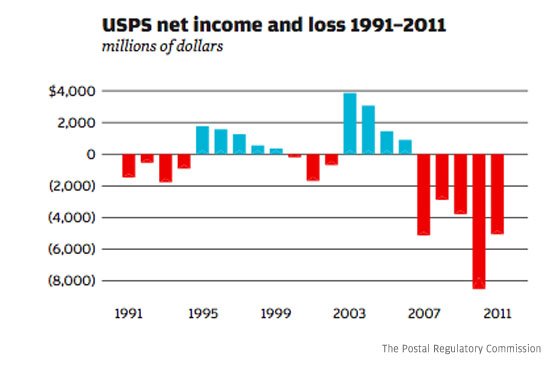
Despite Donahoe’s assurances, his audience couldn’t be blamed for being skeptical. In the past decade, the postal service has been hit by a perfect storm of technological and cultural shifts, economic recession, and political gridlock. Since 2000, the USPS has seen a precipitous decline in the volume of mail. From 2006 to 2011, as people have increasingly sent e-mails instead of letters and paid bills online, first-class mail volume has dropped 25 percent. As the housing and financial sectors sank, so did the amount of direct mail they sent to prospective customers. The country’s second-largest civilian employer (after Walmart), the USPS has been squeezed by rising health-care costs for its half-million employees, plus the requirement to pre-fund their pensions.
While the service has often run a deficit during its 237-year history, it now faces the possibility of insolvency. Following a loss of $5.1 billion in fiscal year 2011, the service reported a $3.3 billion loss in the first quarter of fiscal 2012 alone—a period that’s typically the most profitable of the year because of mail sent in the winter holiday season. The USPS’s total deficit as of last December was already $12.9 billion, and in February, the agency projected that it may run out of cash completely by October.
All of this is alarming news for the magazine industry, which, despite its recent forays into digital publishing, still depends on the postal service to deliver almost 90 percent of its circulation. Some publishers at the summit wondered aloud just how worried they should be. What would happen if the USPS actually shut down?
“The one thing I will not do is cry wolf,” said Donahoe as he wrapped up his speech. “I will not say ‘We’re not going to deliver mail.’…If I say that, you will say, ‘I need some alternative solution.’ And once you go to that alternative solution, we may never get you back. So that’s not going to happen.”
The magazine industry’s fate and that of the USPS have always been inextricably linked. Since the very beginning of the postal service in 1775, periodicals have enjoyed an extremely favorable shipping rate, an agreement rooted in the Founding Fathers’ conviction that the spread of information and opinion across the country was vital to democracy. “Magazines and newspapers accounted for nearly all of the weight of the mail in the first half of the 19th century—as much as 80 to 95 percent—and they only paid five to 15 percent of the revenue,” said Richard R. John, a historian of communications at the Columbia University Graduate School of Journalism. “And that was almost never a controversial issue.”
The postal service, meanwhile, needs to keep magazines in the mail. As mail volume decreases, Donahoe explained in his keynote, advertising (a.k.a. junk mail) becomes an ever-larger portion of it; magazines keep people coming back to their mailboxes, which in turn keeps the postal service in business. “They need us as much as we need them,” agreed James Cregan, executive vice president of government affairs for the MPA.
Both Donahoe and Cregan said that it is unlikely that the preferential pricing scheme for periodicals will end, though some above-inflation price hikes are possible as the postal service tries to quickly reduce its debt. What is perhaps more of an immediate concern, though, is the impact of worsening service.
Magazine publishers say that they’re already dealing with complaints from customers about lost, damaged, and late magazines, and that the latest USPS proposal to regain solvency could worsen the problem with even more staff cuts, fewer processing centers, and an end to Saturday delivery. The USPS says ending six-day delivery would save $2.7 billion annually by 2016, and network consolidation would save $4.1 billion. But even so, some of those changes would have to be approved by Congress; as of this writing, lawmakers were struggling to intervene before the May 15 expiration of a moratorium on closing post offices and processing centers. (Voting to shut down your own districts’ facilities is tantamount to political suicide—almost sure to become a re-election campaign issue.)
Meanwhile, publishers must decide how to deal with slower and less-consistent delivery. William Falk, editor-in-chief of The Week magazine, took the bold step of printing an editor’s letter addressing the problem in his February 3 issue. Of the magazine’s 535,000 subscribers, about 100,000 of them got a letter, in zip codes with the most complaints. In the note, Falk placed the blame for late deliveries directly on the postal service. “The Week magazine prints every Wednesday night at exactly the same time—every week, without fail,” the letter read. “We then pay a very substantial fee to have copies trucked to 70 postal distribution facilities around the country every Thursday morning. This is an investment The Week has made in order to speed delivery of your copy to a postal facility in your area.” According to the USPS’s delivery standards, the letter continued, readers should expect to receive their copies on Friday or Saturday, but that, “to our dismay, that consistent delivery has eroded….”
In an interview, Falk explained that he had heard from readers who, after getting their copies of The Week on Friday or Saturday for years, were now getting it on Monday or Tuesday, or even later. For a weekly magazine, one specifically designed to summarize and contextualize the previous week’s news, that delay makes a huge difference to the magazine’s relevance. “Saturday really is a good day for us to arrive for people, because we have cultural content that helps them plan their weekend… and it’s the chance to look back at the week that’s just occurred,” said Falk. “We don’t really know what we’ll do if they end Saturday delivery—we’ve talked about it, but we haven’t made a decision yet.”
One solution that some publishers at the summit said they were considering is to move their editorial deadline forward, to accommodate earlier postal service deadlines and slower, less-reliable delivery. The drawback to this option is obvious: Now that print magazines are competing for readers’ attention with constantly updated online content, adding more lead time to their delivery seems risky. Closing issues earlier also complicates transactions with advertisers, who like to be able to tinker with copy and placement until the last minute.
Another solution—one heavily discussed at the MPA event, which was sponsored in part by several alternative delivery services—is to opt out of the USPS and go for private delivery. Women’s Wear Daily, a time-sensitive fashion trade paper owned by Condé Nast, already offers hand delivery to its readers in New York City. But for other types of magazines, and readers in less densely populated parts of the country, alternate delivery services can be prohibitively expensive. Publishers at the summit also said they felt their subscribers wanted to get their magazines in their mailboxes, rather than tossed at the end of the driveway like a newspaper. By law, only the USPS can put mail in mailboxes.
Then there is digital delivery. Readers are already accustomed to going online for both short- and long-form magazine content, and sales of tablets and e-readers are soaring. Many magazines already sell PDF versions of their print issues to read on Kindles, Nooks, and iPads (Zinio, the largest service of its kind, currently has 5,500 clients, including CJR). More and more magazines are experimenting with digital sales through the Amazon Marketplace and Apple’s Newsstand. Why not stop delivering altogether?
The answer is that, for all their digital experimentation, magazines are nowhere near ready to abandon print. Online ads still bring in a fraction of the revenue print ads do, apps are still in the early stages of monetization, and digital-download versions are still a relatively small proportion of revenue. Magazine readers aren’t yet ready to lose their print copies, either. A 2010 study by the CMO Council found that 87 percent of people interested in reading magazines on tablets or e-readers still wanted a printed copy to accompany it; another survey conducted by the Harrison Group on behalf of Zinio and MEMS Technology showed that 75 percent of readers felt that digital content complements print content, and only 25 percent felt that digital could replace print.
True, those attitudes will likely shift with time. According to the Audit Bureau of Circulations (ABC), which has allowed for digital editions in its audits since 2002, the number of magazines that request audits of their digital editions increased fourfold from 2007 to 2011, and about a third of the magazines the bureau audits now do so. But as of 2011, digital subscriptions still account for less than 1 percent of total circulation for all US magazines, according to the ABC.
In the absence of any clear short-term solutions, what’s a publisher to do? Stick with the USPS but move up the editorial schedule to accommodate slower service, making the content less current? Switch to an alternate delivery service, which would be more expensive? Or push readers to go digital even faster? No option is perfect, but they’re all on the table.
“The whole industry is talking about everything,” said William Falk of The Week. “There is a sea change going on, and none of us know quite how it’s going to shake out.”
Has America ever needed a media defender more than now? Help us by joining CJR today.