Sign up for the daily CJR newsletter.
An article about a new CJR survey of practices at magazine Web sites that was published in the March/April issue of the magazine appears here. Click here to view the full report, containing complete results and a description of the survey methodology.
Speaking as a card-carrying member of the old media, it has been my observation that virtually every magazine (old media) now has a Web site (new media, a.k.a. digital media), and that the proprietors of these sites don’t, for the most part, know what one another are doing; that there are no generally accepted standards and practices; that each magazine’s Web site is making it up as it goes along; that, as CJR put it in our proposal to the MacArthur foundation (which funded this survey), it is like the Wild West out there.
For example, who makes the final decisions about what goes on the site, the editor of the magazine or, if there is one, the Web editor? Are Web sites fact-checked and copy-edited, if at all, with the same care as their parent magazines? On the business side, how much material is free, and how much is behind a paywall? What about archives—are they marketed, monetized, and curated in ways that differ from current content?
The idea was to conduct a survey, publish the results for all to see, and try to identify best (and worst) practices. And to see if, at a moment when the future of journalism in general and magazines in particular is thought to be in doubt, anything we learned could help fix a business model said to be broken, not to mention improve the flow of information on which our democratic society is predicated.
I’m not going to bore you here with our methodology, the validity of our sample and such, other than to say that after signing on Evan Lerner, home-page editor of Seedmagazine.com, as project director, and Danielle Haas, a member of Columbia’s Communications Ph.D. program, as a research assistant, we recruited a board of advisers and retained a professional survey research firm. After conducting a series of interviews with industry specialists and old- and new-media experts, some of whom are quoted here, we worked up a questionnaire that our survey research firm administered.
Assuring anonymity and offering a year’s subscription to CJR as an incentive, we ended up with 665 responses from a sample of about three thousand consumer magazines (including weeklies, biweeklies, monthlies, and quarterlies, with circulations large and small). A full description of those demographics and the survey process—as well as a report detailing the responses we received on advertising techniques, archiving practices, content-management systems, traffic analysis tools, and many other topics not covered here—may be found here. And the full survey questionnaire and tabulated answers for all questions asked are available there as well.
Although many of our findings might seem predictable (e.g., that Web site missions are “evolving,” that many sites are unprofitable, that advertising is by far the largest revenue source), many are not, and in any case, to see them documented can be sobering, and in some cases depressing.
For example:
- • 59 percent of those surveyed said that either there was no copy editing whatsoever online (11 percent), or that copy editing is less rigorous than in the print edition.
- • 40 percent said that when Web editors, as opposed to print editors, are in charge of content decisions, fact-checking is less rigorous (17 percent said there was no fact-checking online when Web editors made the content decisions).
- • 54 percent said that when errors were eventually pointed out, on sites where the Web editor made content decisions the errors were corrected, but without any indication to the reader that there had been an error in the first place.
And that’s taking respondents at their word!
Does this mean that Web people care less about traditional journalistic standards than print people? Well, let’s put it this way: in the online world, speed is the name of the game. Web sites are interested in maximizing traffic on the theory that that’s the way to attract advertisers, and quantity often trumps quality when it comes to that. Thus, given the prevailing business model (advertising is still king), the question arises: Is online content, with its rapid turnaround requirements, held to the same standards as its print equivalents? Survey says no! We conclude that while Web people don’t always favor speed over accuracy or elegance of style, they nevertheless seem to factor speed (i.e., who is first with the news, or the controversial views, as the case may be) into the equation in a way that tends to undermine traditional journalistic standards.
And it’s no surprise that there’s still something of what one respondent called a cultural “chasm” between Web and print people. For example, Web folks tend to want to give the audience what it wants (a former ESPN Web editor said, “The number one thing that’s drilled into every employee on a daily basis is serving your fan, serving your fan, serving your fan”), not what “a bunch of smart editors” think is a good idea.
Another survey respondent observed that his magazine doesn’t regard its Web site as a competitor, because even though the site’s readership is five times the circulation of the print magazine, “it’s largely seen as an inferior product, compared to what runs in the magazine, in part because we play for audience more, and I think there’s a vestigial elitism as to its being more important if it runs in print.”
Perhaps the least-expected finding, at least for a latecomer to the digital world like me, was the 180-degree reversal in the purpose of some of the Web sites themselves. I’ll get to what we learned about Web site missions below, but here let me confess how uninformed I was. I had naïvely assumed that the purpose of most sites as originally conceived was still the case: to promote the print publication (and/or create new revenue streams) by electronically cashing in on the print publication’s brand, and to use the unlimited capacity of cyberspace to publish material that couldn’t fit into the print version. Yet more than a few respondents reported, as one put it, that “instead of developing stories for print and then republishing them online, we now do the opposite—develop for online, and [at the end of the month] pick the strongest articles to appear in print.” Or, to quote another, “We migrated from a print publication supplemented with online articles to an online publication supplemented with print editions.” The logical (or is it illogical?) conclusion of this kind of thinking may have been summed up by the respondent who proclaimed, “It is our mission to be Web only. Drop the print edition entirely.”
Not to keep you in suspense: as it turned out, our modest survey did not result in a consensus on best practices. At a time when magazines are facing increasing pressures to reduce costs, print readership is shrinking, ad revenues declining, and the young, when not watching Jon Stewart, seem to rely more and more on the Internet for news and information, we don’t claim that our survey holds the answer to how digital technology can be put to work to serve, let alone save, democracy.
The survey does, however, for the first time put in one place some of the prejudices and practices of those in the world of magazines charged with reconciling the world and culture of print with the world and culture of digital media.
Here is some of what we learned in four critical areas: the matter of mission; the prevailing business models; the question of who decides what; and last but not least, how well these magazine Web sites are exploiting the potential of social media.
On the Matter of Mission
Since what you are and who you are lie at the foundation of any organization or enterprise, it’s interesting that so many respondents to our open-ended question—“What do you see as being the mission of your Web site?”—answered by saying, “We are still figuring it out.” Or that their mission is “constantly evolving.” Comparatively few mission statements identify and set (for all, including their staff, to see) their organization’s “true north,” as one former publisher said a real mission statement should do. Mission ambivalence, if that’s what we’re seeing here, is demonstrated by responses like, “The mission is to enhance the print magazine, but it could also become a replacement for the print magazine.”
Does the Web site’s mission differ from that of the print edition?
- • “The Web site is an extension of the print magazine, although it reaches far more people.”
- • “I see four missions for the Web site: to build community; to allow us to do things, such as interactive lists and video, that we can’t do in print; to speed news to the reader faster than the print product; and ultimately, of course, to make money…”
- • Editors who said the missions of their print product and Web site were the same outnumbered those who said they were different three to one.
- • 16 percent of all respondents said their Web sites’ missions involved community-building with readers.
- • Only 5 percent mentioned creating new or unique content as being integral to the site’s mission, whereas 96 percent said they use content from the print magazine online.
The Business Model
These days, the most frequently asked question about journalism (online and off) is whether there is a business model that can sustain it. The conventional wisdom is that newspapers and magazines are dying because advertisers are fleeing to the Web and that most sites are not yet paying their own way because advertisers pay less for online ads than for print ads.
The one thing that is clear is that advertising still plays a dominant role in supporting magazine Web sites. Sixty-eight percent of respondents said that advertising was their primary revenue source, and that number climbs to 83 percent when speaking only of profitable sites. But the prospects for profitability are mixed. About a third of the respondents said their site was profitable, another third said it wasn’t, and the remaining third didn’t know or couldn’t tell.
How the profitability of a magazine’s Web site affects the overall health of the publication was beyond the scope of this survey, but it’s clear that advertising is still an effective way to help keep Web sites afloat. The means by which these sites attempt to generate traffic and/or revenue are worth noting:
- • Just over half of all magazines surveyed (52 percent) provide all of their print content free online. Thirty-one percent said they provide some free print-edition content online. Ten percent say some of that content is free online and some is behind a paywall; only 4 percent have all or almost all print content behind one.
- • Offering free content does not necessarily hurt profitability: 49 percent of the sites that say they don’t make a profit offer all significant content from the print edition free, while 65 percent of the sites that do make a profit offer their content for free.
- • Just over one in ten respondents (11 percent) said that print-subscription sales were the largest revenue source.
- • Besides advertising and print-subscription sales, all other revenue sources scored 3 percent or less. Other options included donations, membership dues, sale of merchandise, and a catch-all “other.”
- • Only fifteen respondents (2 percent) said that charging for online content was their largest revenue source.
- • One respondent said, “We aspire to . . . attract additional revenue from . . . advertisers who cannot afford the print edition.”
Who Decides What?
While some of the findings above seem abstract, when it comes to the matter of who’s in charge, the findings suggest concrete differences in practice. Barring outliers like Wired.com, which began its life as Hotwired, a Web-only, independent entity, most respondents reflected a common and fundamental overlap between the print and Web operations.
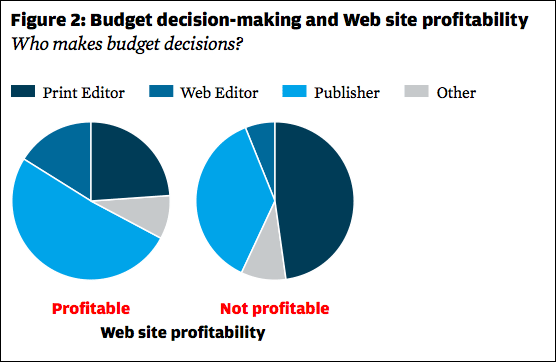
- • In most cases, an upper-level editor or publisher of the print magazine is also in charge of the publication’s Web site. For the three areas of decision-making we examined—those concerning the budget, content, and look and feel of a site—independent Web editors were in charge 11 percent, 19 percent, and 33 percent of the time, respectively.
- • This despite the fact that editors-in-chief are twice as likely to be in charge of the budgets of unprofitable sites as profitable ones. Conversely, independent Web editors are more than twice as likely to be in charge of profitable magazine sites as unprofitable ones.
Of course, given tight budgets and small staffs, many editors wear more than one hat. And where magazine circulation and Web traffic rose, so did the authority granted to an independent Web editor. But even at a big magazine—one of the newsweeklies—an editor told us, “We don’t have separate editorial at all. Our Web staff is all production and design. We have separate Web editors, but not writers, because you want continuity between the brands.”
- • In 72 percent of the cases, the editor-in-chief of the print publication (or another print editor) makes content decisions.
- • Between print editors, Web editors, and publishers, publishers are the most likely to oversee the Web budget, but they do so at less than half (44 percent) of the respondents’ magazines. Of the three, Web editors are most likely to make “look and feel” choices (33 percent).
- • For magazines under 100,000 circulation, Web editors were in charge of budget decisions only 6 percent of the time. Above that threshold, they were in charge 17 percent of the time.
- • The same relationship held true for content decisions: the percentage of Web editors in charge jumps to 27 percent from 12 percent after crossing the 100,000-circulation mark.
- • Magazine Web sites are most likely to be profitable when budget decisions are made by the publisher or an independent Web editor.
- • We asked respondents to give their best estimate of the percentage of their staff that work in print, on the Web, or on both. Averaging their responses, 25 percent work only on the print edition, 5 percent work only on the Web site, and 61 percent are expected to work on both the print and Web editions.
- • Despite the fact that two-thirds of respondents’ staff are expected to work on the Web at least some of the time, only 26 percent of those staffers were hired with Web experience.
Technology and Social Media
The transition to the Web is often couched in negative terms (as one respondent said, “Go figure—you can’t get rich giving stuff away”). But of course, decision-makers at magazines should not underestimate the unique opportunities afforded by the new technology. Given some of the survey’s findings, however, many of those in the business still seem to do so. Most magazine Web sites are beginning to adopt some of the tools and techniques that are only possible on the Web—84 percent produce Web-exclusive content, most have blogs, and about half are active on social media sites, such as Facebook and Twitter. However, these efforts seem to be in the basement when it comes to priorities. Only 10 percent of respondents mentioned multimedia content as a positive aspect of their site, and only 8 percent said they wanted to improve it. In the same spirit, only 16 percent said community-building or social networking was a part of their site’s mission, and only 20 percent wanted to improve that.
Other social media stats of interest:
- • 64 percent of respondents said their Web sites featured blogs, although not everybody can agree on exactly what a blog is. One definition: it’s a Web-based location where an author or authors routinely add content with an eye to engaging directly with readers. One editor says if it’s copy-edited, “it wouldn’t be a blog.” (And he adds, “We probably couldn’t afford [copy editing]. But you know, we hire [bloggers] for their skill as journalists so it’s almost like we’re pre-editing them by who we hire. [Blogging is] more high wire than print, where everything gets edited.”)
- • 64 percent of magazines surveyed have blogs on their Web site. Eighty-seven percent of those magazines have blogs that are maintained by staff members, and 39 percent have blogs written by freelancers or contractors.
- • Nearly three-quarters (73 percent) of the sample publications permit comments to be posted either on blogs or on magazine content.
- • Social media are used by three-quarters of magazines surveyed and close to half (47 percent) of respondents have an “active presence” on social media sites.
- • Of the social media sites we specifically asked about, 60 percent of respondents described both Facebook and Twitter as “effective” or “very effective” for driving traffic. The majority of respondents said that the other sites we asked about (including MySpace, Digg, Reddit, StumbleUpon, Delicious, and LinkedIn) either were ineffective or they did not know enough to pass judgment.
- • Four out of five magazine sites (80 percent) do at least some e-mail marketing.
- • Display technology is not keeping up with mobile technology. According to our respondents, less than one in five design their content to be read on smart phones, and only 4 percent have content that can be read on e-book readers like the Kindle.
Although many respondents were proud of their Web sites, the sentiment was far from unanimous. Example: “The site is soooo 1990.” Asked what the Web site’s best feature was, another respondent replied: “Nothing. By any realistic standard, it stinks.” Still others said, “Our Web site is a disaster.” “Our Web site is a mess!” “Our Web site sucks.” Nevertheless, for many, the site is where the significant action is, and the responses to this survey are chock full of insights and valuable information:
- • “The Web site is more search-oriented. Print readers tend to enjoy a more serendipitous experience, whereas readers come looking for specific information online.”
- • “The Web site is designed to do what the print magazine can’t—deliver breaking news as it happens.”
- • “The Web site makes available business tools that cannot be offered via print, such as spreadsheets, interactive calculation applications, Webinars, and educational video.”
- • One newsweekly has added a full-time traffic analyst (with a master’s in statistics) to help it figure out how to increase traffic.
- • Those who can afford it are hiring high-priced “content-strategy” consultants, “information architects,” and “usability” experts to design and redesign their sites. The results are generally based on how the eye moves (i.e. vertically), which is “why so many sites look the same,” one editor helpfully explains.
The bottom line: although CJR’s survey establishes that many print people still regard Web people as second-class citizens, that sites founded solely to promote print magazines are outmoded to say the least, that profitability is up but standards (i.e., fact-checking and copy editing) are down where Web editors are in charge of the site, the survey nevertheless reveals no consensus on best practices. It is, rather, the beginning of a long-overdue conversation. Among the issues to be explored:
What does it mean that when a Web editor is in charge of both budget and content decisions, traffic and revenue increase but quality and ethical standards decrease? (Not to mention what are the lessons to be learned from studying profitable sites where quality has not decreased?)
If it is indeed true, as the statistics about staffing seem to suggest, that most magazines don’t really take the distinction between Web and print seriously, what follows, short of making Marshall McLuhan mandatory reading? For example, if, as one respondent reported, material that has already appeared in the print magazine is never re-edited for the Web, shouldn’t that practice be revisited? On the surface it seems that one ignores the cultural consequences of the new technologies at one’s peril.
In light of the high percentage of profitable magazine Web sites that offer all their content for free (65 percent), should The New York Times rethink its recent announcement that it intends to charge for content? Or conversely, at a moment when Apple’s iPad and new iPhone apps may make the very idea of someone called a “Web editor” something of an anachronism, do we need to conduct yet another survey?
And finally, how do these findings relate to the issue of the free flow of information required by our democracy as explored recently by the Knight Commission, the Schudson/Downie paper published in the November/December 2009 issue of CJR, and other recent attempts to grapple with information availability and public engagement?
Now the respondents need to get offline and gather in a room, define a list of best practices, agree on such matters as how to define profitability and all the rest, and where they can’t agree, cross swords face to face. But first they should go here, read the study, and tell us the questions we forgot to ask, not to mention the answers.
Has America ever needed a media defender more than now? Help us by joining CJR today.