Sign up for the daily CJR newsletter.
Samar Abu Elouf, a forty-one-year-old Palestinian photojournalist, has documented Israel’s military campaign against Gaza for Reuters and the New York Times. One of her best-known shots, taken on October 7, 2023, shows children looking skyward in the early hours of Israel’s bombing; her portrait of Mahmoud Ajjour, a young boy whose arms were severed in an attack, won the 2025 World Press Photo of the Year. But her Instagram page, filled with pictures from her work and life—rubble, bread, nieces—captures a devastating view of journalism under strain. “My friends at the office in Gaza hang a picture of a chicken on the office board so they don’t forget what it looks and tastes like,” a caption reads.
Abu Elouf is not one of the more than two hundred media workers who have been killed in Gaza since the start of the war. She left for Qatar, regretfully, for fear of her children being harmed—as more of the region was flattened, hospitals were torn to pieces, and food became increasingly scarce. (She could not be reached, but as she told CNN, “being a journalist in Gaza feels like you’re dying on the inside over and over.”) Israel and Egypt blocked members of the international press from covering the damage, save for some tightly controlled embeds, and the scene became, as Amnesty International put it, a “live-streamed genocide”: many local reporters posted what they saw directly online, while Israel invited content creators for managed junkets. “Weapons change over time,” Benjamin Netanyahu, Israel’s prime minister, said during a meeting this fall with influencers in the United States, and “the most important ones are on social media.”
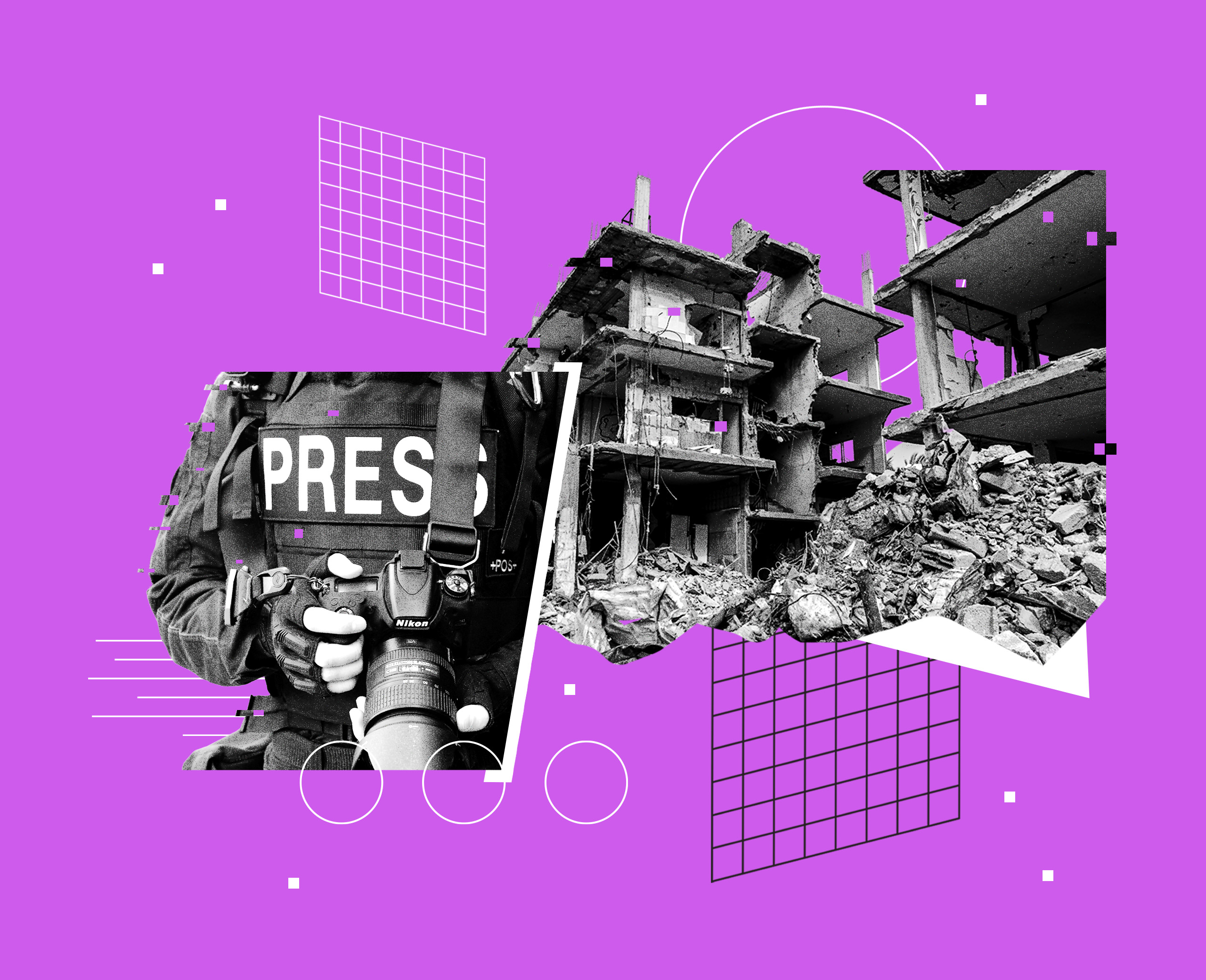
Dead or alive, independent or employees of large news organizations, Palestinian journalists became the subjects of Israeli propaganda campaigns linking them—speciously—to Hamas, an effort that has done much to discredit their work. “You have an unprecedented targeting of journalists as journalists,” Jodie Ginsberg, the chief executive of the Committee to Protect Journalists (CPJ), told me. According to Reporters Without Borders (RSF), about a quarter of the journalists slain in Gaza are believed to have been killed specifically for their coverage.
Over the past two years, there have been objections to this set of circumstances. The United Nations and other organizations have called repeatedly on Israel to let foreign journalists in. Last June, some two hundred press outlets signed an RSF petition calling for an end to the media blockade; in July, these organizations, along with the Times, released a statement urging Israel to let reporters “work securely and without fear or hesitation in Gaza”; and in September, the BBC, Reuters, the Associated Press, and Agence France-Presse coproduced a film calling for access. That month, two hundred and fifty news outlets blacked out their front pages or otherwise went quiet to protest the killings of reporters. Journalists around the world have covered the killings of their colleagues in Gaza, and newsroom leaders have decried the press ban at conferences and in editorials. The Foreign Press Association has petitioned the Israeli Supreme Court for access to Gaza twice; in October, CPJ filed an amicus brief supporting the more recent petition.
But these efforts have not broken through to the wider public consciousness—nor, apparently, to Netanyahu’s: even in the wake of the peace agreement, Israel has not permitted members of the international press to enter Gaza. (The Israeli foreign ministry did not respond to my requests for comment.) At a press conference, Shosh Bedrosian, a spokesperson for Netanyahu’s office, said that Israel would allow foreign press in “soon,” but also issued a warning. “There’s propaganda in the works once these foreign journalists do come into Gaza,” she said. “The reports we see in the global media regarding Gaza do not tell the real story there. They tell the campaign of lies that Hamas spreads.”
Nor have the journalism campaigns seeking access to the territory shown a willingness to break with Israeli protocol, to push in by any means possible, or foregrounded the most prominent media voices, including executives from Meta, TikTok, and Substack, whose platforms share so much news from the region. “The silence has been resounding,” Ginsberg said. “And I think we’ll have repercussions for years to come in terms of people’s willingness to work with and for international organizations and our ability to make sure we’re all reporting clearly and accurately what is happening.” The news industry’s inability to confront Israel’s attacks on press freedom in Gaza with decisive, collective action may well come back to haunt us.
Over the past two years, Gaza has shown governments around the world just how much they can get away with when it comes to silencing the press. “We should not expect these tactics to remain in Israel,” said Laurent Richard, the journalist and executive director of Forbidden Stories, a nonprofit that takes up the work of journalists facing imprisonment or attack. Rather, a “recipe book” has been written, as he put it, on how authoritarian leaders can deal with journalists: “First, block access. Second, harass online. Third, execute them. The execution will sound more acceptable for public opinion because you’ve spread fake news about them, creating permanent doubt.” Technology, he said, is an accelerator, since anyone can create false narratives using social media, doctored images, and artificial intelligence. The Israeli government “works with a lot of think tanks and nonprofits; they’re very involved with the disinfo industry and propaganda on the internet. And with that, they’re killing public debate in its inception,” Richard told me. “It’s the platforms that are making that possible.”
“Other countries will have no hesitation to do the same thing,” agreed Antony Loewenstein, an Australian journalist who has covered international affairs for more than two decades. In his book The Palestine Laboratory (2023), Loewenstein documented how the Israeli military-industrial complex has used Palestinians as guinea pigs for an array of weapons aimed at suppressing dissent. These tools have included defense hardware—think: killer drones—and software developed close to home and then exported at great profit, such as the program used to hack the cellphone of Jamal Khashoggi, the Saudi dissident journalist who was tortured and murdered by government agents. “What happens in Palestine never stays there,” Loewenstein said. “Israel has shown how to get away with it—how to get that impunity themselves. So you’ll see many other nations being far more brazen in targeting journalists, including the Trump administration.”
Much like the conflict over Israel and Palestine, the crisis for press freedom did not begin two years ago. Back in April of 2022, a group including the Palestinian Journalists Syndicate and the International Federation of Journalists filed a complaint with the International Criminal Court to hold Israel to account for targeting and killing reporters. The ICC took no action. Then, a month later, a Palestinian American Al Jazeera journalist named Shireen Abu Akleh was murdered by Israeli forces while covering a raid on a refugee camp. “She was killed in broad daylight in a press vest and helmet in an area with no crossfire,” Sharif Abdel Kouddous, an editor at Drop Site News, said. “It was all documented on camera and by eyewitnesses.” No one was arrested; another ICC complaint was filed; again there was no result. A year later, CPJ released a report, “Deadly Pattern,” recounting cases of twenty journalists killed by Israeli military fire over a period of twenty-two years. “Because there have been no consequences in the preceding decades, it’s clear that Israel appeared to feel emboldened to continue,” Ginsberg told me.
Daniel Hagari, a spokesperson for the Israel Defense Forces, has since said that Israel is “deeply sorry about the death of Shireen Abu Akleh.” Reporters Without Borders has suggested that the ICC take up her case—and that it should consider other members of the press killed since the start of the war in Gaza, assisting families wishing to pursue charges. But the ICC, and international law in general, is not well positioned to be the ultimate defender of press freedom, at least not at the moment. Karim Khan, the chief prosecutor at The Hague, faces allegations of sexual misconduct; an investigation is underway, and in May, he stepped aside. Where he had shown an interest in prosecuting Israel, his deputies seem resistant to taking on controversial cases in his absence. “The court’s just stymied,” Kenneth Roth, the former director of Human Rights Watch, said. “In theory his two deputies are running things, but they don’t have the stature to charge Israeli officials. So nothing’s happening.”
Further complicating matters, the Trump administration, in an apparent sign of allegiance to Netanyahu, has sanctioned Khan, both deputies, and several ICC judges—freezing their assets, blocking their access to the American financial system, and restricting their entry to the country. As an arbiter of justice, The Hague is wobbly. And even if it were to initiate new proceedings against the Israeli government, Roth said, the court would begin with incidents that “killed huge numbers of people”—for instance, the six hundred two-thousand-pound bombs provided by the US that pummeled the Gaza Strip in the first weeks of the war. “They’re not gonna start with journalists,” he told me.
That leaves states—both democratic and non—not only with methods of dismantling press freedom, but also with the very likely prospect of immunity. “I don’t think it’s hyperbolic to say you may see other governments kill journalists in the medium or long term,” Ginsberg said. “But I certainly think in the short term what we’re going to see is this increased move to criminalize the very act of journalism.” As she told me: “If we are not able to get justice and accountability for our murdered colleagues in Gaza, why should anyone else get that?”
Recently, Forbidden Stories corralled a roomful of Israeli and Palestinian journalists to investigate the targeting of Gazan reporters and media buildings by the IDF. Richard noted that the way Israeli authorities talked about the killings seemed to have evolved over the course of the war, reflecting a growing confidence in their mission. “At the beginning,” he told me, “they were mobilizing themselves to say, ‘Yeah, this person was a terrorist,’ although without providing solid evidence to support the claim. Now they’re not even taking the time to explain themselves to say how someone wearing a press vest was killed.” He was referring to the murder of Anas al-Sharif, an Al Jazeera correspondent, who was accused, without compelling evidence, of association with Hamas; he was killed alongside several Al Jazeera staffers—correspondent Mohammed Qreiqeh and camera operators Ibrahim Zaher and Mohammed Noufal—as well as two freelancers, Moamen Aliwa and Mohammad al-Khaldi. No explanation was given for the killings of al-Sharif’s colleagues.
Israel has been able to push boundaries, Abdel Kouddous observed, because “they’ve faced zero consequences for their actions, both by military and financial backers in the West” and “because of how large legacy media institutions have covered the killings of Palestinian journalists.” To him, “it speaks to a much larger issue of how the international order has broken down over the open backing of genocide. But with regards to journalism in particular, a new precedent has been set: there’s no accountability,which means journalists everywhere have become an open target.”
The damage that this war has done to press freedom may reveal the perils of making too many concessions to power—state power, as well as the soft power of public opinion. The war has shown us the real limits of a well-meaning ethic of impartiality: How can you be impartial when the target is not some partisan group or minority, but your very own profession? Can you be impartial? Should you? Then again, breaking with Israeli protocol would put yet more reporters at risk. The only way around these challenging questions is to continue practicing journalism through creative, collaborative means. “We had to make do without being in the field,” Richard said, pointing to how Forbidden Stories investigated the deaths of more than a hundred journalists using satellite images and experts in ballistics, weapons, and audio as well as interviews with witnesses. Even without access, they found a way.
And while Abu Elouf has not been in Gaza to photograph the war’s ravages for the past year, her Instagram page has turned into a diary of her family’s survival: her twin nieces turning two, her sister’s battered house, drones, fires, traffic jams, meager meals. These are snapshots; they won’t win any awards. But they are reminders that on the other side of every camera is a person living through the same war as her subjects, whether she’s wearing a press vest or not. As Richard put it, “We forget at the expense of the next generation.”
This piece is part of Journalism 2050, a project from the Columbia Journalism Review and the Tow Center for Digital Journalism, with support from the Patrick J. McGovern Foundation.
Has America ever needed a media defender more than now? Help us by joining CJR today.